
Your product listing is the highest-leverage asset in your marketplace business and the one most sellers treat as an afterthought. In 2026, with three discovery layers to optimize for simultaneously (keyword algorithm, COSMO semantic AI, and Alexa for Shopping), the gap between an optimized listing and a neglected one has never been more expensive. This is the complete guide to getting it right.
- Listing optimization in 2026 requires optimizing for three discovery layers simultaneously, the A9/A10 keyword algorithm, COSMO semantic AI, and Alexa for Shopping, each with different content requirements
- Backend attribute completeness is the single most neglected optimization, products with 90 percent attribute fill rate hold a structural advantage in AI-mediated discovery over competitors with typical 10 to 20 percent completion
- The mobile 80-character title rule is non-negotiable with 75 percent of shoppers on mobile; every high-value benefit must appear in the mobile-visible window or it is invisible to most buyers
- A complete 7-image gallery with lifestyle shots, infographics, scale reference, and technical visuals drives 15 to 25 percent CVR improvements and also feeds computer vision for visual search discoverability
- Listing optimization compounds over time, the 90-day case study result of 47 percent CVR increase, position 4 organic rank, and 72 percent organic sales growth is achievable without increasing ad spend
The Complete Guide to Marketplace Listing Optimization in 2026: Everything You Need to Rank, Convert, and Dominate
Why Your Listing Is the Most Expensive Asset You Are Ignoring
Most sellers treat their product listing as a box to check. They upload images, write a title, add some bullets, and move on to running ads. Then they spend hundreds or thousands of dollars each month on advertising traffic that arrives at a listing built to lose.
Here is the hard truth: your product listing is the single highest-leverage asset in your entire marketplace business. A well-optimized listing ranks for dozens of keywords simultaneously, converts 15 to 25 percent of visitors, and compounds organic sales velocity month over month without additional ad spend. A poorly optimized listing burns PPC budget, ranks nowhere meaningful, and converts under 8 percent, meaning more than nine out of every ten people who click your ad leave without buying.
The gap between these two scenarios is not luck or product quality. It is listing optimization, and in 2026, the requirements for getting it right have changed significantly.
Over the past 18 months, the marketplace's discovery architecture has been fundamentally rebuilt. The traditional keyword-matching algorithm has been layered with COSMO, an AI-driven semantic understanding system, and Alexa for Shopping (formerly Rufus), the generative AI shopping assistant that reached 300 million customers in 2025, generated nearly 12 billion dollars in incremental annualized sales, and was made the default search layer for every signed-in US customer in May 2026. Listing optimization in 2026 means optimizing for all three discovery systems simultaneously, and the sellers who understand this are already pulling ahead.
This guide covers everything: how the algorithm actually works in 2026, how to research keywords that convert, how to write every visible and invisible element of your listing, how to build an image gallery that converts on mobile, how to use A+ Content as both a conversion and an AI discovery asset, and how to monitor and iterate for compounding long-term results.
Part 1: Understanding How the Marketplace Algorithm Works in 2026
The Three-Layer Discovery Architecture
To optimize your listing effectively, you need to understand that in 2026, shopper discovery operates across three distinct layers, each with different mechanics and different optimization requirements.
Layer 1: The A9/A10 Keyword Algorithm
Traditional keyword search remains the foundation of marketplace discovery, accounting for approximately 80 to 85 percent of organic traffic as of Q1 2026. The algorithm matches keywords in a shopper's typed query against keywords in your listing, weighted by a set of behavioral and performance signals. The seller community often refers to recent iterations as A10, reflecting the significant rebuilding of the system around AI and behavioral signals, though the platform has not formally confirmed this naming.
What has changed under the current algorithm: keyword density is dramatically less important than it was in 2022 or 2023. Simply placing a keyword more times does not improve rank. What matters now is keyword placement in high-authority fields (title first, bullets second, backend terms third), combined with the behavioral signals that prove relevance: conversion rate, click-through rate, sales velocity, return rate, and seller authority metrics.
The algorithm also now penalizes keyword stuffing. Titles and bullets packed with keywords at the expense of readability create poor click-through rates and weak conversion signals, which the algorithm interprets as poor relevance and demotes accordingly. The era of gaming keyword density is over.
Layer 2: COSMO (Contextual and Semantic Matching)
COSMO is the AI semantic layer deployed on top of the traditional algorithm. Rather than matching keywords literally, COSMO understands product categories, use cases, and buyer intent contextually. It reads your listing to understand what your product actually is, who it is for, and what problems it solves, then matches it to queries that express that intent even when the exact keywords do not appear.
This is why backend attribute fields have become so strategically important in 2026. COSMO reads structured attribute data (Intended Use, Material, Compatibility, Target Audience, Skill Level, and hundreds of category-specific fields) as primary product intelligence for building its contextual understanding. An empty attribute field is a gap in the AI's model of your product, which reduces your eligibility for contextually relevant recommendations.
Layer 3: Alexa for Shopping (AI Conversational Discovery)
As of May 13, 2026, what was previously called Rufus was unified into Alexa for Shopping and made the default search interface for all signed-in US customers. Unlike keyword search, which returns hundreds of results, Alexa for Shopping narrows results to approximately five named products per query. This winner-takes-all mechanic means that a listing not in those five is effectively invisible for AI-mediated shoppers.
The AI reads your entire listing, including title, bullets, description, A+ Content, images (through computer vision), reviews, and Q&A, and evaluates whether your product can confidently answer a shopper's specific question. The emphasis on "confidently" is important: the AI is conservative by design and will exclude products where critical information is missing rather than make a recommendation it cannot support.
Research from Q1 2026 indicates the AI assistant now mediates 15 to 20 percent of mobile queries and is growing every quarter. On Black Friday 2025, 38 percent of all marketplace sessions involved the assistant. These numbers will only increase.
Key Ranking Signals in 2026
Understanding the specific signals the algorithm weights most heavily in 2026 allows you to prioritize optimization efforts by impact:
Conversion Rate (CVR): The single most powerful ranking signal. A well-optimized listing in a competitive category should target 10 to 20 percent conversion rate. Products with strong CVR earn better organic placement, which generates more organic traffic, which produces more conversions, creating a compounding flywheel. Below 8 percent CVR on an established product is a signal for immediate listing intervention.
Click-Through Rate (CTR): Your title and main image determine whether shoppers click from search results to your listing. Strong titles and optimized images can improve CTR by 5 to 15 percent. Since CTR is a direct behavioral relevance signal, improving it also improves organic rank velocity.
Sales Velocity and History: How quickly and consistently your product sells. Historical sales data creates momentum: the algorithm is more willing to test a high-velocity listing in new keyword positions. New products must build this signal through launch strategies; established products must protect it by maintaining ranking and avoiding stockouts.
External Traffic That Converts: Traffic arriving from Google, TikTok, Instagram, influencers, and other off-platform sources that converts on the marketplace is treated as market validation. The algorithm rewards this signal with improved organic rankings because it indicates genuine demand that exists outside the platform's own ecosystem. Brands with external traffic strategies hold a structural advantage that pure-marketplace sellers lack.
Return Rate: The A10 algorithm now evaluates return rate as a negative quality signal. High return rates indicate that listings are inaccurately representing products, which harms customer satisfaction and reduces ranking eligibility. Accurate, complete listing content is not just good practice. It is now a ranking factor.
Seller Authority: A composite signal that includes Order Defect Rate (target under 1 percent), on-time delivery rate (target above 95 percent), response time, resolution rates, and Brand Registry status. FBA sellers hold a structural advantage here, but seller-fulfilled sellers can remain competitive by consistently meeting FBA-level service standards.
Part 2: Keyword Research That Actually Converts
Moving Beyond Volume to Intent
The most common keyword research mistake in 2026 is optimizing for search volume in isolation. A keyword with 50,000 monthly searches is useless if the buyers using it are not in the intent mindset that leads to your product category. Effective keyword research in 2026 focuses on the intersection of volume, relevance, and purchase intent.
Primary Keywords: The one to three terms that most precisely describe your product and carry the highest purchase-intent search volume. These belong in your title within the first 80 characters and in the opening of your first bullet point. They are the terms the algorithm uses to classify your product's core relevance.
Secondary Keywords: Modifier terms that describe specific variants, features, or use cases (size, color, material, compatibility, occasion). These belong in remaining title characters, throughout bullet points, and in the description. They expand ranking reach without competing with primary keyword clarity.
Long-Tail Intent Keywords: Phrases of four or more words that describe specific buyer needs ("best travel mug for hot drinks all day," "leakproof water bottle for hiking," "insulated tumbler for office commute"). These are high-conversion terms because buyers using them have already done their research and know what they want. They belong in backend search terms and throughout natural listing copy where they fit without forcing.
Conversational AI Keywords: Phrases structured as questions or natural language statements that match how buyers speak to the AI assistant ("keeps drinks cold for hours," "safe for dishwasher," "good for beginners," "works with iPhone 15"). These appear throughout title, bullets, description, Q&A, and backend terms.
The Research Process
Step 1: Start with your own top-converting search terms in Search Query Performance (Brand Analytics). These are terms already working for you. Understand why, and then protect them.
Step 2: Analyze your three to five closest competitors' listings. What keywords appear consistently in their titles and bullets? What are they ranking for organically that you are not?
Step 3: Use keyword research tools to identify high-volume terms in your category, then filter for purchase-intent signal. Informational queries ("how does a French press work") belong in your Q&A, not your title.
Step 4: Mine your own reviews and competitor reviews for the exact language buyers use to describe the product, its benefits, and its use cases. This is your most accurate source of buyer vocabulary and maps directly to how conversational AI queries are phrased.
Step 5: Map every keyword to a placement: primary keywords to title, secondary to bullets and description, long-tail to backend terms and description, conversational to Q&A and natural copy throughout.
Part 3: Title Optimization
The 80-Character Rule and Why It Changes Everything
Your product title allows up to 200 characters. Mobile devices display approximately 80 characters before truncation. With over 75 percent of marketplace shoppers browsing on mobile, your effective title is 80 characters for the majority of your buyers. Everything beyond character 80 is invisible unless they expand the listing, which most mobile shoppers do not do.
This single fact reorganizes how titles should be written. Every seller who front-loads their title with a brand name that buyers do not recognize, a model number that has no search volume, or secondary features that could appear later is giving their most valuable real estate to information that does not drive the click.

The Title Formula That Works in 2026
Structure: Primary Keyword + Key Differentiator + Primary Benefit + Critical Attribute + Secondary Keyword (if space permits)
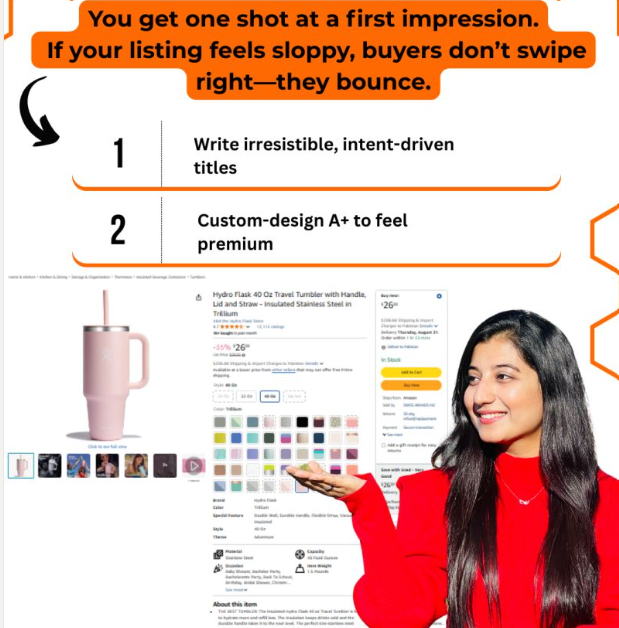
Before (keyword-stuffed, poorly structured): "Stainless Steel Insulated Travel Mug Cup Thermos BPA Free Leakproof with Lid Handle 32oz 40oz Water Bottle Coffee"
After (structured for mobile, human readers, and AI): "32oz Leakproof Insulated Travel Mug, Keeps Drinks Hot 12 Hours, BPA-Free Stainless Steel, Wide Handle Lid"
The rewritten title does more in fewer characters: the primary keyword is first (insulated travel mug), the differentiator leads (leakproof), the benefit is specific and measurable (keeps drinks hot 12 hours), the trust signal is present (BPA-free), and the key attribute is included (wide handle lid). It answers the implicit questions the AI evaluates: "Will it leak? How long does it stay hot? Is it safe?"
Title Rules for 2026
Do not use ALL CAPS (except brand name where appropriate). Do not use exclamation marks or promotional language ("best seller," "on sale," "top rated"). Do not repeat the same keyword more than once. Do not use special characters or HTML. Write for natural human reading flow, because the AI rewards natural language and the algorithm penalizes stuffed copy that hurts CTR.
Allow 7 to 14 days after a title change before evaluating ranking impact, because COSMO and the AI layer take time to re-index and re-evaluate your listing's contextual signals.
Part 4: Bullet Point Optimization
The Structure That Converts
Bullet points serve two simultaneous functions: ranking (through keyword placement) and conversion (through buyer persuasion). Most sellers sacrifice one for the other. Optimized bullets do both.
The mobile collapse rule changes bullet priority: mobile layouts show the first two bullets by default, with the remaining three collapsible. Your two most powerful, most persuasion-critical statements must be in bullets one and two.
The bullet structure that works:
IMPACT WORD IN CAPS: Feature that delivers the benefit, translated into the specific real-world outcome the buyer actually wants.
Before (feature listing, low conversion): "High-quality stainless steel construction for durability."
After (benefit-outcome structure, high conversion): "MILITARY-GRADE STAINLESS STEEL: Built with 18/8 food-grade steel that resists rust, odors, and dents through years of daily use, drops, and travel pressure without losing performance."
Before: "Keeps drinks cold."
After: "STAYS COLD 24 HOURS, HOT 12: Vacuum insulation technology maintains your drink temperature from morning coffee to evening workout, proven across 50+ degree temperature swings."
What each of your five bullets should address, in priority order:
Bullet 1: Your primary differentiating benefit, the single most important reason to choose your product over the nearest competitor. This is what buyers would tell a friend about the product.
Bullet 2: Your strongest trust signal or risk-removal statement. Warranty, guarantee, certification, return policy, or satisfaction commitment. This answers the question every buyer is privately asking: "What if it doesn't work?"
Bullet 3: Use case specificity that helps buyers see themselves using the product. Name the contexts, activities, or occasions. This is where lifestyle relevance is established in copy form.
Bullet 4: Technical specification or compatibility information that buyers need to confirm the product fits their situation. Dimensions, compatibility, power requirements, or capacity.
Bullet 5: Secondary benefit, bundle content, or additional trust signal that reinforces the purchase decision for buyers who engage deeply.
Keep each bullet to one to two lines on a phone screen. More length reduces readability and signals low editorial quality to both human buyers and the AI system.
Part 5: Product Description and Backend Keywords
Writing a Description That Works for Humans and AI
Even if your listing uses A+ Content (which replaces the visible description for desktop viewers), your product description field is still indexed by the algorithm and read by Alexa for Shopping when evaluating whether to recommend your product. Leaving it empty or filling it with a keyword list is one of the most common and easily fixable optimization gaps.
Your description should open with a three-line hook that follows the problem-validation-solution structure:
Line 1: Name the specific frustration or problem your core buyer faces. "Tired of travel mugs that claim to be leakproof and fail the first time you toss them in your bag?"
Line 2: Validate the frustration as legitimate and common. "Most mugs are designed to the minimum spec, not tested under real-world conditions."
Line 3: Introduce your product as the specific solution with at least one specific claim. "This one is pressure-tested to 35 psi, holds temperature for 24 hours verified in third-party testing, and has a lifetime guarantee because we back the engineering."
From that opening, expand into use cases, secondary benefits, and conversational keyword content written in plain, natural language. Aim for 300 to 500 words. The description is an underutilized AI surface that most sellers leave entirely empty or fill with generic copy that provides no recommendation signal.
Backend Search Terms
You have 250 bytes (not characters) of backend keyword space, invisible to buyers but fully indexed by the algorithm.
Fill all 250 bytes with:
Long-tail keyword variations that did not fit naturally in title or bullets. Singular and plural versions of core terms (the algorithm does not always treat these as equivalent). Common misspellings of your product name or category. Spanish language terms for US listings (a high-value and consistently underutilized opportunity). Synonyms and alternative names that different buyer demographics use. Use case descriptors and occasion keywords that are too long for visible copy.
Never include: Words already in your title (wasted bytes, the algorithm de-duplicates). Punctuation or commas (they consume bytes with zero indexing value). Competitor brand names (terms of service violation). Stop words (a, the, for, with). Subjective terms (best, amazing, top) that buyers do not search for.
After updating, verify indexing using a keyword checker tool. Some terms take 24 to 72 hours to fully index, and others may be filtered by category restrictions. Many sellers update backend terms without confirming the changes were effective.
Part 6: Image Gallery Optimization
Images Are the Primary Conversion Driver
Buyers process visual information approximately 60,000 times faster than text. On mobile, where the majority of browsing happens, images are evaluated before a single word of copy is read. Your image gallery is not a supplement to your copy. It is the primary persuasion engine, and in 2026, it also functions as discoverability data for both the AI assistant (through computer vision) and visual search.
Listings with mobile-optimized infographic images convert approximately 18 percent higher than those using standard photography alone. Listings with strong lifestyle imagery outperform those without by 22 percent in click-through rate. Sellers who invest in a professional, structured image gallery typically see conversion rate improvements of 15 to 25 percent over those running with basic product photography.
The 7-Image Sequence That Maximizes Performance
Image 1 (Main Image): The Click Driver
Your main image appears in search results at thumbnail scale before the buyer reaches your listing. It must communicate product quality and core identity at small size. Test it by viewing your listing on a phone in the search results view. If the product category and quality impression are not immediately clear at thumbnail size, the image needs to be remade.
Stay within platform guidelines: white background, product fills 85 percent of frame, no logos or promotional text. But within those constraints, optimize aggressively: use the highest-resolution photography you can produce (2000px or above), calibrate lighting for accurate color representation, and choose the angle that communicates the product's most recognizable form.
Image 2: Feature Infographic
Your most important product benefits and differentiators, communicated visually with text overlays. Keep text to five to seven words per callout, use high-contrast color combinations, and ensure all text is readable at mobile display scale. Lead with outcomes, not features: "Stays cold 24 hours" over "vacuum insulation technology."
Limit to three to four callouts per infographic. More than that creates visual clutter that mobile shoppers interpret as overwhelming rather than informative.
Image 3: Size and Scale Context
Show the product next to a recognizable object (a hand, a common household item, a person) that communicates scale. Sizing-related returns are one of the most common causes of high return rates, and a scale reference image directly reduces this issue while providing the AI's computer vision with dimensional context.
Image 4: Lifestyle Image One
Show the product in its primary use environment with a relatable user. The buyer should see themselves in this image. Research your top 50 reviews to understand exactly which contexts your buyers describe most frequently, then build this image around those specific scenarios. A generic lifestyle image is better than nothing, but a buyer-specific lifestyle image converts at measurably higher rates.
Image 5: Secondary Lifestyle or Gifting Context
A second use environment that extends the product's appeal to a different segment, or a gifting presentation that signals the product as an appropriate gift. Particularly valuable during Q4 and for products with strong gifting use cases.
Image 6: Technical or Compatibility Infographic
For products with technical specifications, compatibility requirements, dimensions, or assembly steps, a dedicated technical infographic eliminates the most common pre-purchase hesitations. Show dimensions visually, compatibility badges for relevant devices or systems, and assembly or usage steps where applicable.
Image 7: Trust and Guarantee Visual
A clean, simple image that reinforces your warranty, return policy, certifications, or satisfaction guarantee. Seeing a commitment like "Lifetime Guarantee" or "Certified BPA-Free" as a standalone visual element in the image gallery reinforces trust at the moment buyers are deciding whether to add to cart.
Video (if available): A 30 to 60 second product video showing the item in use, demonstrating its primary benefit, and confirming key claims. Video is the highest-converting content format on mobile. Sellers with brand registration should treat product video as a high-priority investment for any SKU doing more than a threshold of monthly revenue.
Image Alt Text (The AI-Invisible Optimization)
Image alt text within A+ Content, largely ignored by sellers for years, is now read by the computer vision layer of the AI assistant. Write descriptive alt text that accurately describes the scene in each image: "Person filling 32oz insulated travel mug from kitchen tap before morning commute, showing one-handed opening mechanism" provides meaningful product intelligence to the AI. "Product image 3" provides nothing.
Part 7: A+ Content
From Conversion Tool to AI Intelligence Source
A+ Content for Brand Registered sellers is simultaneously a conversion rate driver and an AI recommendation asset. Platform data confirms average conversion rate increases of 3 to 10 percent from standard A+ Content, with Premium A+ Content (including interactive modules, video, and shoppable carousels) associated with uplifts up to 20 percent. In 2026, Shoppable A+ Content with in-content add-to-cart functionality has been rolled out and is worth prioritizing for top-revenue SKUs.
On mobile, A+ Content appears more prominently relative to reviews than it does on desktop, giving it greater influence at exactly the moment mobile buyers are deciding. Because mobile users skim rather than read, A+ Content designed around dense text blocks performs poorly. Content designed around short headlines, strong visuals, and specific factual claims performs well.
The AI assistant reads A+ Content as product intelligence, not marketing material. Content that states specific, verifiable claims provides more AI citation value than content built around aspirational brand language. "Non-drowsy formula with 200mg ibuprofen per caplet, designed for daytime use" is a citation. "Trusted relief from the brand families rely on" is not.
The A+ Content Structure That Performs in 2026
Module 1: Hero Banner One strong lifestyle or product visual paired with a single, clear headline that communicates the core value proposition. Not a tagline. A specific statement: "The Last Travel Mug You Will Ever Buy."
Module 2: Brand Story Two to three paragraphs on origin, mission, or expertise. Buyers, especially younger demographics, increasingly want to know who they are buying from. A credible brand story builds trust that anonymous private-label products cannot match. Keep it specific and honest rather than generic.
Module 3: Comparison Chart Compare your own product variants (not competitor products, which is prohibited) on the dimensions that matter most to buyers in your category. A comparison chart that helps buyers find the right size, configuration, or feature set reduces wrong-variant purchases and the associated returns.
Module 4: Use Case Modules Two to four modules, each showing a specific use scenario with a lifestyle image and a three to five word headline followed by a one to two sentence benefit description. Name the scenario specifically: "For the Daily Commuter," "For Weekend Camping Trips," "For the Home Office." Specificity creates recognition that general lifestyle images cannot.
Module 5: Feature Deep-Dive Expand on the most technically important or most commonly misunderstood aspects of your product. This is where buyers with detailed questions get the information they need to convert. Specific data points, materials, certifications, and performance test results belong here.
Module 6: FAQ or Q&A Summary Five to eight of the most common buyer questions answered directly and completely. This module serves both buyers who read deeply and the AI assistant, which uses Q&A content as a primary recommendation citation source.
Part 8: Listing Attributes and Q&A
The Most Neglected Optimization Surface
Backend product attributes (Intended Use, Material Composition, Oven Safe Temperature, Connectivity Protocol, Target Audience, Skill Level, and hundreds of category-specific fields) are the most consistently underutilized optimization surface available and the one with the highest return relative to time invested for AI-driven discovery.
The AI assistant is built on a language model that reads clean, structured, labeled data more effectively than unstructured marketing copy. Every populated attribute field is a node in the knowledge graph the AI uses to match your product against shopper queries. Every empty field is a severed connection. A product with 90 percent attribute completeness holds a significant structural advantage over a competitor with 20 percent completeness, even if the competitor has better copy.
The practical implication is stark: if a shopper asks the AI "Can I put this pan in the oven at 500 degrees?" and your Oven Safe Temperature field is blank, the AI cannot confidently answer that question and will not recommend your product. Your competitor who filled in "Oven safe to 550 degrees Fahrenheit" wins the recommendation.
Audit your full attribute list for your product category. Most categories have 50 to 200 available fields. Most sellers populate 10 to 20. Work through every relevant field systematically, prioritizing those that map to common buyer questions in your category.
Q&A Section Strategy
Target 15 to 20 substantive Q&As on any product doing significant monthly revenue. The AI assistant pulls from Q&A content to answer shopper questions that are not addressed in listing copy or attributes. Every complete, specific answer is a potential recommendation citation.
Seed your Q&A section by identifying the most common questions from your reviews, customer service inbox, and competitor Q&A sections. Answer each one completely and specifically. "Yes, the lid and body are both top-rack dishwasher safe. Remove the silicone seal before washing to extend its lifespan" is a citable answer. "It depends on how you use it" is not.
Part 9: Reviews as a Listing Element
Why Review Quality Beats Review Volume in 2026
The AI assistant reads reviews as product information, not just social proof. It extracts specific claims, use case confirmations, compatibility notes, and experiential details from review text to evaluate whether your product can confidently answer a shopper's question. A product with 200 detailed, specific reviews across multiple contexts has dramatically more AI recommendation surface area than one with 2,000 short, generic reviews.
The implications for review strategy:
Vine Program: For new products, enroll in Vine to seed 30 detailed reviews from verified buyers. Vine reviews are consistently longer and more specific than organic early reviews and provide the AI with immediate product intelligence at launch.
Post-Purchase Messaging: Use platform-approved follow-up messaging to request reviews from buyers, with messaging that encourages specific, detailed feedback rather than a simple star rating. Specific reviews compound in value faster than generic ones.
Review Response: Responding to detailed reviews with useful additional information ("You mentioned using it for camping, it's also great for gym bags because...") adds content the AI can reference.
Negative Review Management: Respond to negative reviews with specific information that addresses the underlying concern. A response that says "We have updated the instruction manual and added a pre-installed bracket to address the assembly concern mentioned here" directly overwrites a negative signal with positive, specific product information.
Review Benchmarks for 2026
Products with 4.5 stars or above and 50 or more reviews hold a measurable ranking and recommendation advantage across both keyword and AI-mediated discovery. The threshold for meaningful Buy Box and AI recommendation competitiveness starts at 4.0 stars. Below 3.8 stars, most AI recommendation scenarios effectively exclude the product regardless of other optimization quality.
Part 10: A/B Testing and Continuous Optimization
Why Optimization Is Never Finished
The marketplace algorithm was updated three times in 2025 alone. Buyer behavior, competitive positioning, and seasonal intent all shift continuously. Listing optimization is not a project with a completion date. It is an ongoing operational practice.
Brand Registered sellers have access to Manage Your Experiments, the platform's native A/B testing tool, which allows statistically controlled tests of title variants, main images, bullet points, and A+ Content. Run tests for a minimum of four to six weeks, or until 95 percent statistical confidence is reached. Never test multiple elements simultaneously: isolate one variable per test to know specifically what drove any performance change.
The optimization sequence by impact for a new or underperforming listing:
Week 1: Title rewrite. Highest impact, fastest to implement, results often visible within days in CTR change.
Week 2: Main image replacement. Second-highest impact on CTR and conversion, especially visible on mobile.
Week 3: Bullet point restructure. The benefit-outcome formula across all five bullets, with trust signal moved to bullet two.
Week 4: Backend keyword audit and attribute completeness review. Often produces the biggest AI recommendation improvements.
Week 5 to 6: A+ Content build or refresh, with mobile design principles applied.
Week 7 to 8: Q&A seeding and review strategy implementation.
Ongoing: Monthly review of Search Query Performance data for new high-volume terms. Quarterly full listing audit against current algorithm requirements.
Key Performance Metrics to Track
- Conversion Rate (target 10 to 20 percent in competitive categories, 15 to 25 percent for optimized listings)
- Click-Through Rate (improvement of 5 to 15 percent indicates effective title and image optimization)
- TACoS (Total Advertising Cost of Sales): should decline over time as organic rank improves
- Organic rank on primary keywords: track weekly, investigate immediately if rank drops more than three positions
- Unit Session Percentage (the platform's internal conversion metric): available in Business Reports
Part 11: The 2026 Compliance and Policy Update Checklist
What Has Changed and What Will Get You Suppressed
The platform updated listing compliance requirements significantly in 2025 and early 2026. Sellers who violate these policies risk listing suppression, which removes visibility entirely during the exact period compliance was violated.
June 2026 ASIN Creation Policy: Vendors must hold a formal Brand Registry Reseller role to create new ASINs for brands they do not own. This change affects resellers and distributors building catalog depth.
AI-Generated Content Review Requirement: The platform's AI-powered listing suggestion tool (available in Seller Central) is rolling out improvements but requires human review before acceptance. Sellers who accept AI-generated title and description suggestions without reviewing them have published inaccurate or off-brand content. Always treat AI-generated suggestions as drafts.
Prohibited Terms in Titles and Bullets: "Best seller," "Number one," "on sale," "#1 product," "Amazon's Choice" (in your own copy), competitor brand names, and medical/health claims without approved substantiation.
Image Compliance Updates: No text overlays on main images. No lifestyle elements on the primary image. No before/after images showing weight loss. No promotional badges in the image gallery that use platform-specific terminology.
High-Return Rate Penalties: The algorithm now treats persistent high return rates as a negative quality signal. Review your return rate monthly. If a specific product consistently returns above 10 percent, the root cause is almost always an inaccuracy in the listing, not the product itself.
Part 12: The Complete 90-Day Listing Optimization Roadmap
A real-world implementation timeline, built around the sequence of changes that deliver the fastest measurable improvements in order.
Days 1 to 30: Foundation
Complete your keyword research using Search Query Performance, competitor analysis, and review mining. Map every term to a specific placement.
Rewrite your title for the top five SKUs by revenue. Test on mobile before publishing.
Rewrite all five bullet points using the benefit-outcome structure. Move your trust signal to bullet two.
Audit and complete your backend attribute fields. Target 90 percent completion across all available fields.
Verify backend keyword indexing using a keyword checker tool.
Update your product description with a problem-validation-solution hook and natural-language keyword content.
Seed your Q&A section with 15 to 20 substantive answers.
Days 31 to 60: Creative and Content
Commission new photography if your current images do not meet the mobile readability and lifestyle specificity standards. Prioritize main image and lifestyle shots.
Build or rebuild A+ Content with mobile-first design principles. Include brand story, comparison chart, use-case modules, and feature deep-dive.
Add descriptive image alt text to all A+ Content modules.
Enroll top SKUs in Vine if not already active.
Establish a review response cadence for all incoming reviews.
Launch your first A/B test: start with main image or title, whichever has the most obvious improvement opportunity.
Days 61 to 90: Performance and Iteration
Review Search Query Performance data for new high-volume terms. Update title and bullets where warranted.
Analyze conversion rate before and after changes. Calculate the revenue impact of CVR improvement: even a 1 percentage point improvement on a product with 1,000 monthly visitors is 10 additional sales per month compounding indefinitely.
Review organic rank on primary keywords weekly. If rank has not improved on at least two target keywords, diagnose: is there a conversion rate issue, a keyword indexing gap, or a content relevance problem?
Complete your second A/B test with a different variable.
Build a monthly monitoring cadence for the five core metrics: CVR, CTR, TACoS, organic rank, and Buy Box percentage.
Real-World Results: What Optimization Actually Delivers
A seller with an initial 11.2 percent conversion rate, 4.3 star rating, and 87 reviews, ranking at position 15 for their primary keyword, completed a full listing optimization sequence over 90 days:
Weeks 1 to 2: Keyword research identified three high-volume terms that were missing from the title and bullets. Title and bullet updates implemented.
Weeks 3 to 4: Professional photographer replaced all seven images with an optimized sequence including lifestyle, infographics, and scale reference.
Weeks 5 to 8: Enrolled in Vine, which generated 18 new reviews (16 of which were five stars) with detailed, specific content.
Weeks 9 to 12: A+ Content built with brand story, comparison chart, and use-case modules.
Results at 90 days:
- Conversion rate: 16.5 percent (a 47 percent increase)
- Star rating: 4.6
- Reviews: 134
- Primary keyword organic rank: position 4
- Organic sales: up 72 percent with no increase in advertising spend
This is not an exceptional outcome. It is a consistent result pattern for sellers who follow the optimization sequence in the right order.
Conclusion: Your Listing Is an Asset That Compounds
Every day your listing remains unoptimized is a day it is paying you below its potential while costing you ad spend that could be converting at a higher rate. A well-optimized listing does not just improve today's conversion rate. It builds organic rank that compounds over months, reduces effective ad costs through better CTR and CVR signals, improves AI recommendation eligibility for an increasingly significant share of discovery traffic, and creates a competitive moat that competitors cannot overcome simply by increasing their bids.
In 2026, listing optimization covers more ground than it ever has: three discovery layers to optimize for simultaneously, mobile readability requirements that are non-negotiable, AI attribute completeness that most sellers ignore, and content quality standards that the algorithm now actively enforces through ranking signals.
The sellers who treat listing optimization as a one-time task will continue cycling through expensive ad spend without compounding results. The sellers who treat it as an ongoing operational discipline will build marketplace businesses that grow more efficient with every passing month.
The product has not changed. The listing strategy determines what it earns.
Ready to build a listing that ranks, converts, and compounds?
At Brevlin, we specialize in full-stack listing optimization for marketplace sellers at every stage. From keyword architecture and AI-ready copy to mobile-first image galleries, A+ Content strategy, and attribute completeness audits, we engineer listings that perform across all three discovery layers in 2026.
Whether you are launching a new product or reviving an underperforming catalog, we identify exactly what is costing you conversions and fix it in the sequence that delivers the fastest measurable results.
Partner with Brevlin to transform your listings into your best-performing asset.
The complete 2026 marketplace listing optimization guide covering the three-layer discovery architecture (A10, COSMO, Alexa for Shopping), keyword research strategy, title and bullet optimization, product description and backend keywords, 7-image gallery structure, A+ Content for conversion and AI discovery, attribute completeness, Q&A strategy, review optimization, A/B testing methodology, compliance updates, and a full 90-day implementation roadmap with real performance benchmarks. Includes 5 FAQs and a CTA to Brevlin's listing optimization services.
A listing rebuild is the cheapest growth lever most sellers never pull. Every element earns its place, or it costs you rank and conversion at the same time. — Maimoona Iqbal (Marketplace Growth Specialist)
Artikel fertig. Du hast gerade 32 Minuten in dein Wissen investiert.
Häufig gestellte Fragen
The marketplace's search and discovery system now operates across three layers simultaneously. The traditional keyword algorithm (A9/A10) still handles 80 to 85 percent of organic traffic and matches typed queries to listing keywords weighted by conversion rate, CTR, and sales velocity. COSMO is the semantic AI layer that understands intent and context rather than keyword matching, fed primarily by structured attribute fields. Alexa for Shopping (formerly Rufus) is the conversational AI assistant that now mediates 15 to 20 percent of mobile queries and narrows results to approximately five products per query. Each layer requires different optimization approaches.
Attribute completeness. Most sellers populate 10 to 20 percent of available backend attribute fields and leave the rest empty. The AI assistant reads these structured fields as primary product intelligence and excludes products where critical attributes are missing from recommendations. Working through all available category attributes and populating them with accurate, specific data is the highest-leverage, fastest-to-implement optimization available, and it is the one most consistently ignored.
Platform data shows average conversion rate increases of 3 to 10 percent from standard A+ Content and up to 20 percent from Premium A+ Content. In 2026, Shoppable A+ Content with in-content add-to-cart functionality is now available for top-revenue SKUs and is worth prioritizing. On mobile, A+ Content appears more prominently relative to reviews than on desktop, giving it greater influence at the decision moment. The AI assistant also reads A+ Content as product intelligence, making specific, factual claims in A+ modules more valuable than generic brand language.
Run tests for a minimum of four to six weeks or until 95 percent statistical confidence is reached. Never test multiple elements simultaneously. Prioritize by impact: main image first (fastest CTR signal), then title, then bullet points, then A+ Content. Use Manage Your Experiments for statistically controlled tests on title, main image, and A+ Content variants. For image and copy testing outside that tool, ensure you have sufficient traffic volume to reach significance before drawing conclusions.
The Q&A section is a direct AI recommendation citation source. The assistant pulls from Q&A content to answer shopper questions that are not addressed in listing copy or attributes. Target 15 to 20 substantive Q&As on any high-revenue product. Seed questions from your reviews, customer service messages, and competitor Q&A sections. Answer each one completely and specifically. Vague answers have no citation value. Specific, complete answers give the AI exactly what it needs to confidently recommend your product for relevant conversational queries.


