
Manual PPC takes 15 to 20 hours per week for sellers with 50 or more products. AI automation cuts that to under 3 hours of strategic oversight. CPCs rose up to 30 percent in competitive categories in 2026. AI competitors adjust bids hourly. Manual teams adjust weekly. That gap is costing sellers hundreds of dollars in wasted spend every week. But handing everything to AI without the right structure is just making the wrong campaigns run faster. This is the complete 2026 guide to what AI should own, what humans must keep, and how to build the hybrid system that compounds results.
- Manual PPC management for 50 or more products consumes 15 to 20 hours per week while AI automation reduces this to under 3 hours of strategic oversight, with ACoS improvements of 6 to 12 percentage points on average at equivalent spend levels
- AI wins on bid timing, dayparting, negative keyword frequency, and search term pattern recognition because these are data-deterministic decisions that benefit from speed and 24/7 consistency that no human team can match
- Six decisions must remain with humans regardless of automation level, campaign architecture, target ACoS calculation from actual unit economics, launch-phase lifecycle strategy, TACoS interpretation, inventory-aware bidding, and competitor event response
- The break-even threshold for AI PPC automation is approximately 3,000 dollars per month in ad spend, where a 6 to 12 percentage point ACoS reduction saves more monthly than most tool subscription costs in the first month
- AI PPC raises the performance floor for all sellers by compressing reaction time and eliminating waste, but humans raise the ceiling by setting the campaign architecture, TACoS targets, and lifecycle strategy that determine whether AI optimizes toward the right outcome
Amazon PPC in 2026: AI vs Manual Campaign Management
AI-powered PPC is not replacing manual optimization. It is replacing the wrong parts of it.
Sellers who handed everything to automation are discovering that AI optimizes what you give it. If your campaign structure is wrong, AI makes the wrong structure faster. If your listing converts at 5 percent, AI drives more traffic to a listing that cannot close.
But sellers still running 100 percent manual PPC are facing a different problem: the marketplace now moves at a tempo that human management cannot match. CPCs rose up to 30 percent in competitive categories in 2026. AI-driven competitors adjust bids hourly. Manual teams adjust weekly. That reaction-time gap is costing sellers hundreds of dollars in wasted spend per week.
The sellers winning in 2026 are not the best manual optimizers. They are the ones who identified exactly which decisions AI handles better and which ones still require human judgment, then built the right hybrid system around that answer.
What Has Changed in PPC Management in 2026?
The core shift: the marketplace now operates at a speed and data volume that manual management cannot sustain at scale.
For a seller with 50 or more products, manual PPC management means monitoring thousands of keywords and dozens of campaigns daily. Missing a two-hour window of peak conversion or a competitor stockout can mean hundreds of dollars in wasted spend. Missing it weekly means thousands.
Three specific changes in 2026 have made manual-only PPC increasingly uncompetitive:
1. Real-time auction dynamics Competitor bids, stockout events, and seasonal demand signals now shift within hours, not days. An AI system making bid adjustments every 15 minutes outperforms a human reviewing every Tuesday by default.
2. Sponsored Prompts inside Alexa for Shopping Since March 25, 2026, Sponsored Products ads are eligible to appear inside Alexa for Shopping conversations. The evaluation mechanic is different: the platform assesses listing content relevance, not just bid amount. AI tools that connect bid decisions to listing quality signals adapt faster than manual managers.
3. The new ML attribution model The January 2026 attribution model update evaluates the full customer journey rather than last-touch alone. Manual reporting that was calibrated to the old model is now producing misleading ACoS readings. AI platforms updated their optimization logic. Many manual accounts have not.
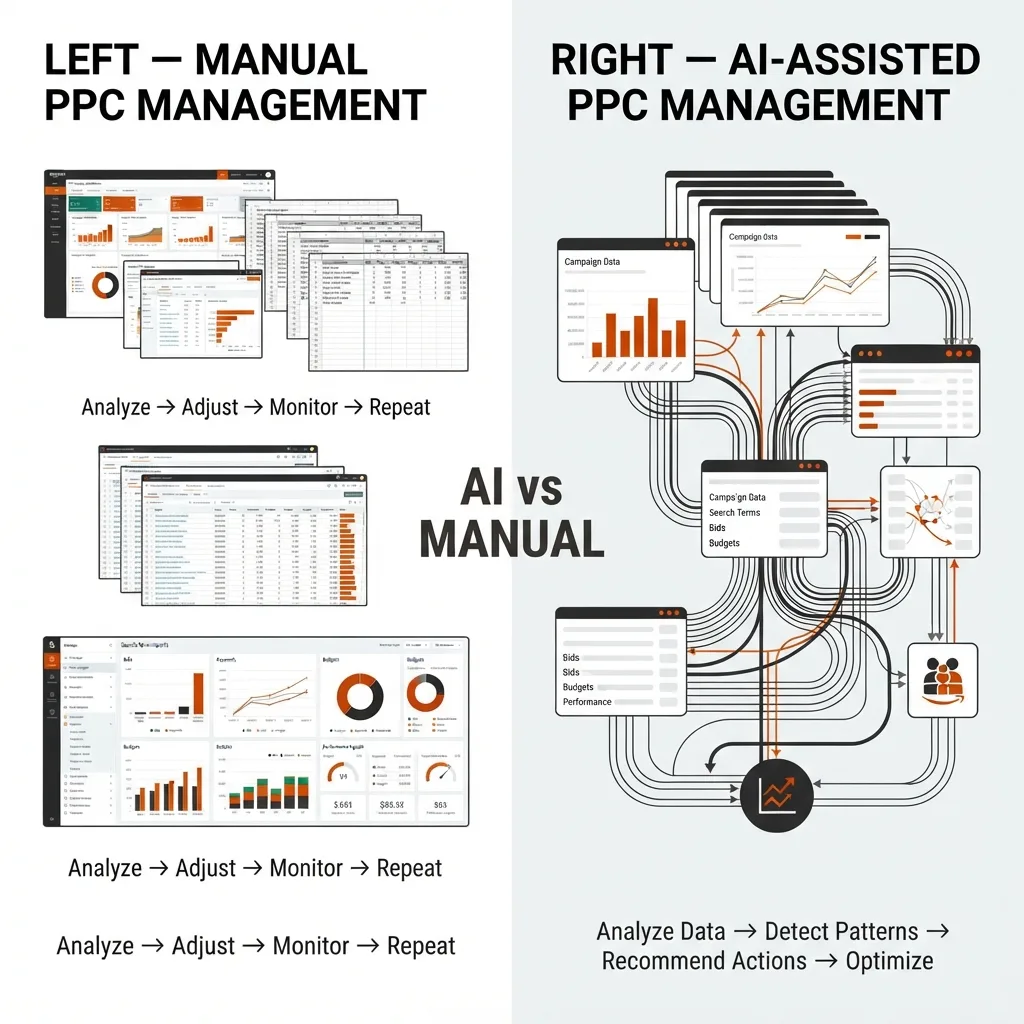
AI PPC vs. Manual Optimization: Side-by-Side Comparison
The honest comparison sellers need before making decisions about their PPC setup:
| Decision | AI Wins | Manual Wins |
|---|---|---|
| Bid adjustments (timing) | ✅ Real-time, 24/7 | ❌ Weekly lag |
| Negative keyword frequency | ✅ Daily review | ❌ Weekly at best |
| Dayparting (hourly bid scheduling) | ✅ Data-driven hourly | ❌ Requires manual setup |
| Campaign architecture | ❌ Cannot create strategy | ✅ Human judgment required |
| TACoS interpretation | ❌ No organic context | ✅ Human reads full picture |
| Launch-phase strategy | ❌ No lifecycle awareness | ✅ Seller sets the objective |
| Search term pattern recognition | ✅ Processes full history | ❌ Misses patterns at scale |
| Margin-floor enforcement | ⚠️ Only if configured | ✅ Human sets the rules |
| Seasonal budget planning | ⚠️ Reactive | ✅ Human anticipates events |
| Competitor intelligence | ❌ Account-only data | ✅ Human reads the market |
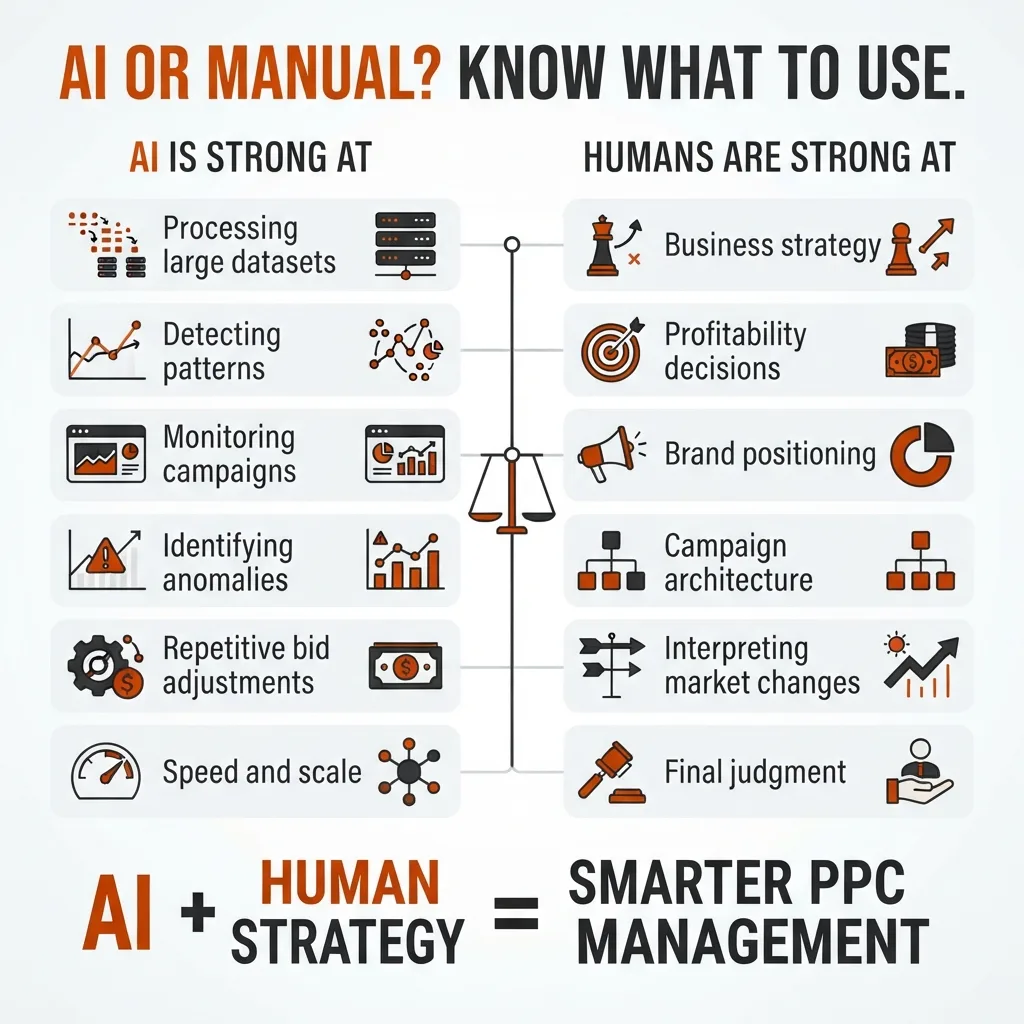
Key takeaway: AI wins on execution speed and data volume. Humans win on strategy, context, and the decisions that require understanding what the numbers do not show.
What AI-Powered PPC Actually Does (And Does Not Do)
AI PPC tools automate the repetitive, data-deterministic decisions that consume most of a manual manager's time.
Specifically, AI handles:
- Bid adjustments based on recent keyword-level ACoS vs target, updated every 15 to 60 minutes
- Negative keyword additions for search terms meeting zero-conversion criteria (typically 5+ clicks, 0 conversions)
- Keyword harvesting from auto campaigns to exact match based on conversion thresholds
- Dayparting adjustments based on hourly conversion rate patterns from your own account history
- Budget pacing to prevent early daily budget depletion before peak conversion hours (typically 7 to 10 PM)
- Placement modifier updates based on ACoS differentials between Top of Search, Product Pages, and Rest of Search
What AI does not do:
- Determine which products deserve advertising investment vs which should be paused
- Set your campaign architecture (which keywords go in which campaigns)
- Make TACoS-based decisions without organic rank context
- Adjust for inventory levels, supplier delays, or upcoming promotional events
- Recognize that a spike in ACoS is caused by a new competitor entering, not by a bidding problem
The most common AI automation failure: a seller enables AI bid management without configuring minimum margin floors. The AI optimizes for conversion volume, drives ACoS down to apparent targets, while silently eroding contribution margin because it has no visibility into product cost or landed margins. Always configure margin floors before enabling any automated optimization.
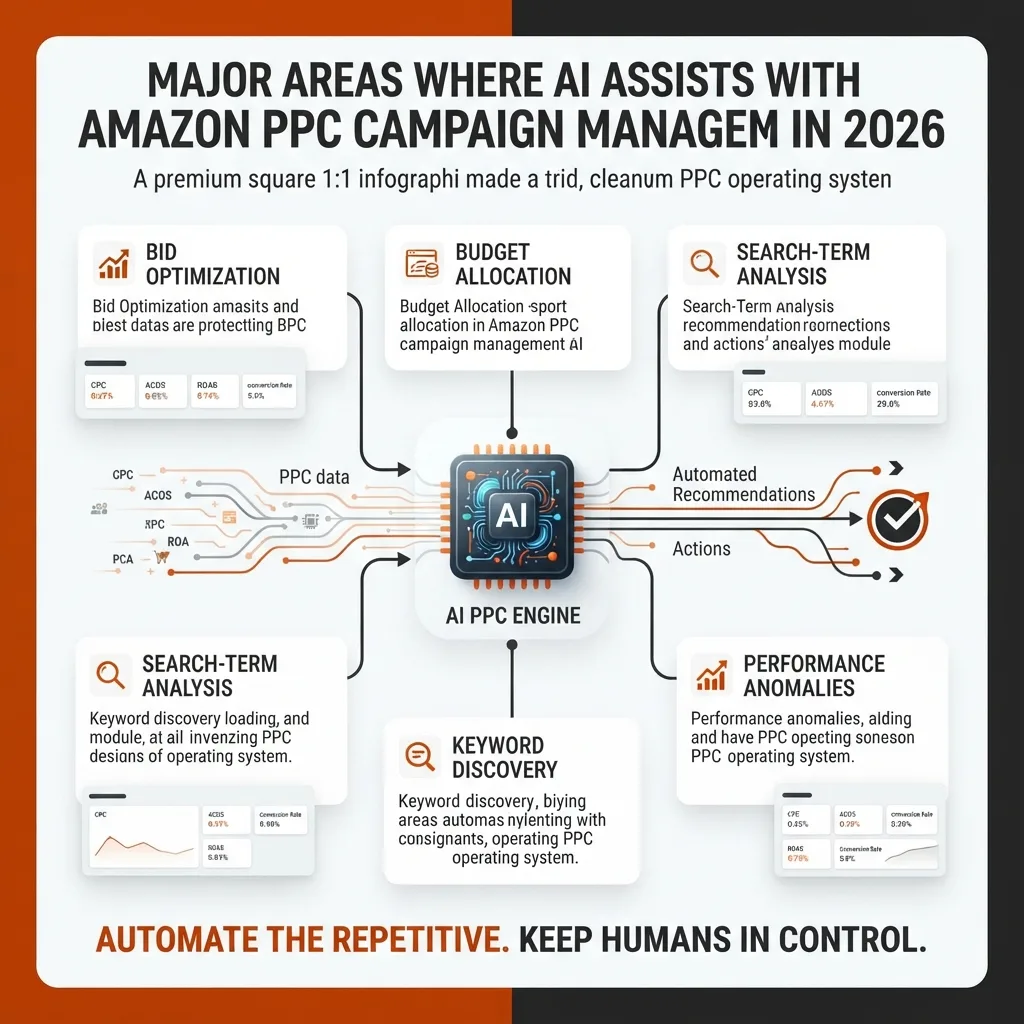
The Results: What Sellers Are Seeing in 2026
Sellers using AI bid management report ACoS reductions of 6 to 12 percentage points compared to equivalent manual management at the same ad spend level.
This improvement comes primarily from two sources:
1. Eliminating reaction-time lag Manual campaigns catch underperforming search terms weekly. AI catches them within 24 to 48 hours. For an account spending 5,000 dollars per month, even 10 percent waste elimination saves 500 dollars monthly, more than most AI tool subscription costs.
2. Dayparting precision Research shows marketplace conversion rates peak between 7 and 10 PM and drop significantly between 2 and 6 AM. AI tools using hourly bid scheduling reduce spend during low-conversion hours by 30 to 50 percent without reducing converting click volume. Most manual managers lack the time or data infrastructure to implement this.
Time savings are equally significant:
- Manual PPC management (50+ products): 15 to 20 hours per week
- AI-managed with human oversight: under 3 hours of strategic review per week
- Annual time saving at the lower estimate: 600+ hours per year
A seller who optimizes daily with AI outperforms a seller who optimizes weekly by hand, even when the manual approach is technically more sophisticated. Frequency beats sophistication at data volume.
The Six Decisions That Still Require Human Judgment
AI cannot make these decisions well. They require business context that advertising data alone cannot provide.
1. Campaign Architecture
The structure of your campaigns determines what data AI can see and optimize. Auto and exact match mixed in the same campaign, or multiple unrelated products sharing a daily budget, produces misleading data that AI optimizes incorrectly.
Build clean architecture first. Connect AI to it second.
The proven structure for 2026:
- Auto campaigns for discovery (15 to 20 percent of budget)
- Phrase match for expansion (20 to 25 percent of budget)
- Exact match for proven converters (55 to 65 percent of budget)
2. Target ACoS Setting
AI optimizes toward the target you set. Set it wrong and it optimizes toward the wrong outcome with maximum efficiency.
Your target ACoS must be calculated from actual unit economics:
- Take your selling price
- Subtract COGS, platform fees, FBA fees, storage, and return rate cost
- The remainder is your contribution margin
- Your target ACoS is contribution margin divided by selling price, minus your required profit margin
A product with 20 percent net margin after all costs and a 10 percent profit requirement should have a target ACoS of 10 percent. Setting it at 20 percent because "20 percent sounds good" erodes the entire profit margin.
3. Launch-Phase Strategy
During a product launch, the objective is organic rank-building through conversion velocity, not ACoS efficiency. An AI set to minimize ACoS during launch will underinvest in the sales velocity that builds rank, because it has no awareness of the product lifecycle.
Manually override AI ACoS targets during launch. Accept above-break-even ACoS for the first 60 to 90 days as a deliberate rank-building investment. Return to efficiency targets once organic rank on primary keywords has reached the top 30.
4. TACoS Interpretation
ACoS measures advertising cost against advertising-attributed sales. TACoS measures advertising cost against total revenue, including organic sales. AI tools optimizing for ACoS cannot see TACoS, and the two can diverge significantly.
A seller whose ACoS improved from 28 to 18 percent while TACoS rose from 9 to 18 percent has optimized a metric while worsening the underlying business. Organic rank declined while paid efficiency appeared to improve. Only a human reviewing both metrics simultaneously catches this.
Review TACoS every week. If it is rising while ACoS looks healthy, reduce bids rather than congratulate yourself.
5. Inventory-Aware Bidding
AI tools do not have visibility into your inventory position. A well-optimized campaign running on a product with 14 days of cover at current velocity is accelerating a stockout that will cost you organic rank for weeks.
Before AI scales budget on a campaign, confirm:
- Inventory cover exceeds 45 days
- No FBA inbound shipment is delayed
- No supplier constraint is expected within the lead time window
6. Competitor Event Response
When a competitor stockouts, your impression share and conversion rate often improve temporarily. AI will increase bids in response to the better performance signal, then reduce them when the competitor restocks and performance normalizes. A human who recognizes the competitor event can maintain conservative bids and protect the temporary advantage more profitably.
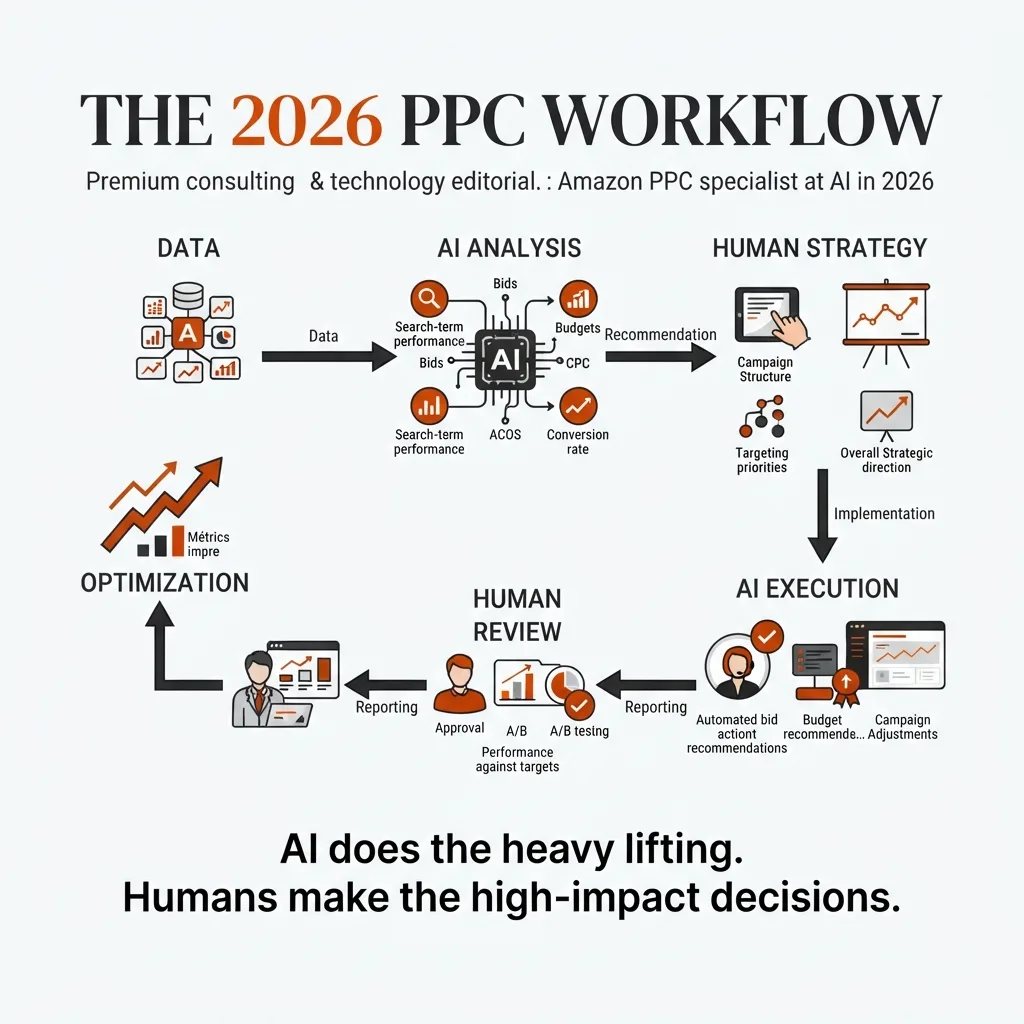
How to Structure the Hybrid Approach
The right framework is not AI or manual. It is AI for execution, human for strategy.
Here is the specific division:
Hand to AI:
- Bid adjustments (daily or more frequent)
- Negative keyword additions for zero-conversion terms meeting defined criteria
- Keyword harvesting from auto to phrase to exact
- Budget pacing and dayparting
- Placement modifier updates based on performance data
Keep with humans:
- Campaign architecture decisions
- Target ACoS calculation and setting
- Launch-phase strategy and lifecycle stage management
- Weekly TACoS review and trend interpretation
- Inventory-informed campaign scaling decisions
- Seasonal budget planning and event preparation
The minimum viable review cadence:
- Monday: Check TACoS vs prior week. Flag any campaign ACoS spike above 15 percentage points from rolling average.
- Tuesday: Review AI-proposed action list (negatives, bid adjustments). Approve or override.
- Thursday: Inventory and budget pacing check. Adjust if any product is approaching stockout.
Total human time: 90 minutes per week for a well-configured AI-managed account. That is not zero human involvement. It is the right human involvement at the right decisions.
When AI PPC Automation Makes Economic Sense
The break-even threshold for AI PPC tools is approximately 3,000 dollars per month in advertising spend.
At that level, a 6 to 12 percentage point ACoS reduction saves 180 to 360 dollars per month in advertising costs, typically more than the tool's subscription cost. Below 3,000 dollars per month, the case is less clear and periodic Claude-assisted manual analysis may produce comparable results at lower cost.
| Ad Spend Level | Recommended Approach |
|---|---|
| Under 1,000 dollars per month | Manual management with weekly Claude analysis sessions |
| 1,000 to 3,000 dollars per month | Rule-based automation (Seller Central dynamic bidding) |
| 3,000 to 10,000 dollars per month | AI bid management (Scale Insights, Jarvio) |
| Above 10,000 dollars per month | Full AI automation with dedicated oversight (Perpetua, Quartile) |
| Agency-managed above 50,000 dollars per month | Enterprise platform with custom rules and human strategist |
The most common mistake at each level: spending money on tools designed for the next tier up before the current tier's basics are solid. A seller with 2,000 dollars per month in spend and a poorly structured account needs campaign architecture work, not an enterprise AI platform.
Conclusion: AI Raises the Floor. Humans Raise the Ceiling.
AI-powered PPC has permanently raised the baseline of what "good" campaign management looks like. A seller running 100 percent manual optimization is now competing against AI systems that adjust bids every 15 minutes, eliminate waste within 48 hours of it appearing, and never miss a peak conversion window.
But AI does not replace the strategic thinking that determines whether the campaigns are structured to build organic authority, whether the TACoS trend signals a healthy business, or whether the launch is being managed for rank or prematurely for efficiency.
The sellers compounding results in 2026 are those who gave AI the execution work it is genuinely better at, retained the strategic decisions that require business context AI cannot model, and built the weekly review habit that keeps both layers aligned.
That combination produces what neither pure manual nor pure AI management can achieve alone: campaigns that get more efficient every week and that build the organic rank that makes advertising progressively less necessary over time.
Not sure whether your campaigns are structured correctly for AI management, or whether your TACoS is signaling a problem your ACoS dashboard is hiding?
At Brevlin, we audit campaign structure, TACoS trends, and launch-phase strategy before recommending any AI automation tool. We build the architecture that makes AI work, then connect the right tool for your ad spend level.
A complete 2026 comparison of AI-powered versus manual PPC campaign management, covering what has changed to make manual-only management increasingly uncompetitive (real-time auctions, Sponsored Prompts, ML attribution), a side-by-side decision matrix, what AI automation actually does and does not handle, measurable results data (6 to 12 point ACoS reduction, time savings), the six specific decisions that still require human judgment, how to structure the hybrid approach with a 90-minute weekly review cadence, and the ad spend break-even thresholds by seller size.
The sellers asking whether AI or manual PPC is better are asking the wrong question. The right question is, which specific decisions should AI be making, and which ones should I still own? AI wins on bid timing, dayparting, negative keyword frequency, and data volume. Humans win on campaign architecture, TACoS interpretation, launch strategy, and the judgment calls that require knowing your cost structure and competitive context. The sellers who have answered that question clearly are running hybrid operations that outperform both pure manual managers and sellers who handed everything to automation without structure. The architecture matters more than the tool. — Maimoona Iqbal (Marketplace Growth Specialist)
Artikel fertig. Du hast gerade 12 Minuten in dein Wissen investiert.
Häufig gestellte Fragen
AI wins on bid timing, negative keyword frequency, dayparting, search term pattern recognition, budget pacing, and placement modifiers because these are data-deterministic decisions that benefit from speed and consistency. Humans win on campaign architecture, target ACoS calculation from actual unit economics, launch-phase lifecycle management, TACoS interpretation, inventory-aware bidding, and competitor event response. These decisions require business context that advertising data alone cannot provide.
The break-even threshold is approximately 3,000 dollars per month in advertising spend. At that level, a 6 to 12 percentage point ACoS reduction saves 180 to 360 dollars monthly, typically exceeding the tool subscription cost. Below 3,000 dollars, rule-based automation through the platform's native dynamic bidding and periodic manual analysis sessions may produce comparable results at lower cost. Above 10,000 dollars per month, full AI automation with dedicated human oversight from platforms like Perpetua or Quartile produces the strongest results.
Sellers using full AI automation typically reduce their manual workload from 15 to 20 hours per week to under 3 hours of strategic oversight. The 90-minute minimum viable weekly review covers: Monday TACoS check and ACoS spike flags, Tuesday AI action list review and approval, Thursday inventory and budget pacing check. The key is that the time savings come from removing execution work (bid adjustments, negative keyword additions, keyword harvesting), not from eliminating the strategic decisions that require human judgment.
TACoS measures advertising spend as a percentage of total revenue including organic sales. ACoS only measures spend against advertising-attributed sales. They can diverge significantly: a seller whose ACoS improved from 28 to 18 percent while TACoS rose from 9 to 18 percent has optimized an advertising metric while worsening their business because organic rank declined. AI tools optimizing for ACoS cannot see TACoS. Only human weekly review of both metrics simultaneously catches this pattern before it compounds into significant margin erosion.
The most common failure is enabling AI bid management without configuring minimum margin floors. The AI optimizes for conversion volume and apparent ACoS targets while silently eroding contribution margin because it has no visibility into product cost. Always configure margin floors before enabling any automated optimization. The second most common failure is connecting AI to a poorly structured account: auto and exact match mixed in the same campaign, or multiple unrelated products sharing a daily budget. AI makes the wrong structure run faster. Fix architecture first, connect AI second.


