
AI can write your listing in seconds. But if it sounds like everyone else, it will not sell. With over 600 million products competing for visibility and 18% of listings already built from the same AI templates, differentiation is now the real competitive edge.
- About 18% of listings are now built from the same AI templates, with heavily AI-generated listings showing 37% fewer reviews and lower ratings than more distinctive ones
- Full listing refreshes drive a median 4.2 percentage point CVR lift over 90 days. Replacing spec-only bullets with benefit-led copy alone averages 1.8pp improvement per ASIN
- Listings must now satisfy three discovery systems simultaneously, the keyword algorithm, the semantic knowledge engine, and the AI shopping assistant that handles 274 million daily queries with users converting at 60% higher rates
- AI should handle keyword clustering, structural drafting, and review mining. Human editing handles brand voice, specificity, and emotional resonance. Neither layer is optional
- Sellers who consistently A/B test listing elements improve CVR 15 to 25% annually through compounding wins, directly reducing ACoS without changing bids
Introduction
In 2026, AI has fundamentally changed how product listings are created. Sellers can generate titles, bullet points, and full descriptions in seconds using generative AI tools. The result is faster launches, lower content costs, and a dramatically reduced barrier to getting products live. Marketplaces now host over 600 million products, with roughly 3,700 new sellers joining the leading platforms daily.
But speed has created a new problem: sameness.
A study published in early 2026 analyzed over 500 listings across 10 product categories and found that approximately 18% of them showed high-confidence signals of being generated from the same AI templates. Those listings were technically keyword-compliant. They were not, however, distinctive. Compared to listings with lower AI scores, the most template-like listings had 37% fewer reviews and lower average ratings, suggesting that structural similarity may be contributing to weaker buyer trust and engagement over time.
The math is clear. When everyone uses the same tool with the same prompts, the output converges. And when listings converge, buyers skip past them to something that feels real.
The top sellers in 2026 have not abandoned AI. They have learned to use it differently: as a starting engine, not a finished product. They combine AI speed with human brand knowledge, customer insight, and editorial judgment to produce listings that are optimized and compelling, not just indexed.
This article breaks down where AI listing tools fall short, what the 2026 data shows about conversion and discoverability, and how to build a content process that scales without losing what makes your brand different.
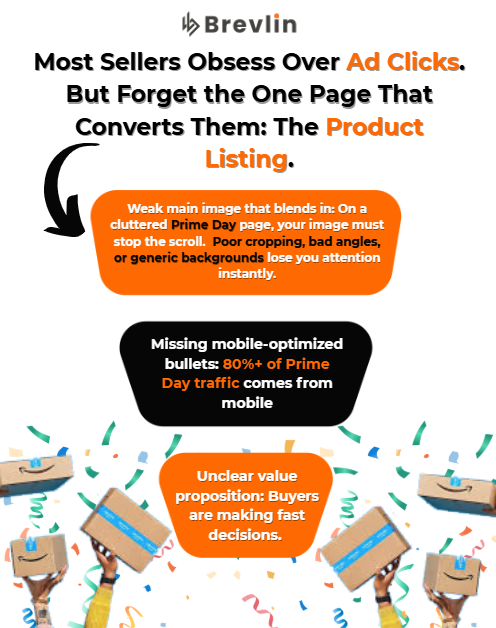
Why Generic AI Listings Fail: The Conversion Gap
Listing quality has a direct, measurable impact on profitability, and in 2026 that relationship is tighter than ever because rising ad costs leave almost no margin for poor conversion.
Industry benchmarks from 2026 show that the typical marketplace conversion rate sits between 3% and 10%, while well-optimized listings with strong reviews and high-quality visuals consistently achieve 10% to 15%. Top performers in the strongest categories exceed 20%. The gap between a 5% and 10% CVR effectively doubles revenue from the same traffic without changing a single bid.
The downstream effect on advertising is significant. Improving CVR from 8% to 12% on a campaign reduces ACoS by roughly 33% without touching bids or budgets at all. Listing quality is, in many cases, a higher-leverage action than bid optimization because it improves the economics of every click simultaneously across all campaigns.
One recent study tracking listing refreshes across multiple brands found a median CVR lift of 4.2 percentage points over 90 days after a full listing update covering title, bullets, A+ Content, and backend keywords. The single highest-impact change was replacing specification-only bullet points with benefit-led copy that addressed the top three review objections inline. That one change alone drove an average 1.8 percentage point CVR improvement per ASIN, measurable within 4 to 6 weeks.
AI-generated listings built from generic templates rarely achieve this because they optimize for structure and keyword presence, not persuasion. They tick boxes but do not close buyers.
The Three Discovery Layers Your Listing Must Now Satisfy
In 2025 and 2026, the marketplace search ecosystem shifted significantly. Listings now need to perform across three separate discovery systems simultaneously, and AI content strategies that ignore this are being left behind.
The first is the keyword algorithm, which continues to match search queries to listing fields including title, bullets, description, category attributes, and backend keywords. This layer rewards structured, keyword-rich copy placed in the right fields. Titles remain the highest-weighted field, with the mobile cutoff at roughly 60 to 80 characters making front-loading essential.
The second is the semantic knowledge engine, which builds connections between what shoppers search, what they actually want, and which products match those intentions. A search for "shoes for a wedding" now returns formal dress shoes even if the listing never uses those exact words. When this system was rolled out to just 10% of US search traffic in a test period, it drove a 0.7% increase in purchases and an 8% boost in shopper engagement. For sellers, this means keyword density matters less than whether the listing accurately communicates what the product does, who it is for, and how it is used.
The third and fastest-growing layer is the AI shopping assistant that now handles over 274 million daily queries. Shoppers using this assistant convert at a 60% higher rate than those who do not. Interactions grew 210% year over year. The assistant reads entire listings, including A+ Content, images (using OCR), and Q&A sections, to answer conversational questions and make recommendations. A listing optimized only for traditional keyword search is leaving a disproportionate share of high-converting traffic on the table.
Over 12 million listings were created using generative AI tools in 2025 alone. Sellers who use AI to generate their listings see a 40% increase in overall listing quality scores. But quality scores do not guarantee discovery across all three layers. Structural AI outputs that do not include contextual, conversational, and benefit-driven language will rank for keywords and be ignored by the other two systems.
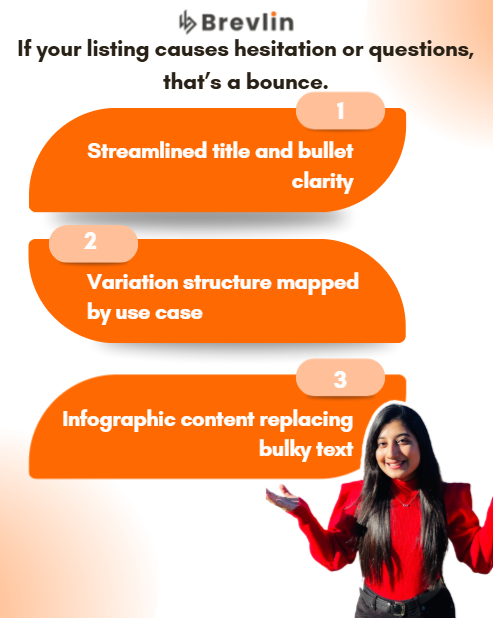
AI as a Starting Point, Not the Final Output
AI listing tools produce strong raw material: keyword-rich titles, structured bullet frameworks, and technically compliant descriptions. That is genuinely valuable. Writing from a blank page is slower, and AI surfaces keyword clusters that manual research often misses.
But the most capable AI tools are also designed for speed and breadth, not differentiation. They do not know why your product exists, what makes your version worth paying more for, or how your best customers talk about it in their own words. Those elements have to come from you.
The practical workflow that top sellers use in 2026 looks like this:
Use AI to generate a keyword-optimized structural draft. Take the draft and rewrite every bullet through the lens of your actual customer: what problem does this solve, why does your version solve it better, and what proof can you reference? Feed the AI your top 50 to 100 customer reviews and ask it to extract the phrases, concerns, and specific outcomes buyers mention most. Layer those exact phrases and framing into the final copy. Run the output through at least one human editorial pass focused on brand voice and emotional resonance before publishing.
Sellers who consistently A/B test their listing elements improve conversion rates 15 to 25% annually through compounding small wins. The tool provides scale. The human review provides direction.
Using AI to Mine Customer Language
One of the highest-value applications of AI in listing creation is not writing the listing itself. It is analyzing what buyers have already written about products like yours and extracting the language that drives purchase decisions.
AI can process hundreds of customer reviews in seconds and surface patterns that human analysis would take hours to find: the phrases that appear most often in 5-star reviews, the objections that appear in 3-star reviews, and the specific use cases buyers describe when they explain why they chose a product.
Listings built around this customer language tend to outperform internally-generated copy for a straightforward reason: they reflect how buyers think and speak, not how product teams think and speak. When a shopper reads copy that mirrors their own concern or use case, it creates recognition. Recognition builds trust. Trust converts.
This is also increasingly relevant for the AI shopping assistant layer. The assistant reads your listing and reviews together to answer shopper questions. If your listing already addresses the objections and use cases that appear in your reviews, the assistant is more likely to recommend your product in response to relevant queries.
Avoiding Keyword Stuffing in a Semantic Search Era
Older listing strategies relied on keyword repetition: use the target term as many times as possible across every field. That approach is now actively penalized. The platform's title policy, updated in January 2026, restricts special characters, marketing language, and repetitive keyword usage. Non-compliant titles can be auto-replaced by the platform's own AI, and those replacements may not represent your product the way you would choose.
The modern approach uses semantic keyword clustering: grouping related search terms by what the buyer is actually trying to accomplish, rather than surface-level text similarity. A buyer searching "lumbar support chair for back pain" and a buyer searching "ergonomic office chair for long hours" are expressing different use cases that may justify different content angles within the same listing.
AI keyword tools can process reverse ASIN data from competitors, identify gaps between your listing and theirs, and cluster 500 to 2,000 terms by buyer intent automatically. The output is a prioritized keyword map that tells you what to emphasize in the title, what to cover in bullets, what belongs in backend fields, and what to address in A+ Content.
The result is listings that rank for a broader semantic footprint and read naturally to human shoppers, because the copy is organized around meaning rather than repetition.
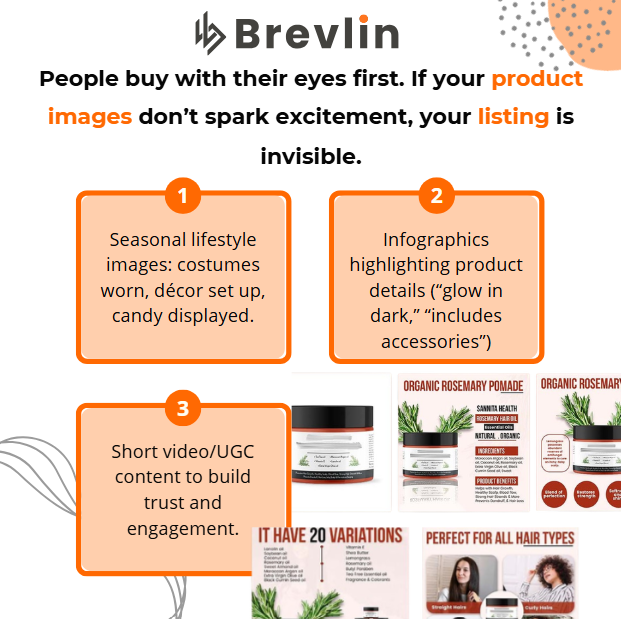
AI and Visual Optimization: The Conversion Lever Most Sellers Ignore
AI has significantly expanded how sellers can approach image strategy, and images remain one of the most underleveraged conversion levers on most listings.
The main image drives click-through rate from search. The product should fill at least 85% of the frame on a clean white background. Any deviation from this standard will cost CTR before a buyer ever reads a word of copy. The platform's AI shopping assistant uses OCR to read text embedded in images, meaning infographics with clear standard fonts contribute to discoverability in conversational search. Cursive and heavily stylized text is not reliably read.
AI tools can now generate professional lifestyle images, infographic overlays, comparison charts, and A+ Content visuals without expensive photoshoots. They can also analyze image performance data to identify where shoppers drop off in the image stack, which image positions drive the highest engagement, and which visual formats perform best by category.
Well-optimized image stacks should use all available slots strategically: a clean main image for CTR, infographics with feature callouts in positions two through five, a lifestyle image showing the product in its actual use context, a comparison chart (which the AI shopping assistant specifically reads to answer comparison questions), and a size or quantity guide where relevant.
Sellers who align both text and visual optimization to this layered discovery model are the ones consistently achieving conversion rates above 12% in competitive categories.
Balancing AI Scale with Brand Identity
The risk of over-relying on AI listing tools is not just generic copy. It is the gradual erosion of the distinctive positioning that separates your brand from a commodity.
When 18% of listings already look and sound the same, differentiation is a competitive edge that compounds. The sellers most protected from copycat competition and algorithm volatility are the ones whose listings clearly communicate what their brand stands for: who the product is for, what values it reflects, and why the buying decision feels like the right one.
Maintaining that identity at scale requires defining it explicitly before feeding it to any AI tool. A brand voice guide, even a simple one, provides the reference that prevents every AI output from drifting toward the same generic center. The guide should specify the tone, the level of technical detail, the type of proof that gets cited, and the claims that are off-limits. Every AI draft runs through this guide before human editing begins.
The practical output is listings that are both efficient to produce and genuinely distinctive: AI handles keyword research, structural drafting, and review mining; the brand guide and human editing pass handle personality, specificity, and emotional resonance.
Continuous Optimization: Treating Listings as Living Assets
Most sellers optimize a listing once at launch and leave it. Top sellers treat listings as living assets that require ongoing attention.
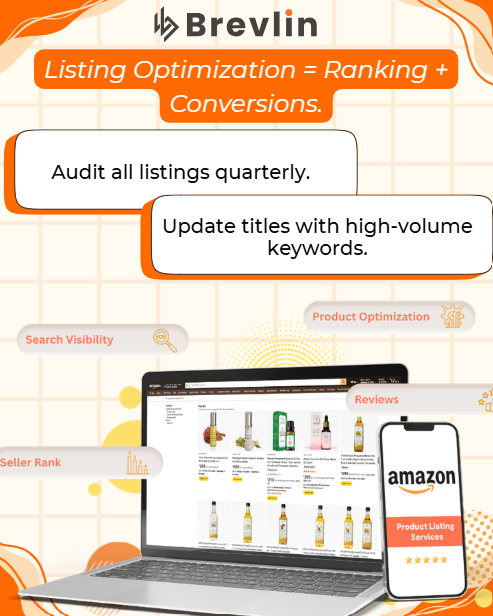
The platform's native A/B testing tool lets sellers test titles, main images, and bullet points against real traffic with statistically significant samples. The recommended practice is to run one variable at a time for a minimum of 4 to 8 weeks, implement the winning variation permanently, and immediately begin the next test. Sellers who consistently run these tests improve conversion rates 15 to 25% annually through compounding small wins, and that compounding effect on ACoS can be significant given that CPCs are now averaging $1.18 and rising.
AI assists the ongoing optimization loop in several ways: flagging underperforming ASINs based on CVR trend data, generating test hypotheses for new title or bullet variants, and surfacing new customer language from review accumulation as the catalog matures. Healthy listings in 2026 show stable or improving conversion rates, growing organic share of voice, and reducing reliance on paid traffic over time. That last metric, TACoS trending downward as PPC-driven sales convert into organic rank, is the clearest signal that listing quality is doing its job.
Conclusion
AI has made listing creation faster, more accessible, and more technically sophisticated than ever before in 2026. It has also created a marketplace where the average listing sounds like every other listing, because everyone is using the same tools with the same prompts.
The sellers winning are not the ones who avoid AI. They are the ones who use it strategically: mining customer language with it, structuring keyword hierarchies with it, generating first drafts with it, then editing those drafts through the lens of their actual brand, their actual buyers, and the three discovery systems that determine whether a listing gets seen at all.
Listings that balance AI-driven optimization with human-led authenticity will outperform generic AI-generated pages every time. The data supports it. The conversion benchmarks confirm it. The only remaining question is whether your process reflects it.
Ready to Fix Your Listings
Do not let AI turn your listings into copy-paste content.
At Brevlin, we combine AI-driven insights with expert-led strategy to create listings that rank, convert, and differentiate your brand.
Stand out. Convert better. Scale faster in 2026.
A 2026 deep dive into why AI generated listings are creating a sameness problem across major marketplaces, backed by data on conversion benchmarks, the three-layer discovery system (keyword, semantic, and AI assistant), and how to build a listing process that combines AI speed with human differentiation to consistently hit 10 to 15% CVR or higher.
AI listing tools are genuinely powerful, but the sellers I work with who get the best results are not the ones running the most automation. They are the ones who know exactly where AI ends and human judgment begins. The 18% template overlap figure is the clearest signal yet that the real edge in 2026 is differentiation, not speed. Speed is now the baseline. — Maimoona Iqbal (Marketplace Growth Specialist)
Artikel fertig. Du hast gerade 12 Minuten in dein Wissen investiert.
Häufig gestellte Fragen
No. The platform's content policy explicitly permits AI-generated listings submitted through official channels, provided they meet standard quality thresholds and comply with content rules. Disclosure is not required. What matters is whether the content satisfies keyword relevance, semantic clarity, and conversion performance, not its origin.
Use all available image slots strategically. The main image drives click-through rate and should show the product filling at least 85% of the frame on a white background. Infographics in positions two through five should carry feature callouts with clear, standard fonts so the AI shopping assistant can read them. A lifestyle image, comparison chart, and size guide round out a complete stack.
At minimum, review listings every 30 days and run formal A/B tests on high-traffic ASINs at least quarterly. Update immediately when: pricing changes significantly, new review objections emerge, a competitor enters the category, or CPC trends suggest conversion efficiency is slipping.
The single highest-impact change identified in 2026 studies is replacing specification-only bullet points with benefit-led copy that addresses the top three buyer objections directly. Run AI review mining on your reviews and your top three competitors to surface those objections. Then rewrite each bullet as Feature plus Benefit plus Proof rather than a plain feature list.


