
Keyword search is no longer the only path to product discovery in 2026. Alexa for Shopping (formerly Rufus) is now the default AI layer for 300 million shoppers, handling up to 20 percent of mobile queries and driving 12 billion dollars in sales. Visual search is reshaping category discovery. Here is how to optimize for all three layers.
- Alexa for Shopping (formerly Rufus) is now the default AI discovery layer for every signed-in US shopper, having reached 300 million customers and driven 12 billion dollars in incremental sales before the May 2026 rebrand
- The AI assistant narrows results from hundreds to approximately five products per query, making non-appearance in those five effectively invisible for AI-mediated shoppers
- Backend attribute completeness is the highest-leverage AI optimization action, every empty field is a severed knowledge graph connection that reduces eligibility for AI recommendations
- Visual search evaluates images for shape, color, material, and aesthetic match, making photography simultaneously a conversion asset and a discoverability data source
- The Q&A section and customer reviews are primary AI citation sources; listings with 15 to 20 substantive Q&As and detailed review content have dramatically more surface area for AI recommendation than those relying on copy alone

Introduction
For more than a decade, marketplace sellers focused on one primary battleground: typed keyword search. Ranking for the right terms, winning the featured offer placement, and optimizing for the algorithm that matched keywords to listings was the entire game. That game has not ended. But in 2026, a new and rapidly growing layer of product discovery sits on top of it, and sellers who are not optimizing for it are already ceding ground.
The shift is driven by two forces converging simultaneously: AI-powered conversational search and visual discovery.
On the AI side, what was known as Rufus, the marketplace's generative AI shopping assistant, was officially renamed Alexa for Shopping on May 13, 2026, and expanded from an opt-in feature to the default search layer for every signed-in US shopper on the marketplace app and website. No Prime membership required. No Echo device required. Over 300 million customers used the assistant during 2025, a 149 percent year-over-year increase in monthly active users, generating nearly 12 billion dollars in incremental annualized sales. On Black Friday 2025 alone, 38 percent of all marketplace sessions involved the AI shopping assistant. These are not experimental engagement numbers. This is a mainstream discovery channel that is already reshaping which products buyers see and which ones stay invisible.
On the visual side, image-based product discovery is transforming categories like fashion, home decor, accessories, and beauty. Shoppers screenshot inspiration images, upload them to the marketplace app, and receive instant visual matches. The connection between your product imagery and AI-driven visual recognition is now a discoverability factor, not just a conversion factor.
The sellers who understand how to optimize for both of these surfaces have a compounding advantage that traditional keyword SEO alone cannot create. This guide breaks down exactly what that optimization looks like in 2026 and what you need to change in your listings, attributes, and content strategy to be visible across all three layers of modern marketplace search.
1. Understanding the New Discovery Architecture
To optimize effectively for AI-driven and visual search, you first need to understand how the discovery architecture has changed and why optimizing for each layer requires a different approach.
Traditional keyword search (the A10 algorithm) still accounts for approximately 80 to 85 percent of discovery traffic as of Q1 2026. It matches keywords in a shopper's typed search query to keywords in your listing, weighted by conversion rate, click-through rate, sales velocity, and seller authority. This has not changed and should not be deprioritized.
The AI shopping assistant layer now handles 15 to 20 percent of shopper queries on mobile and is growing every quarter. This layer works fundamentally differently from keyword matching. The assistant interprets intent through a language model, adds context to what the shopper is asking, and generates its own search behavior from that interpreted intent. A shopper who types "men's running shoes" is served traditional search results. A shopper who asks "What is the best running shoe for flat feet under one hundred dollars for marathon training" is served AI-recommended results where keyword matching alone is insufficient. The assistant surfaces approximately five named products, compared to the hundreds returned by traditional search. If your product is not in those five for a given query, it does not exist for that shopper.
Visual search works through computer vision AI that interprets the shape, color, material, pattern, and style of uploaded images and matches them against product catalog data. Unlike keyword or AI-text search, visual search bypasses language entirely. A shopper who cannot describe what they are looking for can show it instead. This is particularly powerful for discovery in visually driven categories.
These three layers share some optimization requirements (reviews, pricing, fulfillment) but diverge significantly in what makes a listing discoverable and recommendable. Understanding where they diverge is where the strategic opportunity lies.
2. How the AI Shopping Assistant Actually Evaluates Your Listing
The AI shopping assistant reads your entire listing and evaluates it against shopper queries holistically, not keyword by keyword. Understanding specifically what it reads and how it weighs different elements is the foundation of effective AI-optimized listing strategy.
The assistant evaluates your listing across seven primary data sources: product title, bullet points, product description, A+ Content, backend structured attributes, customer reviews, and Q&A sections. Of these, the backend structured attributes and customer reviews are the two most systematically underutilized by sellers.
Why structured attributes matter more than most sellers realize: The AI assistant is built on a large language model that craves clean, labeled, structured data over unstructured text. Every populated attribute field in your backend (Intended Use, Material Composition, Care Instructions, Compatibility, Oven Safe Temperature, Connectivity Protocol, and hundreds of category-specific fields) is a node in the knowledge graph the assistant uses to match your product to shopper queries. An empty attribute field is a severed connection. From the assistant's perspective, a blank field means uncertainty, and uncertainty means exclusion from recommendations.
The practical implication: if you sell a cast-iron skillet and leave Oven Safe Temperature blank, the assistant cannot confidently recommend your product when a shopper asks "Can I use this in the oven at 500 degrees?" Your competitor who populated that field gets the recommendation. Your competitor who left it blank does not, regardless of how well-written their title and bullets are.
Research shows that products with 90 percent or more of available attribute fields populated with specific, accurate data consistently outperform keyword-stuffed listings in AI-mediated discovery. Before writing or rewriting any copy, audit your attribute completeness as the highest-priority optimization action.
Why reviews are a primary AI recommendation signal: The assistant reads your reviews as product information, not just social proof. It pulls specific claims, use cases, compatibility confirmations, and user experience details from review text to evaluate whether your product can confidently answer a shopper's specific question. A product with 200 detailed, specific reviews across multiple use cases has dramatically more surface area for AI citation than a product with the same star rating but vague, short reviews.
This means proactively managing the quality of your review content through follow-up messaging, responding to reviews that contain useful product information, and using the Vine program to seed detailed, substantive early reviews on new products.
3. Conversational Keyword Optimization: Writing for How Buyers Actually Speak
The shift from keyword-based to conversational AI-driven discovery requires a fundamental change in how listing copy is written. Traditional keyword optimization inserts high-volume search terms into titles and bullets in a way that is technically effective but reads awkwardly. AI-driven discovery punishes this approach. The assistant rewards listings that read naturally because they are trained on natural language and evaluate whether your listing can credibly answer a shopper's question.
The comparison is instructive:
Keyword-optimized title: "Stainless Steel Insulated Water Bottle 32oz BPA Free Leakproof Lid Travel Mug Thermos"
AI-optimized title: "32oz Insulated Water Bottle, Keeps Drinks Cold 24 Hours and Hot 12 Hours, Leakproof Stainless Steel for Hiking, Travel, and Daily Commutes"
The second version contains many of the same keywords. But it also answers the implicit questions the assistant evaluates when matching against conversational queries: "How long does it stay cold?", "Will it leak?", "What activities is it designed for?" A shopper who asks "What is the best water bottle for hiking that keeps drinks cold all day?" is far more likely to trigger a match with the second title than the first.
Apply the same principle to bullet points. Structure each bullet to answer a specific question your buyers actually ask:
Instead of: "Premium material construction" Write: "Built with 18/8 food-grade stainless steel, stays rust-free and odor-free after years of daily use"
Instead of: "Versatile product" Write: "Works for hiking, gym sessions, office use, and commuting, fits standard car cup holders and most backpack side pockets"
The "best for" and "how to" question formats are particularly high-value for AI optimization. Shoppers who use the assistant often ask "What is the best X for Y?" The listing that most explicitly answers that question wins the recommendation.
Your product description is also fully indexed by the assistant. Even if you use A+ Content (which replaces the visible description), the description field is still read and evaluated. Use it to answer the five to ten most common questions your buyers have about the product, written in plain, natural language.
4. The Q&A Section: An Underutilized AI Optimization Asset
The Q&A section on your listing is one of the most underutilized optimization surfaces for AI-driven discovery, and also one of the easiest to improve.
The assistant pulls directly from Q&A content when answering shopper questions that are not addressed in the listing copy itself. A question like "Is this dishwasher safe?" answered in your Q&A section becomes an additional data point the assistant can cite when recommending your product to a shopper who asks about dishwasher safety. Without a Q&A answer, the assistant either cannot answer the question or, worse, cites a competitor who does have an answer.
Target 15 to 20 substantive Q&As on any product doing significant monthly revenue. Seed the Q&A section by identifying the most commonly asked questions from your reviews, customer service messages, and competitor Q&A sections, then answering them completely and specifically. Vague answers ("It depends on how you use it") provide no citation value. Specific answers ("Yes, the lid and body are both top-rack dishwasher safe. We recommend removing the silicone seal before washing to extend its lifespan") give the assistant exactly the information it needs to confidently recommend your product for dishwasher-compatibility queries.
5. A+ Content as an AI Information Source
A+ Content is not just a conversion tool in 2026. It is a significant source of structured information that the AI assistant reads to understand your product's fitness for specific buyer needs.
The assistant evaluates A+ Content as an informational resource rather than a promotional one, which changes the optimal design principle. Content that reads as genuinely informational (comparison charts with specific data, use-case modules with concrete scenarios, feature callouts with specific claims rather than marketing language) provides more citation value than content built around vague brand language and aspirational imagery.
The "Help Me Decide" feature, launched in October 2025, is particularly instructive. When a shopper has been browsing similar products and asks the assistant to help them choose, the assistant generates a side-by-side comparison drawn directly from listing content, reviews, and A+ Content. If your A+ Content explicitly states what your product does better than alternatives (faster assembly, longer warranty, specific compatibility advantages), that claim becomes a potential citation point in a decision recommendation. If your A+ Content says only "trusted by millions of families," it provides nothing the assistant can use in a comparison.
Practically, this means your comparison chart within A+ Content should include specific, factual differentiators rather than just checkmarks. Your use-case modules should name specific scenarios rather than generic lifestyle descriptions. Your feature callout sections should provide specific measurements, materials, or performance claims rather than marketing adjectives.
Image alt text within A+ Content, which was largely ignored by sellers for years, is now read by the computer vision layer of the assistant. Write descriptive alt text that accurately describes what the image shows: "Woman using 32oz insulated water bottle during trail hiking session, showing one-handed opening mechanism" provides dramatically more information to the AI than "product lifestyle image."
6. Visual Search Optimization: Images as Data
Visual search transforms your product images from purely persuasive assets into discoverable data. The computer vision AI interprets the visual characteristics of your images (shape, color, material, pattern, design aesthetic) and uses them to match against shopper-uploaded photos or screenshots of inspiration images.
This shift makes image quality, accuracy, and visual clarity simultaneously a conversion and a discoverability factor. Grainy, poorly lit, or visually ambiguous product shots do not just hurt conversion. They impair the AI's ability to classify and match your product, reducing visibility in visual search results.
The optimization principles for visual search:
Clean backgrounds matter for AI classification. The computer vision model needs to isolate and classify the product itself. Cluttered backgrounds introduce visual noise that reduces classification accuracy. This aligns with existing listing guidelines but now carries a discoverability implication beyond compliance.
Multiple angles improve match accuracy. A single front-facing product shot gives the AI one perspective to classify. Multiple angles, including side profiles, three-quarter views, and detail shots, give the visual search algorithm more data points to match against a wider range of shopper-uploaded images. A shopper who uploads a side-profile screenshot of an inspiration image will get better matches against your product if you have a side-profile image than if all your images are frontal.
Color accuracy is critical. Visual search relies heavily on color matching. Images where the color rendering diverges from the actual product due to lighting conditions or post-processing will produce incorrect visual matches. Ensure your product images reflect the true color with calibrated, consistent lighting.
Lifestyle images for visual discovery. Shoppers browsing social media and uploading inspiration screenshots are not uploading product-on-white-background images. They are uploading lifestyle contexts, a kitchen scene, an outfit combination, a living room setup. Your lifestyle images are your primary visual search discovery asset in these scenarios. Images that accurately represent how the product looks in real-world contexts produce better visual search matches against the informal screenshots that shoppers actually upload.
Visual consistency across your catalog. Products from the same brand shot with consistent lighting, backgrounds, and compositional style are more likely to surface together in visual search results, creating a cluster effect that reinforces brand recognition and cross-sells between products.
7. Voice Commerce: The Winner-Takes-All Discovery Channel
Voice-based shopping operates on the most unforgiving discovery mechanics of any channel available in 2026. Traditional typed search returns hundreds of results. AI text search returns approximately five. Voice search returns one or two products, presented verbally, with no visual listing to evaluate. The winner-takes-all dynamic makes voice optimization both high-stakes and highly specific.
Voice queries are longer, more conversational, and more context-rich than typed queries. "Alexa, order organic fair-trade coffee, whole bean, medium roast, two pounds" is structurally very different from typing "organic coffee." Voice shoppers are often further along in their purchase decision, with more specific preferences and higher purchase intent.
Several factors disproportionately influence voice recommendations:
Brand recognition and past purchase history. When a shopper says "Alexa, order more of that coffee I bought last time," the recommendation draws on order history. Brand recall also matters: shoppers who specifically request a brand name get that brand's products. Building brand awareness through Brand Store development, Sponsored Brand advertising, and consistent branding across all touchpoints indirectly improves voice recommendation frequency.
Prime eligibility and fast fulfillment. Voice shoppers make fast decisions. The friction of shipping delays is disproportionately felt in voice commerce, where the expectation of immediate gratification is highest. Products with Prime-eligible, fast fulfillment status have a significant structural advantage in voice recommendation ranking.
Review score and volume. Voice recommendations lean heavily toward highly rated, frequently purchased products. A product with 4.7 stars and 2,000 reviews will receive dramatically more voice recommendation consideration than a comparable product with 4.3 stars and 200 reviews in the same price range. Review velocity and quality management are prerequisite conditions for voice visibility.
Price competitiveness. The assistant's voice recommendations factor in value positioning. Products priced significantly above comparable alternatives lose voice recommendation consideration even with strong reviews. Competitive pricing relative to your category is not optional for voice visibility.
Conversational language in listing content. The same principle that applies to AI text search applies to voice: listings written in natural, conversational language that directly answers the questions voice shoppers ask perform better in voice recommendations than keyword-stuffed copy. Plain language in titles and descriptions, combined with specific product claims, is the technical foundation of voice optimization.
8. Practical Attribute Optimization: The Highest-Leverage Action
Of all the optimization actions available for AI-driven discovery in 2026, completing your product's backend attribute fields delivers the most return for time invested and is the most consistently neglected.
Start by accessing the full attribute list for your product category in Seller Central. Most categories have between 50 and 200 available fields. Most sellers populate 10 to 20. The gap between what is available and what is populated is where AI recommendation opportunities are being lost.
Work through the attribute fields systematically, prioritizing those most likely to appear in buyer queries:
Physical characteristics: dimensions, weight, color (precise, not "multicolor"), material composition, finish type.
Compatibility and technical specs: device compatibility, voltage/wattage, connectivity protocols, system requirements.
Use case and intended use: activity type, age range, skill level, indoor/outdoor use, occasion.
Safety and certification: certifications, safety ratings, compliance standards, allergen information.
Performance claims: temperature range, battery life, water resistance rating, load capacity.
Each of these is a potential answer to a specific buyer question. Every answer you provide in a structured attribute field is a potential citation point for the AI assistant when recommending your product. Every empty field is an opportunity you are giving to a competitor who populated it.
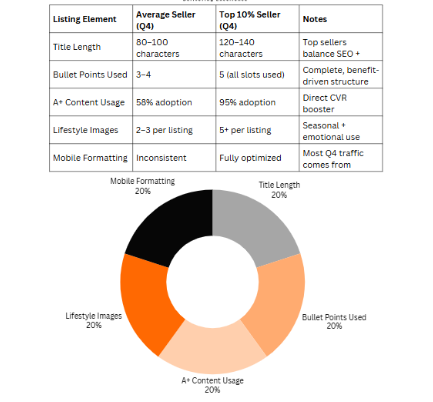
9. The "Help Me Decide" Feature and Differentiation Clarity
The "Help Me Decide" feature deserves dedicated attention because it represents the clearest example of how AI-driven discovery punishes vague differentiation and rewards specific claims.
When a shopper asks the assistant to help choose between two or more products they are evaluating, the assistant generates a structured comparison drawn from listing content, reviews, and A+ Content. The comparison identifies which product is better for specific use cases, which has a longer warranty, which is easier to assemble, which is better for beginners versus advanced users.
If your differentiation is not explicit in your listing, the assistant uses whatever it can find, which may be a competitor's claim, or it may simply omit your product from the comparison summary. Your advantage must be spelled out in specific, factual language that the assistant can cite directly.
Winning in "Help Me Decide" comparisons requires anticipating the dimensions on which buyers compare products in your category and ensuring every relevant differentiator is explicitly stated in your bullet points, A+ Content, and Q&A section. "High quality materials" is not a differentiation claim the assistant can cite. "Grade-5 titanium construction rated to 1,500 psi" is.
10. Building a 2026 AI and Visual Search Optimization Roadmap
The optimization actions above are most effective when applied in a structured sequence rather than randomly. Here is a practical roadmap:
Month 1: Audit and attribute completeness. Pull your full attribute list for each major product. Identify every empty field. Populate all relevant attributes with accurate, specific data. This is the highest-priority action and the fastest to complete relative to its impact.
Month 1 to 2: Q&A seeding and review strategy. Identify the 15 to 20 most common buyer questions from your reviews, customer service messages, and competitor Q&A sections. Populate your Q&A section with complete, specific answers. Review your Vine enrollment status and ensure your top products have a strong base of detailed, substantive reviews.
Month 2: Copy rewrite for conversational search. Rewrite titles and bullets using the conversational structure described above, ensuring each bullet answers a specific buyer question. Rewrite your product description to address the five to ten most common product questions in plain language.
Month 2 to 3: A+ Content optimization. Update your A+ Content to include specific, factual differentiator claims, concrete use-case scenarios, and comparison data. Add descriptive alt text to all images. Verify that "Help Me Decide" comparison dimensions are explicitly addressed.
Month 3: Image audit for visual search. Review your image gallery for color accuracy, multi-angle coverage, background cleanliness, and lifestyle context relevance. Update images that fail the visual search criteria above. Add video for products where it is available.
Ongoing: Monitor and iterate. AI-driven discovery is evolving rapidly. The optimization playbook in Q4 2026 will differ from the Q2 2026 playbook. Check Brand Analytics for Alexa for Shopping attribution data where available. Monitor Search Query Performance reports for changes in impression share on conversational long-tail queries. Review Q&A sections quarterly and update them as buyer questions evolve.
Conclusion
The marketplace's discovery layer is expanding beyond what traditional keyword SEO alone can capture. Alexa for Shopping, launched to 300 million customers with $12 billion in incremental sales already attributed to it, is not an experimental feature. It is a mainstream discovery channel that is becoming more capable, more widely used, and more commercially significant every quarter.
The sellers who win in this environment are those who understand that the AI assistant evaluates listings as answers to buyer questions, not as collections of keywords. Attribute completeness, conversational copy, specific differentiator claims, substantive Q&A content, review quality, and visually accurate images are the inputs that determine AI recommendation visibility. Keyword density alone is no longer sufficient.
Visual search adds a parallel layer of discoverability for categories where shoppers increasingly find inspiration visually and expect instant matching. Images are now simultaneously persuasion assets and discoverability data.
The transition to AI-mediated discovery is already underway. The brands that adapt their content strategy now will hold an advantage that compounds as adoption continues to grow.
Are your listings optimized for how buyers actually discover products in 2026, through conversational AI, visual search, and voice?
At Brevlin, we optimize listings for the full discovery landscape: from traditional keyword SEO to AI-assistant content strategy, attribute completeness, and visual search readiness.
A comprehensive 2026 guide to winning AI-driven and visual search discovery on the marketplace, covering the Alexa for Shopping (formerly Rufus) transition, how the AI assistant evaluates listings, conversational keyword optimization, attribute completeness strategy, Q&A seeding, A+ Content as an AI information source, visual search image optimization, voice commerce ranking factors, the Help Me Decide feature, and a month-by-month optimization roadmap. Includes 5 FAQs and a CTA to Brevlin's listing optimization services.
Most sellers still optimize for a search box that fewer buyers type into every month. The ones filling out every backend attribute now are quietly taking the AI recommendations everyone else assumes are random. — Maimoona Iqbal (Marketplace Growth Specialist)
Artikel fertig. Du hast gerade 20 Minuten in dein Wissen investiert.
Häufig gestellte Fragen
As of May 13, 2026, the marketplace's AI shopping assistant was renamed from Rufus to Alexa for Shopping. The underlying technology, recommendation logic, and listing optimization requirements are unchanged. What changed is reach: it moved from an opt-in feature to the default search layer for every signed-in US customer on the app and website, dramatically expanding its influence over product discovery.
Complete your backend attribute fields first. This is the single highest-impact, fastest-to-implement optimization available. The AI assistant is built on a language model that reads structured attribute data as primary product intelligence. Every empty field is a severed connection in the knowledge graph that reduces your eligibility for AI recommendations. After attributes, rewrite your copy for conversational language and seed your Q&A section with complete, specific answers.
Visual search uses computer vision to match shopper-uploaded photos against product catalog data based on shape, color, material, pattern, and design aesthetic. To optimize: shoot from multiple angles so the AI has more classification data, ensure color accuracy under calibrated lighting, use clean backgrounds for clear product isolation, and invest in lifestyle images that mirror the real-world contexts where shoppers find inspiration (social media, Pinterest, interior design apps).
Voice search returns one or two products, making it the most winner-takes-all discovery channel available. Priority factors are: Prime eligibility and fast fulfillment, review score above 4.5 with high review volume, competitive pricing relative to category, brand recognition from repeat purchase history, and conversational language in listing copy that directly answers the specific questions voice shoppers ask.
The Q&A section is one of the most underutilized AI optimization surfaces. The assistant pulls from Q&A content when answering shopper questions not addressed in listing copy. Target 15 to 20 substantive, specific Q&As on any high-revenue product. Seed questions from your reviews, customer service messages, and competitor Q&A sections, then answer each one completely. Vague answers provide no citation value. Specific answers give the assistant the exact data it needs to recommend your product for relevant queries.


