
Most sellers are running a 2022 SEO playbook on a 2026 algorithm. The platform's search engine has been rebuilt around AI, behavioral signals, and semantic understanding. Keyword stuffing no longer works. External traffic now moves rankings. Conversion rate is the most powerful signal in the system. Here is everything you need to know to rank, convert, and dominate in 2026.
- Marketplace SEO in 2026 operates across three simultaneous layers, A9/A10 keyword ranking, COSMO semantic AI understanding, and Alexa for Shopping conversational discovery, each requiring a different optimization approach
- Conversion rate is the single most powerful ranking signal in the current algorithm, a product that earns more purchases per visitor moves up in rank, which generates more traffic, which compounds further
- Keyword stuffing now actively hurts rankings because COSMO penalizes unnatural copy and low CTR caused by stuffed titles signals poor relevance to the algorithm
- External traffic that converts on the marketplace (from Google, social media, influencers) is treated as market validation and directly improves organic rankings through the Brand Referral Bonus signal
- Sellers who treat SEO as a full-funnel system (keyword research plus CVR optimization plus external traffic plus review quality) consistently outperform those running isolated keyword tactics
Introduction: Why Most Sellers Are Running a 2022 SEO Strategy in 2026
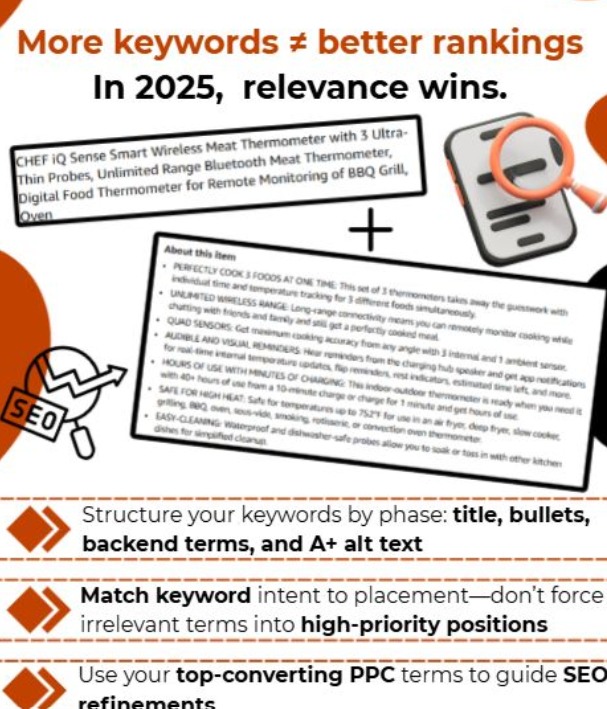
Ask most marketplace sellers how they approach SEO and you will hear a familiar answer: keyword research, title optimization, backend terms, bullet points. These are the right components. But the way most sellers are applying them is built on a playbook that the algorithm has moved past.
The marketplace's search and ranking engine has been fundamentally rebuilt over the past 18 months. Three changes have altered what actually moves rankings, and most sellers are not aware of all three.
First, the algorithm now weights behavioral signals, specifically conversion rate, click-through rate, return rate, and session engagement, more heavily than keyword placement. A listing with weaker keyword density but stronger conversion will outrank a listing with perfect keyword placement but poor buyer engagement. Keyword research gets you indexed. Conversion rate gets you ranked.
Second, COSMO (Common Sense Knowledge Generation), the platform's AI semantic layer, now understands intent and context rather than matching keywords literally. It reads your listing and product attributes to build a contextual understanding of what your product is and who it serves, then surfaces it for queries that express that intent. A shopper who searches "gift for dad who loves grilling" will be matched with BBQ tool sets even if those listings never contain the phrase "gift for dad." COSMO penalizes keyword stuffing because it drives poor CTR and signals inaccurate intent representation.
Third, Alexa for Shopping (formerly Rufus, rebranded May 2026) now functions as the default AI search layer for every signed-in US customer on the marketplace app and website. Over 300 million customers used the assistant in 2025, with monthly active users growing 149 percent year over year. On Black Friday 2025, 38 percent of all sessions involved the assistant. Shoppers who use it during their journey are 60 percent more likely to complete a purchase. These are not experimental engagement numbers. This is a mainstream discovery channel that narrows results to approximately five products per query.
The sellers who are gaining organic rank in 2026 are not finding clever algorithm workarounds. They are doing fundamentals well across all three layers: accurate, natural-language copy optimized for intent, complete attribute data that feeds COSMO, behavioral signals driven by high CVR, and external traffic that amplifies organic authority.
This guide covers everything from how the algorithm actually works, to keyword research that drives real intent traffic, to the technical and on-page factors that compound into lasting rank improvements.
Part 1: How the Marketplace Search Algorithm Actually Works in 2026
The Three-Layer System
Understanding what you are optimizing for is the prerequisite to optimizing effectively. The marketplace's product discovery system in 2026 operates across three layers that work simultaneously but independently.
Layer 1: The A9/A10 Keyword Algorithm
This is the core ranking engine that has powered marketplace search for over a decade, now significantly updated with AI and behavioral signal weighting. The seller community often refers to current iterations as A10, reflecting its evolution toward customer-centric performance metrics, though the platform has not formally released an algorithm update under that name.
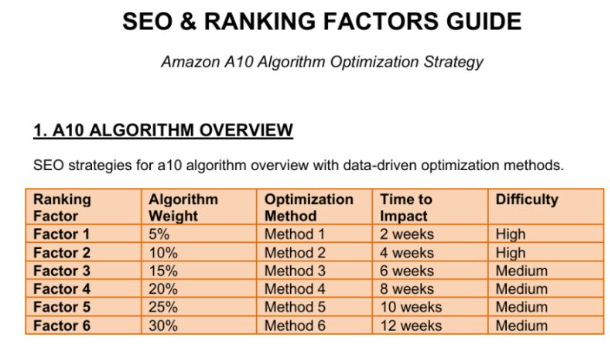
The algorithm operates on two primary questions: relevance (is this product a credible match for the search query?) and performance (when we show this product for this query, do shoppers behave as if it belongs there?). Relevance is established through keyword placement in high-authority fields. Performance is established through conversion rate, CTR, sales velocity, and post-purchase satisfaction signals.
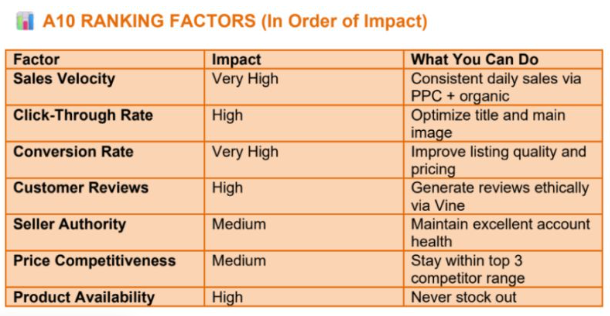
The core ranking factors in priority order:
Conversion Rate: Your session-to-order rate is the algorithm's clearest signal that your product satisfies buyer intent. Everything that improves CVR (images, price, reviews, title clarity, bullet points) indirectly improves your organic rank. A 1 percentage point improvement in CVR on a product with 2,000 monthly visitors is 20 additional sales per month, which compounds into organic rank improvement, which generates more traffic, which produces more conversions. This flywheel, once turning, is the foundation of sustainable marketplace SEO.
Sales Velocity: The number of units sold per day, weighted by keyword relevance. High velocity on a specific keyword signals strong demand for your product on that term. New products must build this signal through launch strategies; established products must protect it through consistent inventory availability and competitive pricing.
Click-Through Rate: How many shoppers click your listing from search results relative to how many see it. CTR signals that your title and main image are compelling and relevant for the query. Strong CTR improvement through better titles and images can move rankings within days because it is one of the fastest behavioral signals the algorithm can read.
Return Rate: The algorithm now treats persistent high return rates as a negative quality signal indicating that listings are inaccurately representing products. A product returning at 10 percent or more in a category where 5 percent is typical will see ranking suppression. The fix is always the same: improve listing accuracy, not return policy.
Seller Authority: A composite signal built from Order Defect Rate (target under 1 percent), on-time delivery (target 95 percent or above), response time, resolution rates, and Brand Registry status. FBA sellers have a structural advantage but are not immune to seller authority issues if inventory management creates stockout patterns or quality control lapses drive returns.
Inventory Availability: A product that is consistently out of stock loses the rank it earned. Stockouts during high-velocity periods like Q4 can require weeks or months of ranking recovery. Inventory management is an underappreciated SEO variable.
Layer 2: COSMO (Semantic AI)
COSMO is the semantic understanding layer deployed on top of the keyword algorithm. Unlike keyword matching, COSMO builds a knowledge graph that connects products to use cases, buyer intent signals, and contextual relationships. It understands that a shopper looking for "something for a new college student's dorm" needs products in categories like bedding, storage, desk accessories, and small appliances, even if those products' listings never contain the phrase "college dorm."
For sellers, COSMO changes the optimization equation in two critical ways. First, keyword density matters less than whether your listing accurately communicates what your product is and who it serves. An accurately described product reaches more relevant queries. A keyword-stuffed product gets penalized for the poor CTR and CVR that keyword stuffing produces.
Second, structured product attributes feed COSMO directly. The Discovery Attributes in your product template (Subject Matter, Intended Use, Target Audience, Material, Compatibility, and hundreds of category-specific fields) are the primary data source COSMO uses to categorize and contextualize your product. A product with complete, accurate attributes has a richer knowledge graph node than one with empty fields. Empty fields mean COSMO cannot confidently associate your product with queries that depend on that information.
Industry benchmarks show that the average listing completes only 20 to 25 percent of available attribute fields. Sellers who hit 90 percent completion hold a structural discovery advantage that keyword optimization alone cannot replicate.
Layer 3: Alexa for Shopping
Alexa for Shopping sits at the top of the discovery stack and reshapes how a growing minority (currently 15 to 20 percent of mobile queries, growing quarterly) finds products. Unlike keyword search which returns hundreds of results, Alexa for Shopping surfaces five. This winner-takes-all mechanic makes AI recommendation eligibility disproportionately valuable.
The AI reads your entire listing including title, bullets, description, A+ Content, images (through computer vision), reviews, and Q&A, then evaluates whether your product can confidently answer a specific buyer question. The emphasis on confidence matters: the assistant is conservative and excludes products where critical information is missing rather than recommending something it cannot support with evidence.
Sellers who interact with Rufus/Alexa for Shopping and ask it questions a real buyer would ask, then check which products it recommends and why, gain direct insight into what information their listing is missing for AI recommendation eligibility.
Part 2: Keyword Research in 2026
The Mental Model That Changes Everything
Before diving into tactics, the mental model matters: the best keyword for any product is not the one with the highest search volume. It is the one that most precisely describes the product, matches buyer intent, and is commercially important enough to drive meaningful sales. Chasing volume on terms where your product generates poor CVR creates a cycle where the algorithm shows you for irrelevant queries, buyers bounce, CVR drops, and ranking falls.
The right primary keyword for a premium stainless steel water bottle is not "water bottle" (extremely high volume, extremely competitive, attracts buyers looking for plastic bottles under ten dollars). It is "insulated stainless steel water bottle" or "metal water bottle for gym" because these terms describe what the product actually is and attract buyers with matching purchase intent.
The Five Keyword Categories You Need in 2026
Primary Keywords One to three terms that most precisely describe your product at the category level. These belong in your title within the first 80 characters, in bullet one, and in the first sentence of your description. They carry the most algorithmic weight because they appear in the highest-authority fields.
Selection criteria: the term accurately describes your product, the buyer intent behind it matches your product, and the search volume is commercially significant. If the highest-volume primary term does not meet all three criteria, use the next one down.
Secondary Keywords Modifier terms that describe variants, features, materials, sizes, or specific attributes (stainless steel, leakproof, BPA-free, 32 ounce, wide mouth). These expand ranking reach by capturing buyers who are searching with more specific requirements. Secondary keywords belong throughout bullet points and in remaining title characters.
Long-Tail Intent Keywords Phrases of four or more words that describe a specific buyer situation: "best water bottle for hiking all day," "insulated bottle that fits in car cup holder," "leakproof travel mug for commuting." These terms have lower individual search volume but dramatically higher purchase intent because buyers using them have already narrowed their consideration. They belong in backend search terms, the product description, and Q&A answers.
Conversational AI Keywords Natural language phrases that match how buyers speak to the AI assistant: "keeps drinks cold for hours," "safe for dishwasher," "good gift for hikers," "easy to clean water bottle." These are how Alexa for Shopping queries are phrased and how COSMO understands intent. They belong throughout all listing copy as naturally integrated phrases rather than as inserted keyword fragments.
Seasonal and Occasion Keywords Terms that spike at specific times of year or for specific gifting occasions: "holiday gift for her," "back to school water bottle," "Christmas gift for dad." These belong in backend terms for year-round indexing and can be integrated into visible copy during relevant periods without disrupting evergreen optimization.
The Keyword Research Process
Step 1: Mine your converting search terms. In Brand Analytics, access Search Query Performance to see which terms are already driving clicks and conversions for your ASINs. These are your highest-confidence targets: buyers are already converting on them through paid traffic. Every converting paid search term belongs in your organic optimization plan.
Step 2: Analyze your Sponsored Products search term reports. After running Sponsored Products campaigns for 30 or more days, download the Search Term Report. The terms with strong conversion data in paid are your best signals for organic keyword targets. If buyers convert through paid on a term, the organic signal from converting on that term will also move rank.
Step 3: Study your three to five closest competitors. What terms appear consistently in their titles and bullet points? What are they ranking for in Search Query Performance that you are not? Gaps between their keyword coverage and yours are your most immediate optimization opportunities.
Step 4: Mine reviews for buyer language. Your reviews and your competitors' reviews contain the exact vocabulary buyers use to describe the product, its problems, and its outcomes. This language maps directly to conversational AI query patterns and long-tail intent keywords. A review that says "the only bottle that stays cold for my twelve-hour shifts as a nurse" tells you the keyword "water bottle for nurses long shifts" is worth targeting and the specific use case to address in lifestyle copy.
Step 5: Map every keyword to a placement. Primary keywords to title (first 80 characters) and bullet one. Secondary keywords to remaining title characters and bullets two through five. Long-tail and conversational keywords to backend terms, product description, and Q&A. Occasion and seasonal keywords to backend terms and visible copy during relevant periods.
Part 3: On-Page SEO Optimization
Title: The Highest-Authority Ranking Field
Your title is the single most heavily weighted keyword field in the algorithm. It is also the first element both the algorithm and shoppers evaluate. In 2026, titles must be optimized for four audiences simultaneously: the keyword algorithm (indexing), COSMO (semantic context), Alexa for Shopping (natural language intent matching), and the mobile buyer (80-character visible window).
Title structure for 2026: Primary Keyword + Key Differentiator + Primary Benefit + Critical Attribute + Secondary Keyword
Character target: 150 to 180 characters total. The mobile-visible window is approximately 80 characters. Both the algorithm and mobile buyers evaluate the first 80 characters most heavily.
Before (keyword-stuffed, underperforms on all four audiences): "Stainless Steel Insulated Water Bottle BPA Free Leakproof Travel Mug Thermos 32oz 40oz Wide Mouth Lid Tumbler Drink"
After (structured for intent, mobile, and AI): "32oz Leakproof Insulated Water Bottle, Keeps Drinks Cold 24 Hours, BPA-Free Stainless Steel, Fits Car Cup Holders"
The rewritten title: leads with the most specific primary keyword (32oz leakproof insulated water bottle), includes a measurable benefit (cold 24 hours), communicates a trust signal (BPA-free), and adds a compatibility detail that addresses a common buyer hesitation (fits car cup holders). All critical information falls within the first 80 characters.
Title rules for 2026:
Do not use ALL CAPS except for brand name where appropriate. Do not include promotional language (best seller, on sale, top rated, #1). Do not repeat the same keyword more than once. Do not use special characters, pipes, or HTML tags. Do not front-load with an unknown brand name or model number. Write for natural reading flow because both COSMO and Alexa for Shopping reward natural language over keyword-stuffed copy.
Allow 7 to 14 days after a title update before evaluating rank impact. COSMO and the AI layer take time to re-index and re-evaluate the listing's contextual signals after changes.
Bullet Points: Ranking Through Conversion
Bullet points serve two simultaneous functions: keyword indexing and buyer persuasion. Most sellers sacrifice one for the other. The highest-performing bullets in 2026 do both by following the impact-outcome structure.
The mobile collapse rule determines priority: mobile layouts show the first two bullets by default, with the remaining three requiring a tap to expand. Your most critical conversion arguments must appear in bullets one and two.
The impact-outcome structure: IMPACT WORD IN CAPS: Feature that delivers this benefit, translated into the specific real-world outcome the buyer is actually purchasing.
Bullet 1: Primary differentiator. The single most important reason to choose your product over the nearest three competitors.
Bullet 2: Trust signal or risk removal. Warranty, guarantee, certification, return policy, or satisfaction commitment. The question every buyer is privately asking is "what if it doesn't work?" Answer it here.
Bullet 3: Use case specificity. Name the exact contexts, activities, or occasions where the product excels. Lifestyle relevance established in copy form.
Bullet 4: Technical specification or compatibility. The information a buyer needs to confirm the product fits their specific situation.
Bullet 5: Secondary benefit, bundle content, or brand credibility reinforcement.
Before (feature list, low conversion value): "Durable stainless steel material."
After (impact-outcome, high conversion value): "BUILT TO LAST A LIFETIME: 18/8 food-grade stainless steel resists rust, odors, and impact damage through years of daily drops, travel, and outdoor use without denting or degrading insulation performance."
The second version has the same information but converts at meaningfully higher rates because it describes the outcome the buyer is purchasing (a bottle that lasts years, survives real-world use, and maintains performance) not just the material it is made from.
Keep bullets to one to two lines on a phone screen. Length beyond that reduces readability and reduces the perceived editorial quality of the listing.
Product Description: The Underestimated Ranking Surface
Most sellers leave the product description as a keyword dump or skip it entirely because A+ Content replaces the visible description for desktop visitors. This is an expensive mistake. The description is still fully indexed by the keyword algorithm and read by Alexa for Shopping when evaluating recommendation eligibility. An empty or generic description is a missed ranking and AI discovery opportunity.
Write a description that opens with a three-line problem-validation-solution hook:
Line 1: Name the specific frustration your core buyer experiences. "Tired of water bottles that claim to be leakproof and then soak your bag on the first commute?"
Line 2: Validate the frustration. "Most bottles are built to the minimum spec because the manufacturer is optimizing for cost, not your actual use."
Line 3: Introduce your product as the specific solution with at least one verifiable claim. "This one is pressure-tested to 35 psi, hold-temperature-verified to 24 hours in third-party testing, and guaranteed for life because we back the engineering."
From that opening, expand into use cases, secondary benefits, and long-tail conversational keyword content written in natural language. Target 300 to 500 words. Use HTML formatting where permitted: short paragraphs, bolded lead lines, and brief bullet sub-lists for buyers who read deeply. These buyers convert at higher rates when given well-organized information.
Backend Search Terms: 250 Bytes of Pure Opportunity
Backend keywords are invisible to buyers but fully indexed, making them the optimal placement for terms that would not fit naturally in customer-facing copy.
The limit is 250 bytes, not characters. Multi-byte characters (accented letters, special characters) count as more than one byte each. Every byte matters.
Fill the entire 250 bytes with:
Long-tail keyword variations that did not fit the title or bullets naturally. Singular and plural versions of core terms, as the algorithm does not always treat these as equivalent. Common misspellings of your product name or category (buyers make spelling errors consistently on high-volume terms). Spanish language variations for US listings, consistently underutilized and valuable given the size of bilingual shopper segments. Synonyms and alternative product names used by different buyer demographics.
Never include:
Words already in your title or bullet points (the algorithm de-duplicates and you waste bytes). Punctuation or commas (they consume bytes with zero indexing value). Competitor brand names (terms of service violation that can result in listing suppression). Stop words (a, the, for, with) that carry no indexing value. Subjective terms (best, amazing, top rated) that buyers do not search for.
After updating backend keywords, verify indexing using a keyword index checker. Some terms take 24 to 72 hours to fully index. Many sellers update backend keywords without confirming the changes took effect, meaning they optimize blind.
Part 4: Technical SEO
Product Attributes and Category Placement
Technical SEO on the marketplace in 2026 centers on two elements that are consistently underweighted: attribute completeness and accurate category placement.
Attribute Completeness
Your product's backend attributes (Intended Use, Material Composition, Target Audience, Compatibility, Oven Safe Temperature, Connectivity Protocol, and hundreds of category-specific fields) are the primary data source for COSMO's contextual understanding of your product. The average seller completes 20 to 25 percent of available fields. Sellers at 90 percent completion hold a discovery advantage that keyword optimization cannot replicate.
Work through your full attribute list systematically. Prioritize fields that map to common buyer questions in your category: physical dimensions and weight, material and safety certifications, compatibility with specific devices or systems, use case and intended environment, skill level or experience requirements, and care and maintenance specifications.
Every empty field is a buyer question your listing cannot answer and an AI recommendation opportunity lost to a competitor who answered it.
Category Placement and Item Type Keyword
Your Item Type Keyword (ITK) classifies your product within the platform's browse tree. If this field is incorrect or too broad, COSMO looks for your product in the wrong neighborhood of the knowledge graph. An ITK of "shoes" when your product is "women's hiking boots" means you appear in the wrong contextual cluster and miss the specific queries that should find you.
Verify your ITK is as granular as possible for your specific product. Check your browse node against your category's most specific sub-category and update if you are placed at too high a level in the tree.
GTIN and Catalog Integrity
Ensure your GTIN (barcode) is correctly registered and matches your product exactly. Catalog integrity issues, including GTIN mismatches, variant structure violations, and parent-child relationship errors, can suppress listing visibility independent of optimization quality. Audit your catalog health metrics in Seller Central monthly.
Part 5: External Traffic as an SEO Signal
Why Google SEO and Marketplace SEO Are No Longer Separate Strategies
One of the most significant changes in marketplace SEO over the past two years is the growing weight placed on external traffic that converts. When a buyer discovers your product through Google, TikTok, Instagram, an influencer recommendation, or an email campaign and then purchases it on the marketplace, the algorithm reads that as market validation: evidence that genuine demand for your product exists independent of the platform's own search ecosystem. This signal improves your organic rankings because it indicates buyer intent that the algorithm did not create through its own recommendations.
The key requirement is that external traffic must convert. Low-quality external traffic that arrives and bounces tells the algorithm the opposite story and can actively harm rankings. The quality of the traffic source matters as much as the volume.
Brand Referral Bonus Program
Brand Registered sellers who drive external traffic through the Brand Referral Bonus program receive a credit of approximately 10 percent on external-traffic-driven sales, effectively subsidizing the cost of off-platform acquisition. This turns external traffic strategy into a double return: the ranking signal value plus the credit that reduces effective cost.
The External Traffic Stack for 2026
Google Shopping and Search: Products optimized for Google Shopping appear in Google search results and drive high-intent traffic to marketplace listings. Because shoppers arriving from Google are already in a purchase mindset, conversion rates from this traffic tend to be strong, which maximizes the ranking signal value.
Social Commerce: TikTok Shop and Instagram Shopping are driving a growing share of product discovery, particularly for buyers under 35. Content that demonstrates the product's primary benefit in a genuine, non-promotional context (user-generated content, creator reviews, before-after demonstrations) produces the highest-converting external traffic. Brand Registered sellers can build content frameworks that generate consistent creator content without requiring paid partnerships on every piece.
Influencer and Creator Networks: Product seeding programs that send products to relevant creators, who then create organic content, generate external traffic that converts at strong rates because the recommendation comes with social proof attached. This traffic is often higher-converting than paid social.
Email Marketing: Sellers who build an off-platform customer email list and use it to drive repeat purchase traffic to marketplace listings generate both the external traffic ranking signal and a structurally lower cost of customer acquisition over time.
Part 6: PPC and SEO: The Strategic Relationship
How Advertising Builds Organic Authority
PPC advertising and organic SEO are separate ranking systems with no direct link. But the indirect relationship is one of the most powerful levers in marketplace strategy when understood correctly.
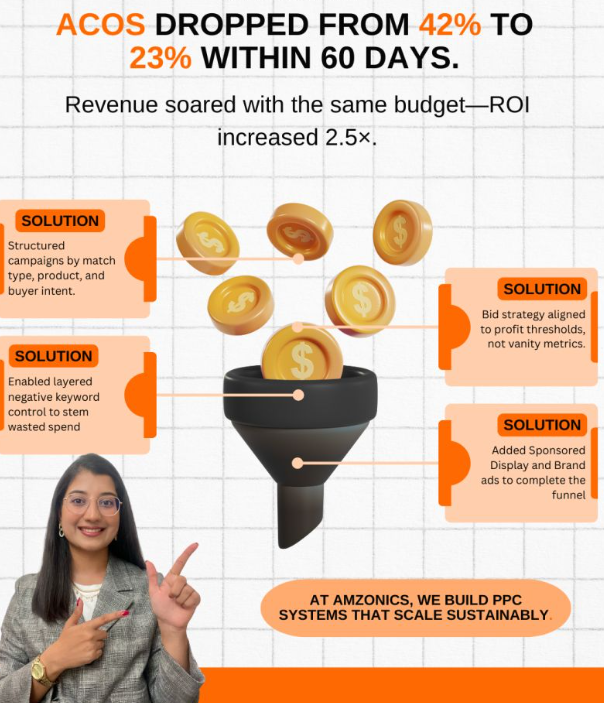
PPC ads drive clicks and purchases on specific keywords. Those purchases generate conversion rate and sales velocity signals on those keywords. The algorithm interprets those behavioral signals as evidence of relevance and organic rank potential. Over time, strong ad-driven CVR on a target keyword translates into organic rank improvement on that keyword, which generates organic traffic at zero marginal cost, which reduces your dependence on paid traffic, which lowers TACoS.
This is the PPC-to-organic flywheel. It is how sophisticated sellers use advertising as a ranking investment rather than a permanent cost.
The practical application:
Launch phase (weeks 1 to 8): Use PPC to drive aggressive traffic on your three to five highest-priority keywords at any cost-effective CPC. The goal is not short-term ROAS. It is building the CVR and sales velocity signal on those specific keywords that will translate into organic rank.
Growth phase (weeks 9 to 16): As organic rank improves on target keywords, begin reducing PPC bids on terms where organic rank is now strong. Reallocate that budget toward discovery keywords where organic rank is still building.
Optimization phase (week 17 onward): Monitor TACoS weekly. A declining TACoS with stable or growing revenue confirms the PPC-to-organic flywheel is working. If TACoS is flat or rising, diagnose whether organic rank is stagnating (possibly a listing quality issue) or whether ad spend is compensating for lost organic volume (possibly a competitor improvement or stockout history).
The Alexa for Shopping Advertising Dimension
Sponsored Product and Sponsored Brand placements now appear within Alexa for Shopping conversations, adding a paid discovery dimension to the AI recommendation layer. As of March 25, 2026, Sponsored Prompts exited beta and became a live, billable CPC placement. Ads shown through the AI assistant are evaluated not just for keyword match but for how well the product content aligns with the shopper's conversational query. Listings optimized for natural language and buyer intent perform better in this placement than keyword-stuffed listings, creating an additional reason why AI-optimized copy improves ad efficiency as well as organic rank.
Part 7: Review SEO
Why Review Quality Beats Review Volume in 2026
The algorithm's evaluation of reviews has evolved from counting stars and volume to assessing quality, specificity, and helpfulness. A product with 200 detailed, substantive reviews where 80 percent carry helpful votes will outperform a product with 500 generic three-word reviews in the same category. The algorithm now weights reviewer credibility and the helpful vote rate on each review alongside the raw count and star rating.
More importantly, Alexa for Shopping reads reviews as product information. It extracts specific claims, use case confirmations, compatibility notes, and performance details from review text to determine whether your product can confidently answer a shopper's question. A product whose reviews say "I use this every day for my hour-long commute, it keeps my coffee hot the entire time and has never leaked" has significantly more AI recommendation surface area for commute and insulation queries than a product with reviews that say "great bottle, love it!"
Review Strategy for 2026
Vine Program: Enroll new products in Vine to seed 30 detailed reviews from verified buyers. Vine reviews are consistently longer and more specific than organic early reviews because Vine participants are required to provide substantive feedback. This gives the AI more citation material at launch and builds CVR faster during the critical ranking window.
Post-Purchase Messaging: Use platform-approved buyer-seller messaging to request reviews. Frame the request around encouraging specific, helpful feedback rather than just a star rating. Specific reviews compound in value over time.
Review Response Strategy: Responding to detailed positive reviews with additional information ("You mentioned using it for camping trips. It also works well for gym bags because the lid locks completely") adds content the AI can read as product intelligence. Responding to negative reviews with specific corrective information directly reduces the negative knowledge graph signal associated with that objection.
Q&A Section Seeding: Target 15 to 20 substantive Q&A entries on any product doing significant monthly revenue. The AI assistant pulls from Q&A when answering shopper questions not addressed in listing copy. Specific, complete answers are citation material. Vague answers are ignored.
Review Benchmarks: Products with 4.5 stars or above and 50 or more reviews have a measurable advantage in both keyword and AI-mediated ranking. Below 4.0 stars, algorithmic visibility suppression begins in most categories. Below 3.8 stars, AI recommendation eligibility is effectively lost regardless of other optimization quality.
Part 8: Visual SEO and Engagement Signals
How Images Affect Organic Rank
In 2026, the algorithm treats visual engagement as a ranking signal. Time spent viewing images, zoom usage rates, video play rates, and image-driven scroll engagement all feed into how the system evaluates listing quality. A product with strong visual assets that keep shoppers engaged will outrank a competitor with better keyword coverage but weak creative, when both have similar conversion rates. The engagement comes first and the conversion follows.
This makes image quality simultaneously a conversion variable and an SEO variable.
Visual SEO principles:
Main image CTR: The most direct visual SEO signal. A stronger main image generates more clicks from search results, which improves CTR as a ranking signal independent of any other listing element. Test main images through Manage Your Experiments or by monitoring CTR changes after image updates.
Mobile readability: Images with unreadable text at mobile scale generate low engagement signals because buyers see them and scroll past. Every image must pass the mobile readability test: view it at the actual size it appears on a phone screen in search results and on the listing detail page.
Image sequence depth: Seven or more images (main, feature infographic, scale reference, lifestyle one, lifestyle two, technical/compatibility, trust and guarantee) provide more buyer engagement opportunities than three images. Buyers who engage with more images convert at higher rates and generate stronger session signal data.
Video play rate: A product video that buyers play sends a strong positive engagement signal. A video that appears but is never played contributes almost nothing. Thumbnail frame selection, video opening hook, and video length (optimal is 30 to 60 seconds for marketplace listings) all influence play rate and therefore the SEO signal value of the video.
Part 9: Measuring and Tracking Marketplace SEO
The Five Metrics That Tell You Whether Your SEO Is Working
Marketplace SEO produces compounding effects that are not always visible in the first week after changes. Tracking the right metrics on the right cadence prevents premature conclusions and identifies genuine problems before they compound.
Conversion Rate (Unit Session Percentage)
Available in Business Reports under Detail Page Sales and Traffic. This is your most important SEO metric. Target 10 to 20 percent in competitive categories, with well-optimized listings reaching 15 to 25 percent. A CVR below 8 percent on an established product is a signal for immediate listing intervention. Track weekly and compare to the same week in the prior month rather than adjacent weeks to control for day-of-week variance.
Organic Rank on Primary Keywords
Track weekly using rank tracking tools or by monitoring your Search Query Performance data for impressions on your target terms. Define an investigation threshold: a drop of more than three positions on a primary keyword over two consecutive weeks without an obvious cause (competitor price reduction, new entrant, your own stockout) warrants immediate diagnosis. A consistent upward rank trajectory, even one position per week, confirms your optimization is working.
Click-Through Rate
Visible in Search Query Performance as click share relative to impression share. A rising CTR on a target keyword confirms your title and main image are increasingly compelling to buyers using that term. A falling CTR despite stable impressions indicates a competitor has improved their creative or pricing and you are losing relative appeal.
TACoS (Total Advertising Cost of Sales)
Calculate as total ad spend divided by total revenue (paid plus organic), multiplied by 100. A declining TACoS with stable or growing revenue is the clearest confirmation that your SEO is working: organic rank is improving and paid traffic is becoming a smaller proportion of total sales. A rising TACoS signals that organic rank is decaying and paid advertising is compensating. This is the most important strategic health indicator in the entire metrics stack.
Buy Box Percentage
Available in Business Reports. Buy Box percentage directly impacts both organic conversion rate (since the vast majority of sales go through the Buy Box) and ad serving (Sponsored Product ads stop running for products that lose the Buy Box). Monitor weekly and investigate immediately if percentage drops below 80 on a mature product.
Tracking Tools and Data Sources
Search Query Performance (Brand Analytics): Your primary source for keyword-level impression share, CTR, and conversion data. Available to Brand Registered sellers. Essential for identifying which keywords are driving visibility and where you are losing share to competitors.
Business Reports (Unit Session Percentage): The most reliable conversion rate data available in Seller Central. Track by ASIN and by parent listing.
Advertising Reports (Search Term Report): After 30 or more days of Sponsored Products campaigns, identifies which search terms buyers are using to find and purchase your products. The highest-converting paid terms are your best organic optimization targets.
Brand Referral Bonus Reporting: Tracks external traffic conversion data and the credit earned from off-platform traffic sources.
Third-Party Rank Tracking Tools: Provide daily organic rank monitoring across target keywords and competitor rank comparison data that Seller Central does not provide directly.
Part 10: Common SEO Mistakes That Are Costing You Rank in 2026
The Errors That Are Most Expensive and Most Common
Understanding what to avoid is as important as understanding what to do. These are the mistakes that account for the largest proportion of ranking underperformance in optimized seller accounts.
Keyword stuffing in titles and bullets The algorithm now penalizes titles and bullets that prioritize keyword density over readability. Keyword-stuffed copy drives poor CTR (buyers scan the title and do not click because it reads unnaturally), which is a direct negative ranking signal. COSMO also penalizes copy that reads as keyword-assembled rather than intent-aligned. Write for humans. The keywords will be present because you researched them correctly and placed them in the right fields.
Chasing the highest-volume keyword regardless of product fit A product that converts poorly on a high-volume term loses rank on that term faster than it gains it. The algorithm quickly learns that your product does not satisfy buyers using that query and demotes you from it. Build rank on terms where your product converts well, then expand to higher-volume adjacent terms as organic authority compounds.
Treating attribute fields as optional Most sellers complete 20 to 25 percent of available attribute fields. Every empty field is a severed connection in the knowledge graph that COSMO and Alexa for Shopping use to find and recommend your product. This is likely the single highest-leverage change available to most catalog optimizations and the most consistently skipped.
Sending external traffic that does not convert External traffic that bounces tells the algorithm your product did not satisfy those buyers. This negative signal can outweigh the positive ranking impact of the traffic. Ensure that external traffic is highly targeted and that the landing experience (listing quality, price competitiveness, review count) is prepared to convert before driving volume.
Making multiple listing changes simultaneously When you change the title, main image, bullet points, and backend keywords in the same week, you cannot know which change drove any performance movement. Isolate one variable at a time with a minimum of two to four weeks between changes to collect meaningful signal data.
Ignoring return rate as a ranking variable A persistently high return rate is treated as listing inaccuracy and suppresses ranking. Before running any rank-building strategy on a product with a high return rate, diagnose and fix the listing accuracy issue first. Running more traffic to a product with a high return rate compounds the negative signal.
Not monitoring rank after changes Sellers who make optimization changes and never check whether organic rank improved are optimizing blind. Set a weekly rank monitoring habit for your five to ten highest-revenue keywords per product. A 14-day window without rank improvement after a significant listing change indicates the change did not produce the expected signal, and investigation is needed.
Part 11: The 90-Day Marketplace SEO Roadmap
A structured implementation sequence delivers faster and more measurable results than random optimization across multiple elements simultaneously.
Days 1 to 14: Research and Audit
Complete keyword research for your top 10 ASINs by revenue. Map every identified term to a specific placement (title, bullet, description, backend). Identify keyword gaps between your current copy and competitors.
Audit attribute completeness for each product. Pull the full available attribute list from Seller Central. Identify every empty field across all priority ASINs.
Review your Search Query Performance data. Identify your top 20 impression-driving keywords and your top 10 converting keywords. Note gaps between the two lists: high-impression, low-conversion terms indicate your listing is being found but not convincing buyers. High-conversion, low-impression terms indicate under-investment in those keywords.
Check your category placement and Item Type Keyword for accuracy. Ensure all GTINs are correctly assigned.
Days 15 to 30: Title and Bullet Optimization
Rewrite titles for your top five ASINs using the structured format. Test each on a mobile device before publishing to confirm the 80-character visible window communicates the primary keyword and key benefit.
Rewrite all five bullet points using the impact-outcome structure. Move your trust signal to bullet two. Ensure bullets one and two alone make a compelling case for buyers who do not expand the list on mobile.
Update backend search terms. Fill all 250 bytes using the keyword map from your research. Verify indexing after 72 hours.
Complete backend attribute fields. Prioritize fields that map to common buyer questions in your category. Target 90 percent completion across all available fields on priority ASINs.
Days 31 to 45: Content and Creative
Rewrite product descriptions with the problem-validation-solution hook. Add long-tail keywords and conversational AI phrases throughout the body.
Seed the Q&A section. Add 15 to 20 complete, specific answers per ASIN sourced from reviews, customer service messages, and competitor Q&A sections.
Evaluate your image gallery against the 7-image sequence. Commission updated photography for any ASIN where the current main image does not perform the mobile-readability test. Update infographics with text that reads clearly at mobile scale.
Enroll priority ASINs in Vine if review count is under 30. Begin post-purchase messaging program for new orders.
Days 46 to 60: A+ Content
Build or rebuild A+ Content for top-revenue ASINs. Apply mobile-first design: short headlines, strong visuals, specific factual claims, icon-based feature callouts, and complete image alt text.
Launch your first A/B test using Manage Your Experiments. Start with the main image or title. Run for a minimum of four weeks or until 95 percent statistical confidence.
Establish your external traffic strategy. Set up Brand Referral Bonus program. Identify the most relevant Google Shopping, creator, or social commerce channels for your category.
Days 61 to 90: Monitoring and Iteration
Review Search Query Performance data for new high-volume terms. Update title and backend keywords where warranted.
Analyze organic rank movement on your 10 primary target keywords. Any keyword without rank improvement deserves diagnosis: CVR issue, keyword indexing gap, or competitor listing improvement.
Review TACoS trend for the 90-day period. A declining trend confirms the SEO investment is building organic authority. A flat or rising trend indicates a need for more aggressive CVR improvement or a diagnosis of ranking stagnation causes.
Complete your second A/B test with a different variable.
Establish your ongoing monthly cadence: full listing audit on the first of each month, rank check every Monday, TACoS review every Friday.
Conclusion: Marketplace SEO Is a System, Not a Checklist
The sellers gaining organic rank in 2026 are not finding algorithm shortcuts. They are building systems: keyword research that produces intent-aligned copy, listing optimization that drives strong behavioral signals, attribute completeness that feeds AI discovery, external traffic that amplifies organic authority, review quality that provides AI citation material, and visual assets that generate engagement signals.
Each component compounds the others. A listing with strong copy and weak images underperforms relative to its keyword investment. A listing with excellent images and poor attribute completeness misses AI recommendation opportunities. A listing with great content and thin reviews underconverts in comparison shopping. The system only produces compounding results when all components function together.
The good news is that most competitors are still running isolated tactics: keyword optimization without attribute completeness, strong copy without mobile-optimized images, good listings without external traffic. Sellers who build the complete system have a compounding advantage that grows wider every quarter as the algorithm continues shifting toward behavioral signals and AI-mediated discovery.
Marketplace SEO in 2026 is not about finding clever tricks before competitors do. It is about doing the fundamentals more completely, more accurately, and more consistently than anyone else in your category.
That discipline is the compounding advantage that no bid increase or promotional strategy can replicate.
Is your marketplace SEO built for 2026 or still running on a 2022 playbook?
At Brevlin, we audit seller catalogs against all three discovery layers: keyword algorithm, COSMO semantic AI, and Alexa for Shopping. We identify exactly where your ranking is leaking and fix it in the sequence that delivers the fastest measurable results.
From keyword architecture and attribute completeness audits to listing rewriting, A+ Content strategy, and external traffic program setup, we build the complete SEO system that compounds organic rank over time.
A comprehensive 2026 marketplace SEO guide covering the three-layer discovery architecture (A9/A10 keyword algorithm, COSMO semantic AI, and Alexa for Shopping), keyword research strategy, on-page optimization, technical SEO, behavioral ranking signals, external traffic strategy, PPC and SEO interplay, review quality, visual engagement signals, common SEO mistakes, performance tracking, and a 90-day implementation roadmap with real benchmark data.
Sellers keep stuffing keywords while the algorithm reads behavior and semantics. Feed it complete data and real conversion signals, and rankings follow. — Maimoona Iqbal (Marketplace Growth Specialist)
Article complete. You just invested 35 minutes in learning something valuable.
Frequently Asked Questions
Marketplace SEO is fundamentally transactional rather than informational. The algorithm's primary goal is to identify which product will most likely result in a completed purchase for any given search query. There are no backlinks, no domain authority, and no content depth signals. Instead, the algorithm weights conversion rate, sales velocity, keyword relevance in specific fields, review quality, fulfillment reliability, and behavioral signals like CTR and time on page. Google SEO experience can be misleading when applied to marketplace without adjustment because the optimization priorities are structurally different.
Not directly. PPC and organic are separate ranking systems. However, they are strongly linked indirectly: PPC ads drive clicks and purchases, which build conversion rate and sales velocity signals on target keywords. The algorithm interprets those behavioral signals as evidence of relevance and rewards the listing with improved organic placement. Sellers who use PPC to build early sales velocity on their primary keywords, then reduce ad dependence as organic rank improves, are applying the most efficient launch and growth strategy available.
Significantly more important than it was two years ago. External traffic from Google, TikTok, Instagram, influencers, and email that converts on the marketplace is treated as market validation: evidence of genuine demand that exists outside the platform's own ecosystem. The algorithm rewards this signal with improved organic rankings. Brand Registered sellers benefit from the Brand Referral Bonus program, which provides a credit of roughly 10 percent on external-traffic-driven sales. The key requirement is that traffic must convert. Low-quality external traffic that bounces tells the algorithm the opposite story and can harm rankings.
COSMO is the semantic AI layer that understands intent and context rather than matching keywords literally. It reads your listing to understand what your product actually is, who it is for, and what problems it solves, then matches it against queries that express that intent even when exact keywords do not appear. For copy, this means writing in natural language that accurately describes your product and its use cases rather than inserting keywords as many times as possible. COSMO penalizes keyword stuffing and rewards listings that communicate clear, accurate intent. Complete product attribute fields feed directly into how COSMO builds its contextual understanding of your product.
Track five core metrics weekly: organic rank on your primary target keywords, conversion rate (Unit Session Percentage in Business Reports), click-through rate visible through Search Query Performance data, TACoS (Total Advertising Cost of Sales, which should decline as organic rank improves), and Buy Box percentage. For AI-mediated discovery, Brand Analytics is beginning to show Alexa for Shopping attribution data. Monitor Search Query Performance for changes in impression share on conversational long-tail queries, as these often indicate AI-driven traffic shifts. Run full audits monthly and investigate immediately if rank drops more than three positions on a primary keyword over two consecutive weeks.


