
Rufus AI is now Alexa for Shopping, embedded in the default search bar for every signed-in marketplace customer since May 2026. Users convert at 60 percent higher rates. It appeared in 38 percent of sessions before going default. And it will not recommend your product if critical attribute fields are empty, bullets describe features instead of answering questions, or your Q&A section is blank. Here is the complete optimization guide for sellers who want to show up in AI-powered product discovery in 2026.
- Rufus AI was rebranded as Alexa for Shopping on May 13, 2026 and is now embedded in the default search bar for every signed-in marketplace customer, making optimization for it mandatory rather than optional for any seller managing their discovery visibility
- Alexa for Shopping converts users at 60 percent higher rates than traditional search and appeared in 38 percent of shopping sessions before going default, representing the fastest-growing and highest-converting discovery channel available
- The AI evaluates listing content as a knowledge document, not a keyword collection, attribute completeness (most sellers fill fewer than 25 percent of available fields), question-answering bullet structure, Q&A section coverage, and review specificity all determine recommendation eligibility
- Empty backend attribute fields are the most common reason products are excluded from AI recommendations, filling every relevant attribute to 90 percent completion is the single highest-impact optimization action and the one most consistently skipped
- Results from Rufus optimization appear within 4 to 8 weeks and compound over time, sellers who complete attributes, rewrite bullets as question answers, seed Q&A sections, and build specific review content are building an AI recommendation advantage that grows month over month
Rufus AI (Alexa for Shopping): Seller Optimization Guide
Rufus AI, now officially rebranded as Alexa for Shopping as of May 13, 2026, is the marketplace's generative AI shopping assistant. It answers buyer questions in natural language, compares products, and delivers personalized recommendations directly inside the search bar.
What changed on May 13, 2026: The standalone Rufus chatbot was retired. Alexa for Shopping replaced it, embedded directly into the main search bar. No opt-in. No separate chat drawer. Every signed-in customer in the US, UK, India, and Germany now interacts with it automatically.
Sellers who optimized for Rufus when it was still a beta feature saw conversion rates 60 percent higher than non-optimized listings among AI-assisted shoppers. Rufus appeared in 38 percent of shopping sessions before the May 2026 rebrand. Now that it is the default interface, the stakes are significantly higher.
This guide explains what Rufus and Alexa for Shopping are, how the AI evaluates listings, and the specific steps sellers need to take right now.
What Is Rufus AI (Alexa for Shopping)?
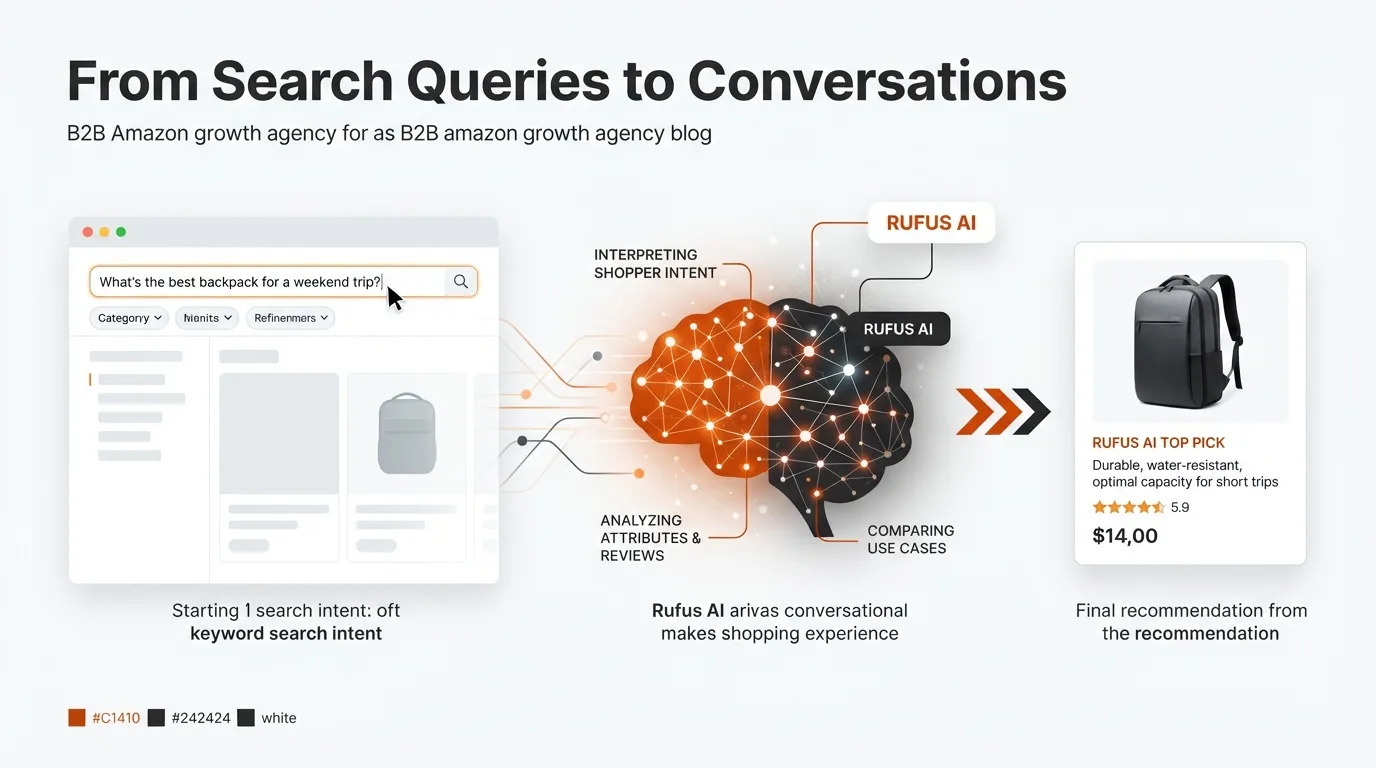
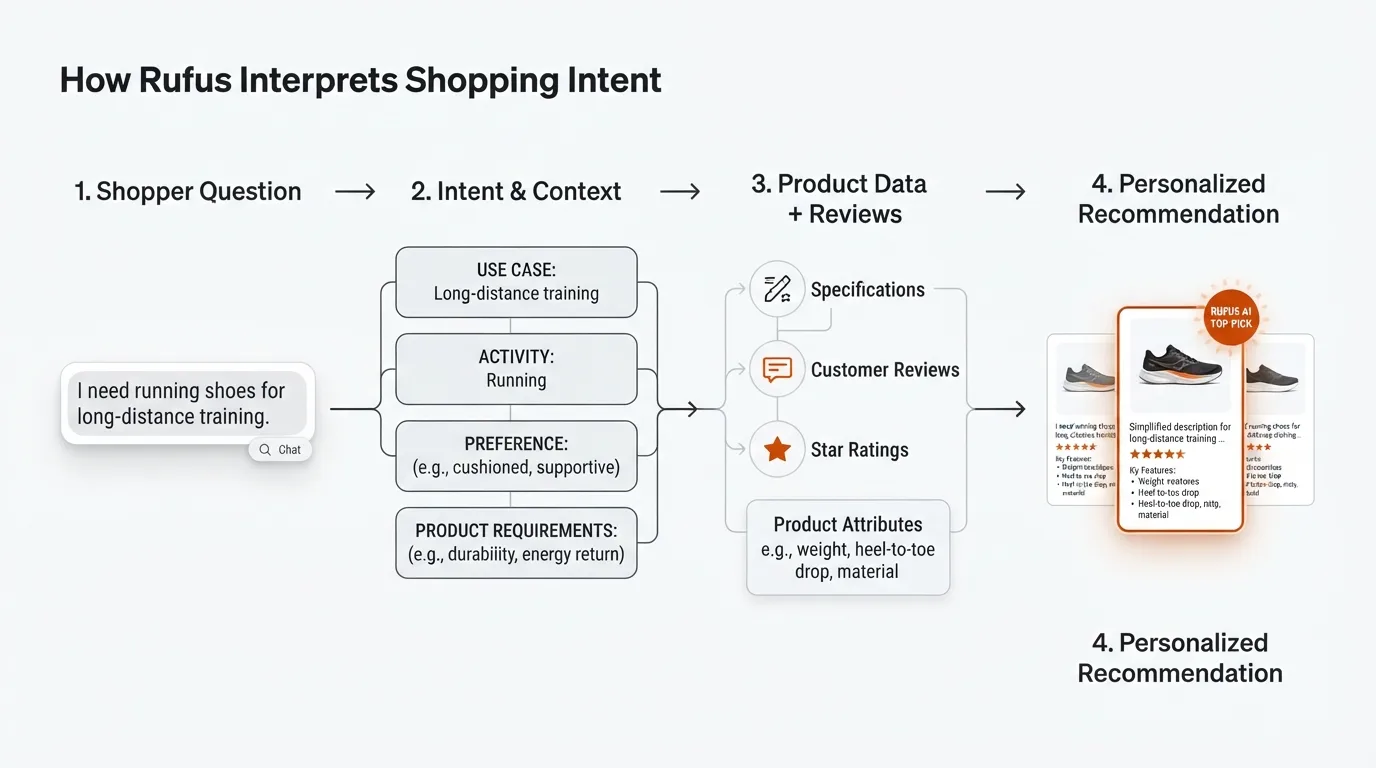
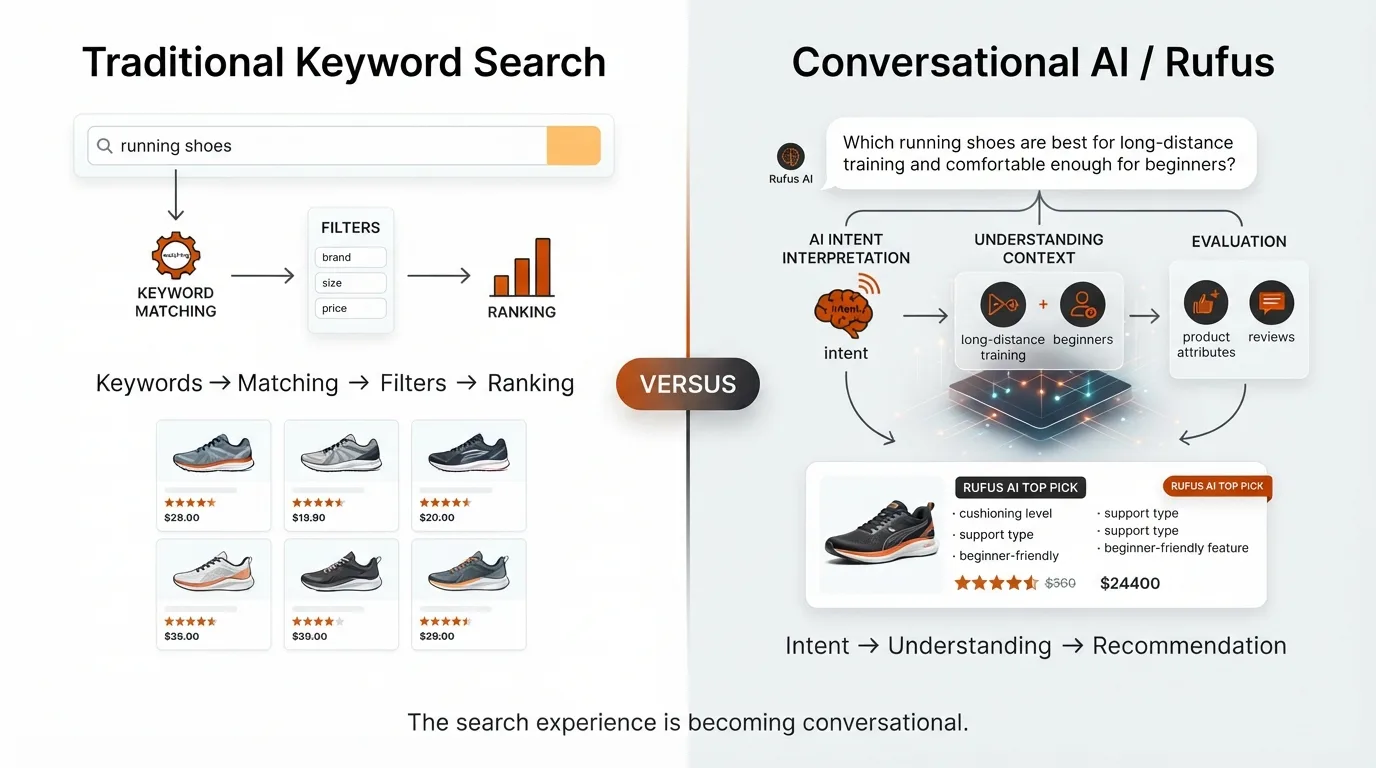
Rufus is a generative AI shopping assistant that interprets conversational buyer intent and recommends products. Rather than matching typed keywords to listing fields, it reads the full meaning behind a shopper's query and surfaces the products most likely to satisfy that intent.
A shopper asking "what is the best insulated water bottle for hiking?" does not get traditional search results first. They get an AI-generated answer citing two to five specific products, with reasoning for each recommendation.
The underlying technology is the COSMO knowledge graph, which maps products to contextual signals: who uses the product, what problems it solves, when it is relevant, and why a buyer might choose it. COSMO does not count keyword frequency. It evaluates whether your listing answers buyer questions completely and accurately.
Key facts sellers need to know:
| Feature | Rufus (legacy) | Alexa for Shopping (2026) |
|---|---|---|
| Access | Separate chat drawer | Embedded in main search bar |
| Availability | Opt-in | Default for all signed-in users |
| User reach | 300M customers in 2025 | Every active shopper |
| Personalization | Session-based | Alexa+ cross-device profile |
| Recommendation depth | 5 to 10 products per query | 5 products (tightened) |
How Alexa for Shopping Evaluates Your Listing
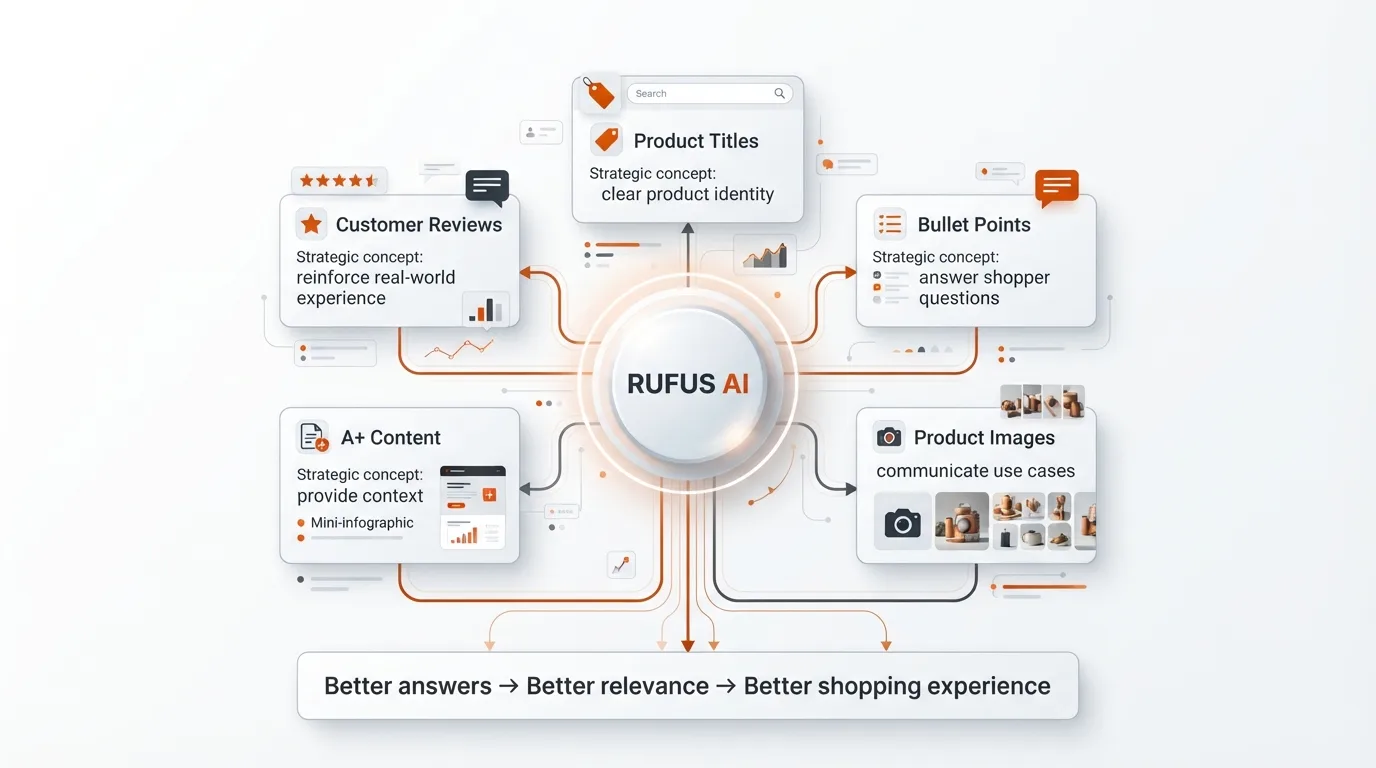
The AI reads your entire listing as a knowledge document, not a keyword collection. It scans title, bullets, description, A+ Content, backend attributes, images (via computer vision), reviews, and Q&A simultaneously to determine whether your product confidently answers a buyer's specific question.
The evaluation has three components:
1. Relevance Confidence
Can the AI answer the shopper's question using only your listing content? If critical information is missing, the AI excludes your product rather than guessing. Empty backend attributes are the most common reason listings are excluded from AI recommendations.
A shopper asking "Is this pan oven-safe to 500 degrees?" receives a recommendation that answers that question. Your product only appears if your listing provides the answer.
2. Trustworthiness Signals
The AI weights reviews and Q&A as evidence, not opinion. A listing with reviews describing specific use cases ("perfect for camping, held cold for 14 hours") is more citable than one with generic feedback ("great product").
Products with below 4.0 stars are effectively excluded from most AI recommendation scenarios, regardless of listing quality.
3. Structural Readability
The AI prefers content that reads as answers to questions, not as feature descriptions. A bullet point that says "BPA-free stainless steel construction" answers nothing. A bullet that says "Made from food-grade BPA-free steel so your drinks stay taste-free, even after hundreds of washes" answers "Is this safe for daily use?"
Alexa for Shopping vs. A9/A10: What You Still Need to Do
Alexa for Shopping and the A9/A10 keyword algorithm run in parallel. Neither replaces the other.
This is the most important dual-optimization fact for 2026. A listing that ranks on page one for traditional search but fails to answer conversational queries misses a growing share of discovery. A listing optimized only for AI but missing core keywords fails in traditional search.
What each system needs from your listing:
| Optimization Layer | A9/A10 Algorithm | Alexa for Shopping |
|---|---|---|
| Keywords | Title, bullets, backend terms | Natural language copy |
| Primary signal | Keyword match + CVR + velocity | Question-answering confidence |
| Attributes | Helpful for indexing | Critical for recommendation eligibility |
| Reviews | Trust signal and ranking factor | Direct citation source |
| Q&A section | Lightly weighted | Primary AI citation database |
| A+ Content | Conversion support | Evaluated as product intelligence |
The practical implication: your optimization checklist now has two layers. Traditional keyword research and placement still come first. Conversational question-answering optimization is added on top.
Step-by-Step: How to Optimize Your Listing for Rufus/Alexa for Shopping
Step 1: Complete Your Backend Product Attributes
Completion rate target: 90 percent or above for all available category fields.
This is the single highest-impact action sellers can take. COSMO reads attribute fields as structured product intelligence. Every empty field is a question your listing cannot answer.
Priority attribute fields to fill first:
- Material composition and certifications
- Intended use and target audience
- Compatibility (device, vehicle, system)
- Oven-safe temperature, waterproof rating, weight capacity
- Age range, skill level, indoor/outdoor use
Most sellers complete fewer than 25 percent of available fields. Sellers at 90 percent completion have a structural AI recommendation advantage their competitors cannot overcome with copy alone.
Step 2: Rewrite Bullets as Question Answers
Replace every specification-only bullet with a benefit-outcome statement that answers a buyer question.
The framework:
| Before (specification) | After (question-answering) |
|---|---|
| "32oz stainless steel" | "Holds enough for a full morning hike, one fill keeps drinks cold for 24 hours" |
| "Leakproof lid included" | "Throw it in your bag without worry, the lid is tested to 35 psi so it never opens mid-commute" |
| "BPA-free materials" | "Food-grade BPA-free steel means zero plastic taste, even with hot drinks or acidic beverages" |
Practical rule: read each bullet and ask "does this directly answer a question a buyer might ask?" If it only describes the product, rewrite it to answer a question.
Step 3: Seed the Q&A Section with 15 to 20 Specific Answers
Alexa for Shopping cites Q&A content directly when answering shopper questions not addressed in listing copy. An empty Q&A section is an empty citation database.
Build your Q&A from:
- Your customer service inbox (recurring pre-purchase questions)
- Top competitors' Q&A sections (questions buyers are asking in your category)
- One-star and two-star review concerns (questions buyers had that were not answered)
Write complete, specific answers. "Yes, the lid and body are both top-rack dishwasher safe. Remove the silicone seal before each wash to extend its lifespan." This is citable. "It depends on how you use it" is not.
Step 4: Update Your Product Description for Conversational AI
The description field is indexed by Alexa for Shopping even when A+ Content replaces the visible description on the page.
Open with the problem-validation-solution hook:
- Name the buyer's frustration: "Tired of water bottles that claim leakproof and fail in your bag?"
- Validate it: "Most lids are built to the minimum spec, not tested under real conditions."
- Introduce your product as the specific answer: "This bottle is pressure-tested to 35 psi and backed by a lifetime guarantee."
Write the description as you would explain the product to a knowledgeable friend, not as a keyword-insertion exercise. Rufus rewards natural language over keyword templates because it is built on a language model that evaluates conversational fit.
Step 5: Improve A+ Content for AI Readability
A+ Content is read by Alexa for Shopping as product intelligence, not marketing material.
Specific, factual claims have citation value. Aspirational copy does not.
| Low AI value | High AI value |
|---|---|
| "Industry-leading quality" | "Third-party tested to 10,000 wash cycles with no insulation degradation" |
| "Perfect for the whole family" | "Safe for ages 3 and up, BPA-free, and dishwasher-safe on all parts" |
| "Trusted by millions" | "4.7 stars from 8,400 verified buyers, with repeat purchase rate above 35 percent" |
Add descriptive alt text to every image in A+ Content. The AI reads alt text as product metadata and uses it to understand what each image shows.
What Rufus Looks at When It Reads Your Reviews
Reviews are not social proof to the AI. They are product documentation.
Alexa for Shopping extracts specific facts from review content and uses them to answer shopper questions. A review that says "I used this for a 3-day backpacking trip in 30-degree weather and my coffee was still warm in the morning" becomes a citation for the question "does this work for camping in cold weather?"
Strategies to generate AI-citable reviews:
- Use Vine to seed detailed, specific reviews from the first thirty customers
- Post-purchase messaging that encourages describing their specific use case ("Where did you use this? What problem did it solve for you?")
- Respond to positive reviews with additional product context ("Great to hear it worked for your camping trip. It also holds ice for 36 hours in summer heat")
One critical note: do not incentivize reviews or request specific ratings. Platform policy prohibits this. The goal is encouraging honest specificity, not manufactured praise.
Common Mistakes That Kill Rufus Recommendation Eligibility
Most sellers who are not appearing in Alexa for Shopping results are making one or more of these errors:
1. Keyword-only bullets with no outcomes The AI reads these as incomplete. Keywords tell the AI what the product is. Outcomes tell it what the product does for the buyer.
2. Empty Q&A sections The most fixable gap. Fifteen substantive Q&As take two to three hours to write and provide immediate AI citation coverage.
3. Generic A+ Content "Premium quality" and "designed for your lifestyle" are meaningless to a language model. Replace with specific measurable claims.
4. Missing or incomplete backend attributes Check your listing's available attribute fields in Seller Central. Fill every relevant one before any other optimization work.
5. Below-threshold reviews Products below 4.0 stars with fewer than fifteen reviews rarely appear in AI recommendations. Prioritize review acquisition before scaling advertising to AI-eligible products.
How Long Does Rufus Optimization Take to Show Results?
Most sellers see noticeable changes in traffic patterns and conversion rates within 4 to 8 weeks of implementing conversational listing improvements. Results compound as the AI learns from the updated content and as review content grows more specific over time.
The Alexa+ personalization layer introduced with the May 2026 rebrand means two shoppers asking the same question can now receive different recommendations based on their individual purchase history and preferences. This makes flexible-context copywriting more important than ever: bullets and A+ Content that surface well across multiple buyer contexts (gift buyers, power users, first-time buyers) outperform content written for a single buyer type.
Rufus Optimization: Priority Action List
Run through this checklist in order before any other listing work:
- Audit attribute completeness. Pull your full attribute list in Seller Central. Fill every relevant field. Target 90 percent completion.
- Rewrite bullets as question answers. Replace every specification-only statement with a benefit-outcome that answers a specific buyer question.
- Seed the Q&A section. Write 15 to 20 complete, specific answers to common buyer questions.
- Update the product description with a conversational problem-solution hook.
- Audit A+ Content for factual specificity. Replace aspirational language with citable claims. Add descriptive image alt text.
- Review your review strategy. Enroll in Vine for new products. Use post-purchase messaging to encourage specific, detailed feedback.
- Check your star rating. Below 4.0 with fewer than 15 reviews: prioritize review acquisition before other optimization work.
At Brevlin, we audit listings against the full Alexa for Shopping recommendation criteria: attribute completeness, conversational copy quality, Q&A coverage, A+ Content specificity, and review readiness. We identify exactly what is reducing your AI recommendation eligibility and fix it in the right sequence.
Book your free Rufus/Alexa for Shopping listing audit with Brevlin.
A complete seller optimization guide for Rufus AI (now Alexa for Shopping), covering the May 2026 rebrand, how the COSMO knowledge graph evaluates listings, the parallel optimization requirements of A9/A10 and Alexa for Shopping, five specific optimization steps (attribute completeness, question-answering bullets, Q&A seeding, description rewrite, A+ Content specificity), review strategy for AI citation quality, common mistakes that kill recommendation eligibility, expected results timeline, and a priority action checklist.
Rufus, now Alexa for Shopping, is not a feature sellers can optionally optimize for. It is embedded in the default search bar for every signed-in customer. Every query that starts with a conversational question now routes through this AI layer before it reaches your listing. The sellers treating it as a side project to revisit eventually are already losing ground to sellers who understood in early 2026 that this is the new front door to product discovery. The optimization is not complex. But it requires shifting from keyword thinking to question-answering thinking. That shift is what unlocks the AI recommendation channel. — Sarah Farber (My background from hospitality, strong analytical and communication skills, and experience working in cross-functional project teams help me to create great products and services.)
Article complete. You just invested 11 minutes in learning something valuable.
Frequently Asked Questions
Rufus AI was the marketplace's original AI shopping assistant launched in 2024. On May 13, 2026, it was retired and replaced by Alexa for Shopping, which is embedded directly in the main search bar rather than a separate chat drawer. Every signed-in customer in the US, UK, India, and Germany now interacts with it automatically. The underlying COSMO knowledge graph and recommendation logic are unchanged. All Rufus optimization tactics still apply fully under the Alexa for Shopping rebrand.
Alexa for Shopping reads your listing as a knowledge document and evaluates whether it can confidently answer a buyer's specific question. It checks attribute completeness (empty fields are the top exclusion cause), whether bullets answer buyer questions or only describe features, Q&A content which it cites directly, A+ Content for specific factual claims, and reviews for specific use-case evidence. Products below 4.0 stars with fewer than 15 reviews are effectively excluded from most recommendation scenarios.
In order of impact: (1) Complete backend attribute fields to 90 percent (empty fields are the most common exclusion cause). (2) Rewrite bullets as benefit-outcome statements that answer specific buyer questions rather than listing specifications. (3) Seed the Q&A section with 15 to 20 complete, specific answers. (4) Update the product description with a conversational problem-solution structure. (5) Audit A+ Content to replace aspirational language with specific, citable claims. Most sellers see noticeable results within 4 to 8 weeks.
No. Alexa for Shopping and the A9/A10 keyword algorithm run in parallel and neither replaces the other. A listing on page one for traditional search but failing to answer conversational queries misses a growing share of discovery. A listing optimized only for AI but missing core keywords fails in traditional search. You need both: traditional keyword research and placement first, then conversational question-answering optimization layered on top.
Most sellers report noticeable changes in traffic patterns and conversion rates within 4 to 8 weeks of implementing Rufus-focused listing improvements. Results compound as the AI learns from updated content and as your review base grows more specific over time. The May 2026 Alexa+ personalization layer means two shoppers asking the same question can receive different recommendations based on individual history, making flexible-context copy that surfaces well across multiple buyer types more important than before.


