
Over 250 million shoppers used Rufus in 2025, with interactions up 210 percent year-over-year. Rufus users convert at 60 percent higher rates than traditional search. Traditional A9 search scanned for keyword frequency. Rufus reads for meaning, evaluates whether your listing answers specific buyer questions, and excludes products where critical information is missing. Keyword stuffing now actively damages rankings under the AI search layer. This is the complete 2026 guide to how Rufus understands your products, why traditional keyword SEO is no longer sufficient alone, and the specific steps to optimize titles, bullets, descriptions, Q&A, and reviews for AI-driven discovery.
- Over 250 million shoppers used Rufus in 2025 with interactions up 210 percent year-over-year, and Rufus users convert at 60 percent higher rates than traditional search, making Rufus SEO optimization a commercial necessity not an optional advanced tactic
- COSMO (the AI knowledge graph powering Rufus) evaluates semantic coherence and intent alignment, meaning keyword stuffing now actively damages rankings by signaling low-quality content to a language model that reads for meaning rather than term frequency
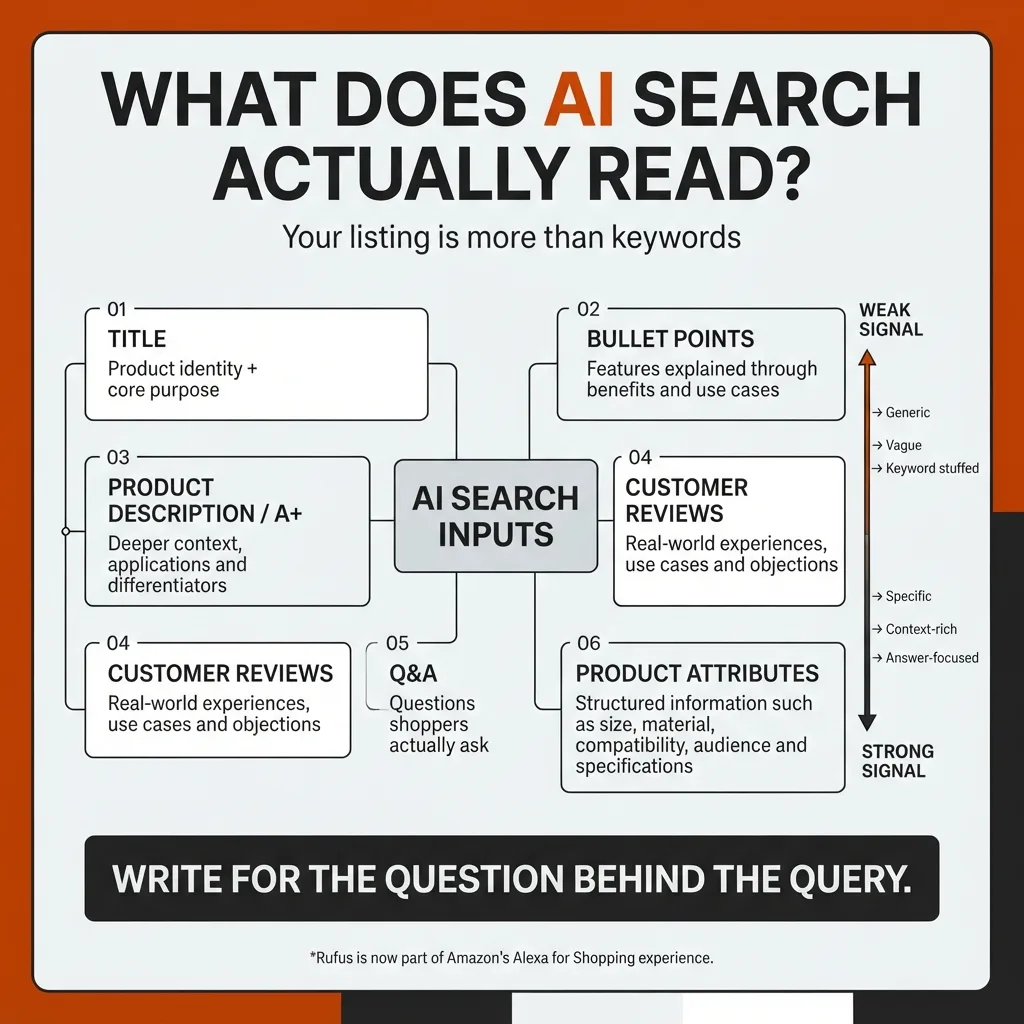
- Rufus uses a three-layer evaluation, backend attribute fields (filtered first, before any copy is read), listing content as question-answering text, and reviews and Q&A as citable product evidence, with missing attributes resulting in immediate exclusion from recommendation sets
- The shift from keyword SEO to noun phrase optimization means every title, bullet, and description element should follow the Feature plus Benefit plus Context structure that allows Rufus to construct confident answers from your listing content
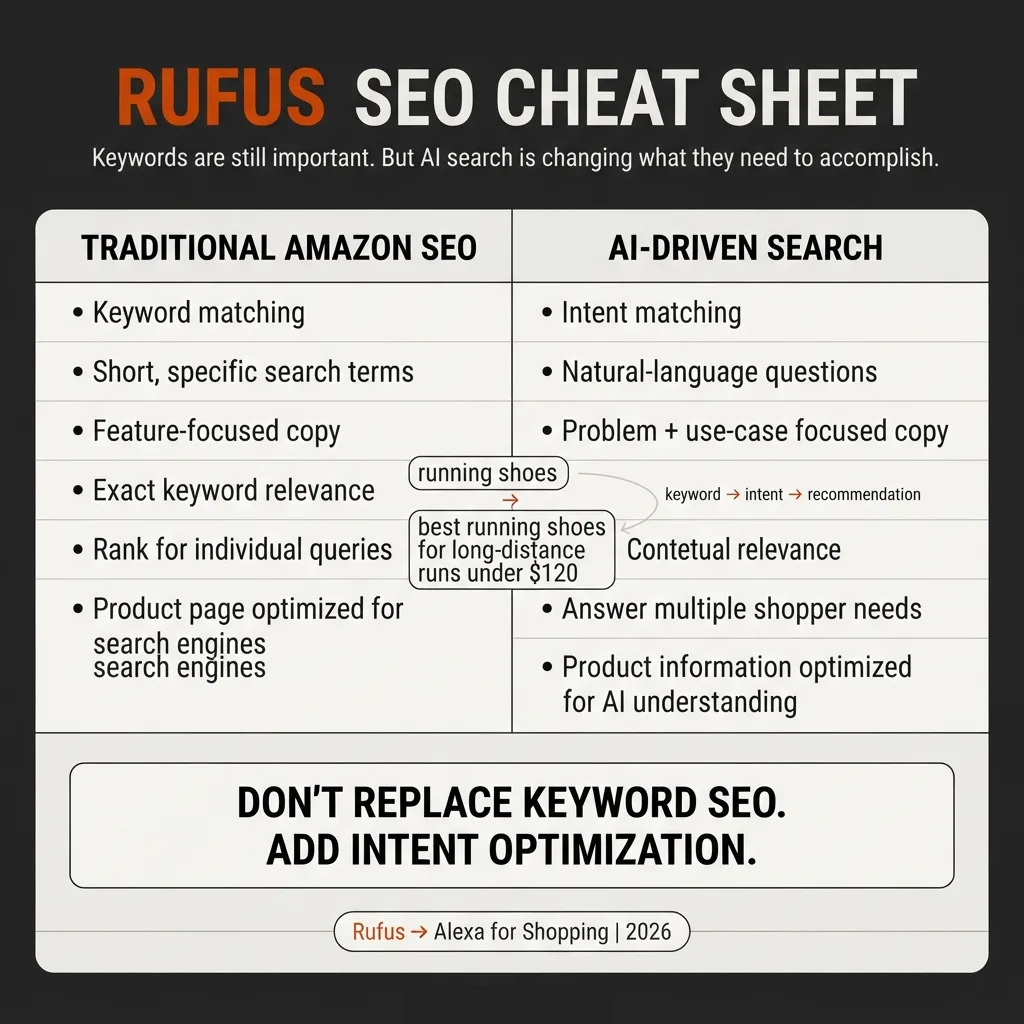
- Traditional A9 search still drives 80 to 85 percent of discovery traffic and must remain the SEO foundation, with Rufus optimization layered on top rather than replacing it, because over-rotating to AI-only optimization loses keyword rank that Rufus alone cannot compensate for
Rufus SEO in 2026: How AI Search Is Changing Product Ranking
The biggest shift in marketplace SEO in 2026 is not a new keyword tool. It is a different kind of reader.
Traditional A9 search scanned your listing for keyword frequency and placement, then ranked results based on relevance scores and behavioral signals. Rufus, now called Alexa for Shopping, reads your listing the way a knowledgeable buyer would: looking for specific answers to specific questions, evaluating whether the content is complete, and deciding whether it can confidently recommend your product.
Over 250 million shoppers used Rufus in 2025, with interactions up 210 percent year-over-year. Shoppers using Rufus convert at 60 percent higher rates than those using traditional keyword search. As of Q1 2026, Rufus mediates 15 to 20 percent of mobile queries, and that share is projected to reach 35 percent by end of 2026.
Sellers who understand what this AI reads, what it rewards, and what it ignores have a compounding ranking advantage over those still optimizing for 2022 search mechanics.
How Rufus Actually Understands Your Products
Rufus does not match keywords. It evaluates whether your listing can confidently answer a buyer's question.
The technology underneath Rufus is COSMO (Commonsense Knowledge Generation), a knowledge graph that maps products to contextual signals: who uses the product, what problems it solves, when it is relevant, and why a buyer would choose it over alternatives.
COSMO is what allows Rufus to answer a query like "what shoes are good for pregnant women?" by inferring that the buyer needs slip-resistant, supportive, comfortable footwear, even if the listing never contains the phrase "shoes for pregnant women." The AI infers intent. It does not count terms.
The three layers Rufus reads:
1. Structured product attributes (evaluated first) Rufus filters candidate products before parsing conversational queries. Missing backend attributes (material, use case, target audience, compatibility, dimensions) remove your product from the candidate set before the shopper's question is even processed. Audits consistently show 30 to 40 percent attribute completion rates in most brand catalogs. That gap is why many listings simply never appear in Rufus recommendations, regardless of keyword optimization.
2. Listing content as question-answering text Rufus reads your title, bullets, description, A+ Content, and Q&A as a knowledge document. It evaluates whether this document can answer the questions buyers in your category typically ask. Listings written as keyword collections fail this evaluation. Listings written as answers to buyer questions pass it.
3. Reviews and Q&A as evidence Rufus treats customer reviews and Q&A not as social proof but as product documentation. Specific review content ("held ice for 18 hours on a full camping day") is citable evidence. Generic review content ("great product!") contributes nothing to AI recommendation confidence.
Why Traditional Keyword Stuffing Is Hurting Rankings in 2026
Keyword stuffing now actively damages performance under the AI search layer, not just conversion rate.
The A9 algorithm partially rewarded keyword density because it scored relevance partly on term frequency. COSMO penalizes keyword stuffing because any language model evaluates semantic coherence. A title reading "Garlic Press Stainless Steel Crusher Mincer Peeler Ginger Silver Heavy Duty" signals low-quality content to a language model, the same way it signals low quality to a human reader.
What keyword-stuffed listings lose in 2026:
- Rufus recommendation eligibility: The AI cannot construct a clear, confident answer about your product from a title that reads as a keyword list
- COSMO intent matching: Stuffed titles interfere with COSMO's ability to classify your product's contextual use cases
- Traditional A9 ranking: Amazon's ranking signals now blend AI quality signals with behavioral metrics, meaning poor semantic coherence increasingly affects even traditional search rank
What the research shows: Sellers with well-structured listings and complete product attributes benefit from the Rufus/COSMO shift, not the ones with the highest keyword density. Readable, specific titles now outperform keyword-packed ones even on traditional search, because the ranking system is blending AI signals with historical behavioral signals.
The sellers still optimizing the way they did in 2022 are losing visibility to sellers who adapted to what the algorithm now actually reads.
Conversational Search vs Keyword Search: What Changes
The fundamental difference: keyword search matches terms. Conversational search interprets intent.
| Dimension | Traditional Keyword Search | Rufus Conversational Search |
|---|---|---|
| Query format | "insulated water bottle 32oz" | "what water bottle keeps drinks cold all day?" |
| Matching method | Term frequency and placement | Intent inference via COSMO |
| Result volume | Hundreds of listings | 5 to 10 recommendations |
| Ranking signals | CVR, sales velocity, CTR | Confidence, completeness, specificity |
| Listing content evaluated | Title, bullets, backend terms | Full listing including Q&A and reviews |
| Missing data handling | Partial match allowed | Product excluded from recommendations |
The practical implication for sellers:
A buyer typing "32oz water bottle" lands on a traditional search results page where your keyword placement and bid strategy determine position. A buyer asking "what water bottle is best for keeping coffee hot during a commute?" goes through Rufus, which reads every listing that might be relevant and surfaces the two to five it can most confidently recommend.
Your listing competes in both contexts simultaneously. You need traditional keyword SEO as the foundation and conversational question-answering content layered on top. Optimizing only for one costs you the other.
How to Optimize Titles, Bullets, and Descriptions for Rufus
Shift from keyword placement to noun phrase optimization. Rufus processes queries in noun phrases: Feature + Benefit + Context strings that answer a buyer question directly.
Titles That Work for Both A9 and Rufus
A keyword-optimized title from 2022: "Water Bottle Stainless Steel Insulated Leakproof 32oz BPA Free Lid Handle Travel"
A 2026 title that serves both systems: "32oz Leakproof Insulated Water Bottle, Keeps Drinks Cold 24 Hours, BPA-Free Stainless Steel, Fits Car Cup Holders"
What changed:
- Primary keyword still leads (32oz insulated water bottle)
- Benefit is stated as an outcome, not a feature (keeps drinks cold 24 hours)
- Context is included (fits car cup holders) so COSMO can match situational queries
- No keyword strings that read as lists rather than sentences
Title optimization rules for Rufus:
- Lead with the most specific primary keyword (type + key differentiator)
- Follow with a measurable benefit claim (not "high quality" but "keeps cold 24 hours")
- Include one use-case or compatibility signal within the first 80 characters
- Remove all keyword-string sequences that do not read as natural language
Bullets That Rufus Can Cite
Rufus lifts information from bullet points to construct answers. For a bullet to be citable, it must be a complete, fact-dense sentence that directly answers a buyer question.
| Before (keyword-heavy) | After (Rufus-readable) |
|---|---|
| "Premium quality stainless steel" | "Built from 18/8 food-grade steel so it never rusts, retains flavor, or degrades with daily washing" |
| "Leakproof lid included" | "Lid tested to 35 psi, stays sealed when tossed in a gym bag, backpack, or car seat" |
| "BPA-free materials" | "100% BPA-free from lid to base, NSF-certified safe for hot drinks, cold drinks, and daily use" |
The test for every bullet: Can this sentence be lifted directly into a Rufus response to a buyer question? If yes, it is optimized. If it only describes the product without answering a question, rewrite it.
Descriptions That Serve Both Discovery Systems
The product description is indexed by Rufus even when A+ Content replaces the visible version on the page. Write it using the problem-validation-solution structure:
- Sentence 1: Name the frustration ("Most water bottles that claim leakproof fail in the first month.")
- Sentence 2: Validate it ("The lid seal is typically the weak point, not the bottle itself.")
- Sentence 3: Introduce your product as the specific answer with evidence ("This lid is tested to 35 psi and backed by a lifetime guarantee on the seal.")
Use natural language throughout. Every paragraph should read as an answer to an implied buyer question. Avoid promotional phrases like "premium," "top-rated," or "best-in-class." COSMO ignores marketing language and evaluates factual specificity.
Reviews and Q&A as AI-Readable Content
Rufus treats reviews and Q&A as product documentation, not social proof. The AI reads this content to find answers to buyer questions that the listing copy has not addressed.
How Rufus Uses Review Content
A review that says "I took this on a 3-day backpacking trip in Colorado, overnight temps hit 28 degrees, and my coffee was still warm in the morning" becomes citable evidence for the question "does this work for camping in cold weather?"
A review that says "great product, would buy again" contributes nothing. The AI cannot extract a specific answer from vague sentiment.
To generate AI-citable reviews:
- Enroll new products in Vine to seed 30 detailed, experience-specific reviews from the first buyers
- Use post-purchase messaging to encourage buyers to describe where and how they used the product
- Respond to positive reviews with additional use-case context that adds to the AI-readable knowledge base
- Never incentivize specific ratings (platform policy violation), but encourage honest specificity
Q&A as a Direct Citation Database
Rufus cites Q&A content directly when answering shopper questions not addressed in listing copy. An empty Q&A section is an empty citation database.
Target 15 to 20 complete, specific answers for any product doing significant monthly revenue. Build the Q&A from:
- Your most frequent customer service inbox questions
- The top complaints in competitor one-star and two-star reviews
- Common questions in competitor Q&A sections
Write complete answers. "Yes, the lid and body are both top-rack dishwasher safe. Remove the silicone seal before each wash to extend its lifespan." This is citable. "It depends on how you use it" provides nothing.
How Sellers Can Prepare for AI-Driven Discovery
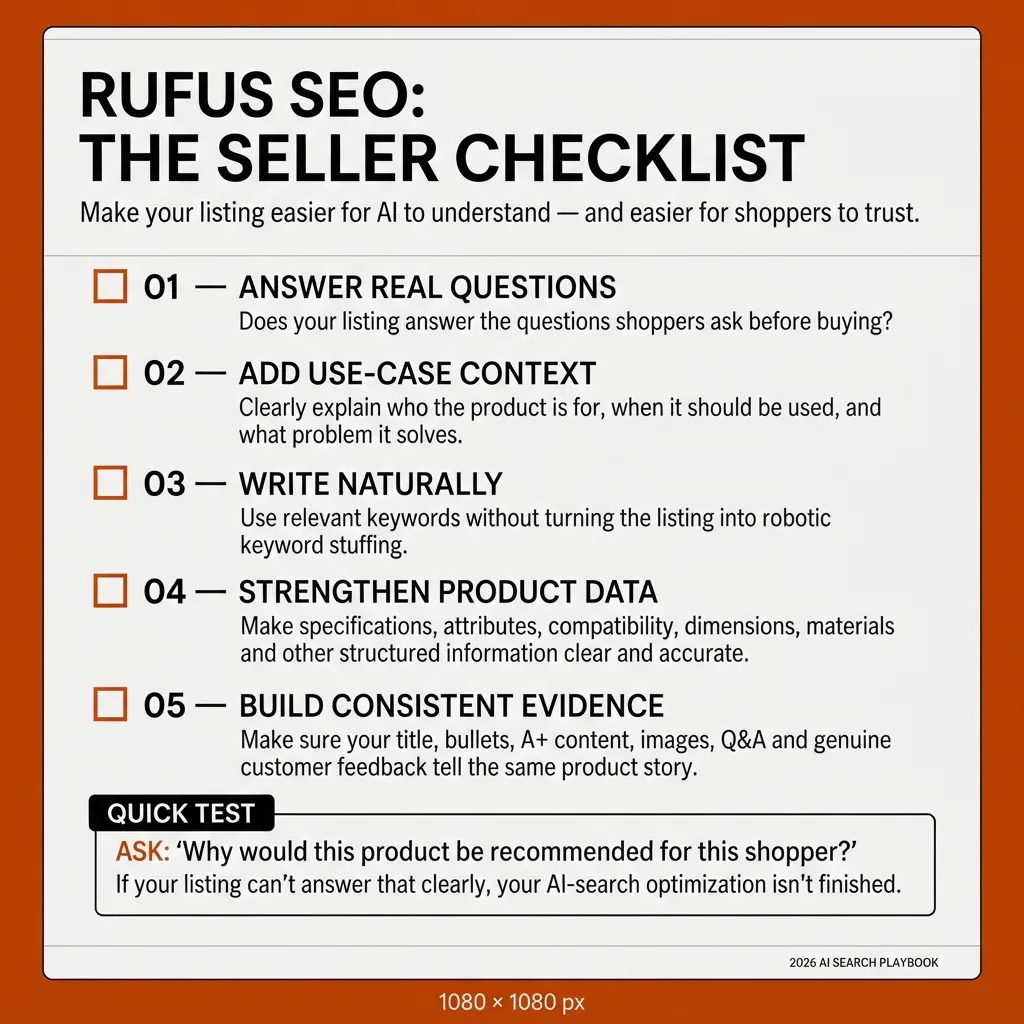
The preparation is not about chasing Rufus specifically. It is about making your listing content comprehensive, specific, and human-readable first, and AI-parseable second.
Priority Action Plan
Step 1: Audit backend attribute completeness Pull your full attribute list for each ASIN in Seller Central. Fill every relevant field. The target is 90 percent completion. This is the highest-impact action because attribute fields are the primary filter Rufus applies before it reads a single word of your copy. Most catalogs have 30 to 40 percent completion. Every empty field is a product exclusion that keyword optimization cannot fix.
Step 2: Rewrite titles using noun phrase structure Replace keyword strings with Feature + Benefit + Context phrases. The 80-character mobile window must contain the primary keyword and at least one buyer benefit before truncation.
Step 3: Rewrite bullets as citable sentences Each bullet should be a complete, fact-dense sentence answerable to a specific buyer question. Test every bullet: could Rufus lift this sentence directly into a response? If not, rewrite it.
Step 4: Seed the Q&A with 15 to 20 complete answers Source questions from your customer service inbox, competitor Q&A, and review complaint patterns. Write answers that are specific enough to be cited by the AI in a conversational response.
Step 5: Audit your review acquisition strategy Move toward review content that is specific, use-case-focused, and descriptive. Vine enrollment for new products is the fastest path to AI-citable early review coverage.
Step 6: Monitor Search Query Performance for conversational traffic signals Brand Analytics is beginning to expose Rufus attribution for Brand Registered sellers. Check Search Query Performance for sudden changes in impression share on conversational long-tail queries. Increases in these queries are often Rufus-driven and signal that your listing is entering AI recommendation scenarios.
What Not to Do
- Do not abandon traditional keyword SEO. Traditional search still drives 80 to 85 percent of discovery traffic. You need both layers. Sellers who over-rotate toward AI-only optimization lose keyword rank and find that Rufus alone does not compensate for the volume loss.
- Do not use aspirational marketing language as a substitute for specific claims. Rufus ignores "premium," "industry-leading," and "trusted by thousands." It reads "third-party tested to 10,000 wash cycles with no performance degradation."
- Do not wait for attribution data before starting. Most sellers who wait for perfect data to act will start this optimization work eighteen months after the sellers who started in early 2026.
The New Success Metric for AI-Era SEO
"Ranking for a keyword" is no longer the primary success metric. The new metric is AI readability: can the AI confidently understand, match, and recommend your product when a shopper asks a relevant question?
The sellers building durable visibility in 2026 are those who answer yes to this question across their full catalog. They have complete attribute fields, conversational listing copy, specific Q&A coverage, and review strategies that generate AI-citable content.
That preparation, done consistently across a catalog, creates a compounding advantage. Every month the AI recommendation share grows, the gap between listings optimized for AI-era SEO and those still built for 2022 keyword mechanics widens further.
The optimization is not complex. It does not require abandoning what works in traditional search. It requires understanding what a different kind of reader values, and writing for it alongside the keyword system that still drives most of your traffic.
Is your catalog ready for AI-driven discovery, or are your listings optimized for a search system that no longer makes all the decisions?
At Brevlin, we audit listings against COSMO and Rufus/Alexa for Shopping criteria: attribute completeness, noun phrase title structure, citable bullet quality, Q&A coverage, and review strategy. We identify the specific gaps costing you AI recommendation eligibility and fix them alongside your existing SEO foundation.
A complete guide to Rufus SEO and AI-driven product ranking in 2026, covering how COSMO and Rufus evaluate listings (three-layer evaluation model), why keyword stuffing actively damages AI search rankings, the detailed comparison between conversational and traditional keyword search with a feature comparison table, specific optimization guidance for titles using noun phrase structure, bullets as citable RAG-ready sentences, descriptions using the problem-solution hook, reviews and Q&A as AI documentation sources, and a six-step seller preparation plan with what not to do.
The sellers asking "how do I rank for Rufus?" are asking the right question a year too late and the wrong way. Rufus does not rank listings. It reads them and decides whether it can confidently recommend the product to a specific buyer asking a specific question. The question sellers should be asking is, "Can Amazon's AI answer any question a buyer might ask about my product, using only what I have written in my listing?" Most listings fail that test badly, not because sellers are doing SEO wrong, but because they have been optimizing for a system that scanned keyword frequency rather than one that reads for meaning. That shift is what this article explains. — Sarah Farber (My background from hospitality, strong analytical and communication skills, and experience working in cross-functional project teams help me to create great products and services.)
Article complete. You just invested 12 minutes in learning something valuable.
Frequently Asked Questions
COSMO (Commonsense Knowledge Generation) is the AI knowledge graph that powers Rufus. It maps products to contextual signals including who uses the product, what problems it solves, and when it is relevant. COSMO allows Rufus to answer questions by inferring intent rather than matching keywords literally. A listing not readable by COSMO will not be recommended by Rufus, regardless of keyword optimization. The most direct way to improve COSMO readability is completing backend attribute fields (target 90 percent completion) and writing listing copy as answers to buyer questions rather than keyword collections.
Keyword stuffing now actively damages Rufus recommendation eligibility because COSMO, like all language models, evaluates semantic coherence. A title reading as a keyword string signals low-quality content to the AI and reduces the confidence with which it can recommend the product. Traditional A9 search partially rewarded keyword density. COSMO penalizes it and rewards intent-aligned content. Sellers with readable, specific listings benefit from this shift while keyword-heavy listings lose ground in both AI-mediated and increasingly in traditional search as the ranking system blends AI signals with behavioral data.
Titles should follow the noun phrase structure: Feature + Benefit + Context. Lead with the most specific primary keyword (type plus key differentiator), follow with a measurable benefit claim stated as an outcome rather than a feature, and include a use-case or compatibility signal within the first 80 characters so COSMO can match situational queries. Bullets should be complete, fact-dense sentences that can be lifted directly by Rufus into a conversational answer. Every bullet should answer a specific buyer question. Descriptions should follow the problem-validation-solution hook structure written in natural language.
Rufus treats reviews and Q&A as product documentation and cites them directly when answering shopper questions not addressed in listing copy. A review describing a specific use case ('held ice for 18 hours on a full camping day') becomes citable evidence for relevant buyer queries. Generic reviews contribute nothing. For Q&A, target 15 to 20 complete, specific answers sourced from customer service inquiries, competitor review complaints, and competitor Q&A sections. Write each answer as a complete, standalone response. Vague or partial answers have no AI citation value.
No. Traditional A9 search still drives 80 to 85 percent of discovery traffic as of Q1 2026. Rufus is a layer on top of A9, not a replacement. Sellers who abandon traditional keyword SEO in favor of AI-only optimization lose keyword rank and find that Rufus alone does not compensate for the volume loss. The correct approach is optimizing for both simultaneously: traditional keyword research and placement as the foundation, with conversational question-answering content and complete attribute data layered on top for AI recommendation eligibility.


