
Most marketplace sellers are running PPC campaigns. Most are not running a PPC system. The difference is the gap between buying clicks and building compounding organic authority. In 2026, with the platform's AI matured and creative quality overtaking bid strategy as the primary performance lever, the playbook has changed completely. Here is the complete guide to building a PPC system that compounds.
- Marketplace retail media ad revenue hit 69.3 billion dollars in 2026, making PPC non-optional for visibility, but the strategies that worked in 2023 are actively hurting sellers today as AI bid automation matures and creative quality overtakes bid strategy as the primary performance lever
- The three-layer campaign architecture (Discovery at 15 to 20 percent, Expansion at 20 to 25 percent, Precision at 55 to 65 percent of budget) is the structural foundation that separates scalable accounts from those where data is obscured and budget is misallocated
- TACoS is more important than ACoS for strategic decision-making, a falling TACoS with growing revenue confirms the PPC-to-organic flywheel is working, while a rising TACoS is the primary signal that organic rank is decaying and ads are compensating
- Negative keywords are the single most underused profitability tool in PPC, weekly search term report review and aggressive negative addition reduces wasted spend by 15 to 25 percent over six months without any reduction in converting traffic
- Listing quality and PPC efficiency are now the same investment in 2026, complete product attributes, conversational copy, detailed Q&A, and substantive reviews simultaneously improve organic AI recommendation eligibility and paid ad performance within Alexa for Shopping conversations
Introduction: Why Your PPC Strategy Needs a Complete Rebuild in 2026
The strategies that worked in 2023 are actively hurting sellers in 2026. Exact-match-only keyword lists, manual daily bid adjustments, siloed campaigns with no structural logic, and the stubborn habit of treating auto campaigns as a budget drain rather than a discovery engine have all become liabilities in the current marketplace advertising environment.
Three structural shifts have rewritten the PPC playbook simultaneously.
First, the platform's AI has matured. Dynamic bidding, auto targeting, and rule-based optimization are now genuinely effective tools rather than blunt instruments. Sellers who insist on manual bid management for every keyword in 2026 are competing against machine learning with spreadsheets. The sellers holding ACoS steady in 2026 are doing it through intelligent campaign architecture that gives the AI the right inputs, not through daily bid tweaks.
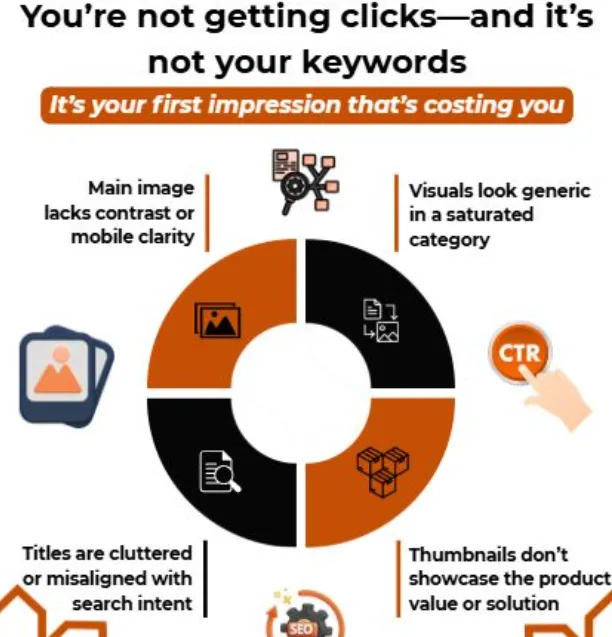
Second, creative quality has overtaken bid strategy as the primary performance lever. A listing with a compelling main image, a clear benefit-driven title, and strong reviews will win ad placements at lower effective CPCs than a competing listing with a higher bid and weak creative. The algorithm has learned to factor creative quality into placement decisions because better creatives generate better CTR and CVR signals, which are more valuable to the platform than a higher per-click fee.
Third, the rise of Alexa for Shopping (formerly Rufus, made default in May 2026) has introduced a conversational discovery layer that sits above traditional keyword search. Sponsored Product and Sponsored Brand placements now appear within AI assistant conversations, and ads shown in this context are evaluated for how well the product content answers the shopper's specific conversational query. A keyword-stuffed listing loses ground in this context. A listing written as an answer to real buyer questions wins.
The marketplace advertising platform passed 69.3 billion dollars in retail media ad revenue in 2026, representing 39.8 percent of all retail media ad spending globally, more than double its revenue from four years ago. The average CPC across the platform now sits at approximately 0.91 dollars, with competitive categories in electronics, beauty, and supplements running significantly higher. In this environment, PPC is no longer optional. It is the mechanism through which new products gain organic rank, established products defend their positions, and brands build sustainable discovery advantages.
This guide covers everything you need to build, optimize, and scale a profitable PPC system in 2026: ad formats and when to use each, campaign architecture, keyword strategy, bidding frameworks, the PPC-to-organic flywheel, budget management, advanced optimization tactics, and the monitoring cadence that separates profitable accounts from expensive ones.
Part 1: The Marketplace PPC Ecosystem in 2026
How the Auction System Works
Marketplace PPC is an auction-based advertising system. Sellers bid on keywords or targeting criteria, the platform shows ads when shoppers match those criteria, and sellers pay only when a shopper clicks. The winning bid in each auction is not purely determined by the highest bid amount. The platform combines bid level with relevance score (based on historical CTR, CVR, and listing quality signals) to determine placement and effective CPC.
This means a product with a proven track record of converting on a specific keyword can win better placements at lower bids than a competitor bidding higher but converting poorly. The practical implication is significant: before scaling ad spend, your listing must be retail-ready. Sending paid traffic to a poorly optimized listing inflates CPC and depresses CVR, making campaigns unprofitable regardless of bid strategy. Optimizing your listing before scaling your ads is not optional. It is the prerequisite that determines whether your ad spend produces compounding returns or compounding losses.
The Three Core Ad Formats
Sponsored Products: The Workhorse
Sponsored Products are the foundation of every marketplace PPC strategy. They appear directly within search results and on product detail pages, looking almost identical to organic listings with only a small "Sponsored" label. They are available to all sellers, require no brand registration, and generate the majority of advertising-attributed sales for most accounts.
Sponsored Products offer two targeting types: keyword targeting (your ad appears when shoppers search for specific terms) and product targeting (your ad appears on specific competitor or complementary product pages). Both have distinct strategic roles. Keyword targeting captures intent-driven search traffic. Product targeting captures mid-funnel shoppers who are already evaluating alternatives on competitor detail pages.
Sponsored Brand Video ads within the Sponsored Products ecosystem deserve specific attention in 2026. As static placements have become more competitive and mobile scrolling has accelerated, video earns more visual attention per impression than static formats. Video ads for products priced above 40 dollars deliver 15 to 30 percent better engagement than static equivalents.
Sponsored Brands: The Awareness and Defense Engine
Sponsored Brands are banner ads that appear at the top of search results and showcase your brand with a custom headline, logo, and curated product selection. They require Brand Registry and are the primary format for brand awareness building and defensive advertising on branded search terms.
Sponsored Brands serve two distinct strategic purposes. Offensively, they capture broad category awareness by appearing at the top of search results before any product listing. Defensively, they prevent competitors from occupying the top placement when buyers search for your brand name specifically.
Sponsored Brand Video, the video-enabled variant, now appears in search results mid-feed and drives significantly stronger click-through rates than static Sponsored Brands in competitive categories. For established brands in competitive categories, Sponsored Brand Video is one of the highest-leverage underutilized formats because fewer sellers invest in the creative production required, creating a relative cost advantage.
Sponsored Display: The Retargeting and Expansion Layer
Sponsored Display ads reach shoppers both on and off the marketplace, allowing sellers to retarget visitors who viewed their product but did not purchase, reach shoppers viewing competitor products, and build awareness among audiences who match buyer demographic and interest profiles.
In 2026, Sponsored Display is powered by machine learning that automatically optimizes for the best-performing audiences based on conversion data. This makes it significantly more effective than it was in prior years for retargeting warm audiences. Shoppers who add your product to cart but do not purchase represent the highest-converting retargeting segment available. Reaching them with Sponsored Display within 24 to 48 hours of their cart event, potentially with a coupon or urgency message, converts at rates that can be two to three times higher than cold traffic.
Sponsored TV and Streaming Video
Sponsored TV places your brand in front of viewers watching Fire TV and Prime Video. These non-skippable video placements are appropriate for brands with upper-funnel awareness goals, product launches with significant brand investment, or seasonal campaigns that benefit from broad awareness before peak shopping periods. Sponsored TV is not appropriate for most small-to-medium catalog sizes but represents a meaningful addition to the format stack for brands at significant scale.
Part 2: Campaign Architecture That Scales
Why Structure Is the Most Undervalued PPC Decision
Most PPC performance problems trace back to campaign structure problems. If your structure is flawed, your data will be obscured, your budgets will be misallocated, and your ability to optimize profitably will be limited regardless of how much you spend or how strong your bids are.
The most common structural mistake among mid-level sellers is cramming multiple variables into a single campaign: multiple products, multiple match types, and keywords with vastly different intents in one campaign. When a campaign contains broad match keywords targeting discovery shoppers and exact match keywords targeting high-intent buyers in the same budget pool, the two types compete for the same daily spend. The discovery keywords typically consume most of the budget (because they generate more impressions), while the high-intent converting keywords run out of funds. The result is high spend with low returns and data that is impossible to interpret accurately.
The solution is isolation. Each campaign layer should have a single clear purpose, a dedicated budget, and a consistent match type.
The Three-Layer Campaign Architecture for 2026
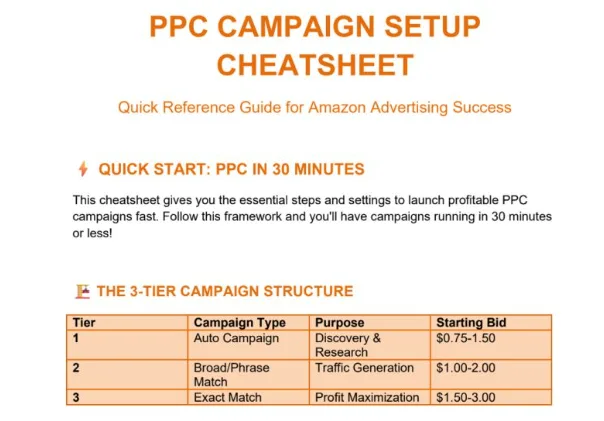
Layer 1: Discovery (Auto and Broad Match)
Purpose: Find new search terms, including conversational queries from Alexa for Shopping, that your manual campaigns have not yet targeted.
Structure: Automatic targeting campaigns at conservative daily budgets (10 to 20 dollars per product for established products, 20 to 30 dollars for active launches). Broad match campaigns targeting your category head terms to capture long-tail variations. Set bids at 70 to 80 percent of your Tier 1 exact match bids. Bid strategy: Dynamic bids, down only. The platform reduces bids when conversion is less likely, controlling waste during discovery.
Weekly optimization: Pull the search term report. Any term with three or more conversions and an ACoS within acceptable range gets promoted to Layer 2 or Layer 3. Any term generating five or more clicks with zero conversions gets added as a negative keyword.
Budget allocation: 15 to 20 percent of total campaign budget.
Layer 2: Expansion (Phrase Match)
Purpose: Capture shoppers who use your proven keywords as part of a longer query without the budget volatility of broad match.
Structure: Phrase match campaigns targeting your top-performing terms from Layer 1, organized by keyword theme. A campaign targeting "water bottle" on phrase match will capture "best insulated water bottle for gym," "leakproof water bottle for hiking," and "water bottle with straw for kids" without requiring you to bid on each variation individually. Bid strategy: Dynamic bids, down only or fixed, depending on keyword maturity. As phrase match campaigns build conversion history, the algorithm becomes more accurate at identifying when to serve the ad.
Weekly optimization: Review search terms converting from phrase match. Promote high-converting specific terms to Layer 3 exact match. Add irrelevant terms as negatives.
Budget allocation: 20 to 25 percent of total campaign budget.
Layer 3: Precision (Exact Match)
Purpose: Control spend with maximum precision on your highest-converting, most valuable keywords.
Structure: Exact match campaigns targeting only terms with proven conversion history from Layers 1 and 2. These are your budget heroes. Each keyword in an exact match campaign should have at least 15 to 20 clicks of data showing a conversion rate consistent with your target ACoS. Organize exact match campaigns by keyword intent cluster: high-intent purchase terms in one campaign, brand-adjacent terms in another, competitor terms in a third.
Bid strategy: Dynamic bids, up and down, for mature exact match campaigns with at least 30 days of conversion data on each keyword. This allows the platform to increase bids by up to 100 percent when the algorithm is confident of conversion, giving you top-of-search dominance at the moments that matter most. Only apply this setting to exact match campaigns with consistent historical performance. Applying it to broad or phrase match creates unpredictable spend volatility.
Budget allocation: 55 to 65 percent of total campaign budget.
Campaign Naming Convention
Clear, consistent campaign naming is not cosmetic. It determines how quickly you can diagnose problems, compare performance across campaigns, and hand off account management. A naming structure that communicates product, match type, intent, and date created (for example: SKU-SP-EXACT-CORE-0126) allows you to answer any campaign performance question without opening individual campaigns to identify what they contain.
Part 3: Keyword Strategy
How to Build a Keyword Architecture That Compounds
The most common keyword mistake in 2026 is still treating keyword research as a one-time setup task. Your keyword portfolio should be a living asset that expands through data from your own search term reports, shrinks through aggressive negative keyword management, and shifts as your product's organic rank evolves and your PPC-to-organic flywheel reduces dependence on paid traffic for specific terms.
Keyword Research: Finding the Terms That Convert
Step 1: Mine your own search term report
After running Sponsored Products campaigns for 30 or more days, download the Search Term Report from Seller Central. The converting terms in this report are your highest-confidence organic and paid keyword targets. Any term that has generated sales in paid will generate organic ranking benefit if you drive consistent conversion on it through PPC.
Step 2: Reverse ASIN analysis on competitors
Identify the three to five competitors ranking organically on your primary keyword. Use keyword research tools to see what search terms are driving their organic traffic. The terms they rank for that you do not yet target represent your most immediate expansion opportunities.
Step 3: Category head terms and modifiers
Start with the one to three terms that most accurately describe your product category (head terms). Build out modifier lists: material descriptors, size and capacity variants, use case modifiers, and compatibility terms. The head term captures volume. The modifiers capture intent and convert at higher rates.
Step 4: Conversational and long-tail terms for AI discovery
With Alexa for Shopping now mediating 15 to 20 percent of mobile queries, your keyword strategy must include conversational phrases that match how shoppers speak to the AI: "keeps drinks cold for hours," "good for marathon training," "easy to clean coffee maker," "safe for dishwasher." These terms appear in auto campaigns and should be promoted to phrase and exact match as soon as they show conversion data.
Keyword Match Types: Which to Use and When
Exact match: Maximum control. The ad only serves when the shopper's query matches your keyword precisely (with minor spelling variations). Use for your highest-converting, most valuable terms where budget efficiency is critical.
Phrase match: Balanced control and reach. The ad serves when your keyword appears as a phrase within a longer query. Use for core terms where you want to capture long-tail variations without the volatility of broad match.
Broad match: Maximum reach. The ad serves for loosely related queries. Use in discovery campaigns with conservative budgets and down-only bidding to find new converting terms.
Auto targeting: Full platform control. Use for initial keyword discovery on new products and for capturing conversational queries from Alexa for Shopping. Auto targeting is particularly valuable in 2026 because the platform uses semantic understanding to match your listing to queries you would never have thought to target manually.
Negative Keywords: The Most Underused Profitability Tool
Negative keywords prevent your ads from showing on irrelevant or underperforming queries. They are the single most underused profitability tool in marketplace PPC and the fastest way to reduce wasted spend without reducing visibility on terms that convert.
Every week, review your search term report and add negatives for: terms with five or more clicks and zero conversions, terms that are semantically unrelated to your product, terms that convert at an ACoS more than twice your target, and competitor brand names that are generating irrelevant clicks.
The compounding effect of consistent negative keyword management is significant. Sellers who add negatives weekly over six months typically reduce wasted spend by 15 to 25 percent without any reduction in converting traffic, which directly improves ACoS and frees up budget for expansion on proven terms.
Part 4: Bidding Strategy and Budget Management
Understanding Bid Mechanics in 2026
The bid you set at the keyword level is a baseline, not a ceiling. Three modifiers sit on top of your base bid and determine the effective amount the platform charges per click.
Dynamic bidding: The platform adjusts your bid in real time based on the probability of conversion. Down only reduces bids when conversion is less likely (recommended for discovery campaigns). Up and down increases bids by up to 100 percent when the algorithm is confident of conversion (recommended for mature exact match campaigns only).
Placement modifiers: You can increase bids by up to 900 percent for specific placements: Top of Search (the first rows of search results), Product Pages (competitor and complementary detail pages), and Rest of Search (all other placements). Use placement modifier data from your campaign reports to identify where your ads convert at the best rate, then apply modifiers to concentrate spend there. A product that converts at 15 percent ACoS at top of search but 35 percent in rest of search should have a significant positive top-of-search modifier and a negative modifier (or exclusion) for rest of search.
Audience bid adjustments: For Sponsored Display campaigns, bid adjustments by audience segment allow you to pay more for retargeted audiences (who convert at higher rates) and less for cold prospecting audiences.
ACoS vs TACoS: The Metrics That Actually Determine Profitability
Most sellers manage PPC by ACoS alone. This is one of the most expensive data interpretation mistakes in marketplace advertising.
ACoS measures your ad spend as a percentage of ad-attributed sales only. A 20 percent ACoS looks excellent on paper. But if your organic sales are declining because your ads are not building rank, and your total revenue is flat while ad spend grows, your TACoS (Total Advertising Cost of Sales, calculated as total ad spend divided by total revenue including organic) is climbing. The business is becoming more ad-dependent, not less.
TACoS is the metric that tells you whether PPC is building your business or renting it.
A falling TACoS with stable or growing total revenue is the signal that PPC is working as an organic rank investment. Your ads are driving conversions on target keywords, which is improving organic placement, which is generating organic traffic at zero marginal cost.
A rising TACoS with flat revenue is the warning sign that organic rank is decaying and paid spend is compensating. You are running faster to stay in the same place.
2026 TACoS benchmarks by stage:
New product launch (weeks 1 to 8): 15 to 25 percent is acceptable. You are purchasing organic rank, not optimizing for immediate profit.
Growth phase (months 3 to 6): 10 to 18 percent. Organic rank should be building on primary keywords and reducing paid dependency.
Established product: 5 to 12 percent. This range indicates a healthy balance of paid visibility and organic momentum.
TACoS above 25 percent on a product live for six or more months almost always indicates listing quality problems, high return rates, or organic rank decay. More ad spend will not solve these problems. Diagnosing and fixing the root cause will.
How to Calculate Your Break-Even ACoS
Your target ACoS must be anchored to your actual unit economics, not a general benchmark. The most common calculation error is using gross margin as the ACoS ceiling, which ignores fulfillment costs, returns, and platform fees.
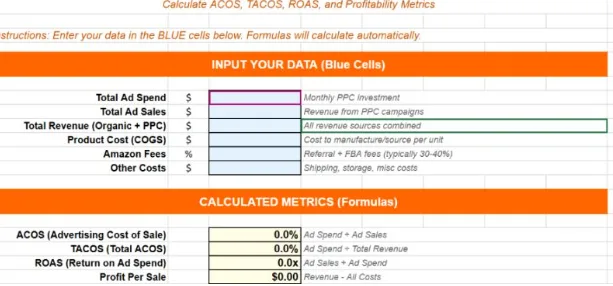
Break-even ACoS = (Revenue minus total costs) divided by Revenue, multiplied by 100.
Total costs include product cost (COGS), fulfillment fees (FBA fees or self-fulfillment cost), storage fees (monthly and long-term), return rate cost (expected refunds plus restocking), and platform commission. For a product selling at 30 dollars with 8 dollars in COGS, 5 dollars in fulfillment, 1 dollar in storage and returns allocation, and 4.50 dollars in marketplace commission (15 percent), total costs are 18.50 dollars and gross profit is 11.50 dollars. Break-even ACoS is 38.3 percent.
At this break-even ACoS, every sale through advertising costs exactly as much as you make. For profitability, your target ACoS should be meaningfully below break-even. For rank-building during launch, you may accept break-even or slightly above for a defined period. The key is knowing these numbers precisely before setting bids.
Budget Management: Avoiding the Most Expensive Mistakes
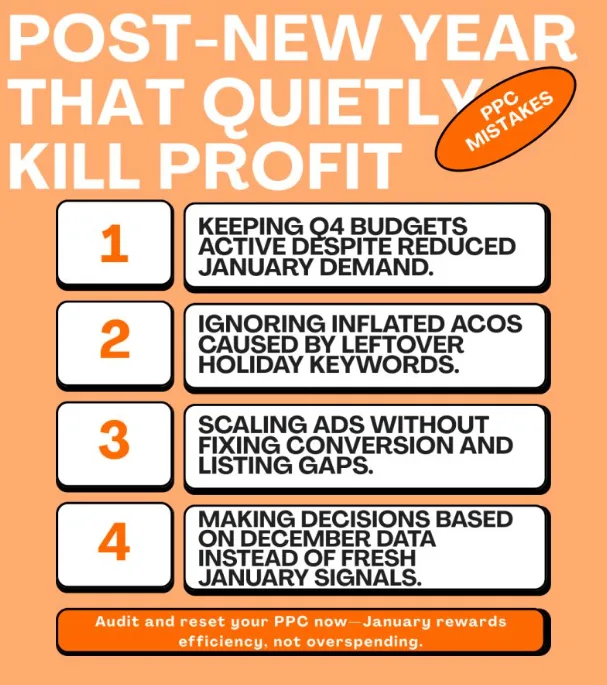
Daily budget depletion: If your campaigns regularly run out of daily budget before peak shopping hours (typically 7 to 10 PM), you are missing your highest-converting window. Increase daily budgets on campaigns with strong ACoS or use budget rules to protect peak-hour spend.
Scaling too fast: Increasing campaign budgets by more than 15 to 20 percent per week disrupts the algorithm's optimization. Rapid budget increases cause campaigns to serve more broadly and less selectively, temporarily increasing ACoS before the algorithm recalibrates. Scale incrementally.
Spreading budget too thin: Ten campaigns each running at 5 dollars per day generate insufficient data to optimize. Each campaign needs enough daily spend to collect meaningful click and conversion data within a reasonable timeframe. For most categories, a campaign needs a minimum of 10 to 20 dollars per day to build usable data within two weeks.
Ignoring campaign-level efficiency: ACoS at the account level masks which campaigns are profitable and which are subsidizing losses. Review ACoS at the campaign level, then at the ad group level, then at the keyword level. The goal is surgical precision: increase spend on profitable segments, reduce spend on unprofitable ones.
Part 5: The PPC-to-Organic Flywheel
How Advertising Builds Lasting Organic Authority
The most powerful concept in marketplace PPC strategy is not how to optimize individual campaigns. It is how to use advertising as a systematic investment in organic rank that reduces long-term advertising dependency.
The mechanism works in three stages. PPC ads drive clicks and purchases on specific keywords. Those purchases generate conversion rate and sales velocity signals on those keywords. The algorithm interprets those behavioral signals as evidence of relevance and organic rank potential. Over time, strong ad-driven CVR on a target keyword translates into organic rank improvement for that keyword. Once the product achieves strong organic rank, organic traffic generates sales at zero marginal cost, which reduces the proportion of total revenue coming from paid sources, which lowers TACoS.
Sellers who have applied this flywheel correctly move products from page 3 to page 1 organically within 4 to 8 weeks of a focused PPC strategy on their primary keywords. Once organic rank is established, they reduce paid spend on those terms while maintaining visibility through organic results and redirect that budget toward keywords where organic rank is still building.
Building the Flywheel: The Launch Phase Strategy
The launch phase is the period where the flywheel must be started, typically the first 8 to 12 weeks for a new product. During this phase, profitability is a secondary objective. The primary objective is building enough conversion velocity on target keywords to signal relevance to the algorithm.
For a new product with zero organic rank history, the recommended approach:
Start with an auto campaign at 20 to 30 dollars per day for the first two weeks. This discovers which search terms your listing is matched against and where early conversion is happening. Avoid exact match campaigns before auto data shows conversion, because bidding high on exact match without knowing which terms your listing actually converts on wastes budget.
After two weeks, pull the search term report. Identify any terms with two or more conversions. Promote these to a phrase match campaign immediately. Identify the three to five terms where you want organic rank (typically your highest-volume, highest-intent keywords that accurately describe the product). Launch dedicated exact match campaigns for these terms with aggressive bids.
For the next four to six weeks, maintain aggressive spend on your exact match target keywords even if ACoS is above your break-even threshold. You are purchasing organic rank during this period. The return on this investment is measured in organic visibility months later, not in immediate campaign profitability.
Review organic rank weekly for your target keywords. As soon as you reach the top of page one organically on a keyword, begin reducing your exact match bid for that keyword incrementally. Let organic rank carry the sales velocity while redirecting the freed budget toward keywords where rank is still building.
Part 6: Advanced Optimization Tactics
Placement Modifier Strategy
Your campaign placement report shows ACoS, CVR, and click volume broken down by Top of Search, Product Pages, and Rest of Search. The performance differences between these placements are often dramatic, and most sellers do not act on this data because it requires a modifier rather than a bid change.
A practical example: If your campaign shows 18 percent ACoS at Top of Search and 42 percent ACoS in Rest of Search, the Rest of Search placements are unprofitable. Apply a negative modifier to Rest of Search (or set bids so the effective Rest of Search bid is below what generates impressions) and reinvest that budget in Top of Search where the conversion economics work. This reallocation alone can reduce account-level ACoS by five to ten percentage points without reducing total sales volume.
Dayparting and Hourly Bid Management
Shopper behavior is not uniform across 24 hours. Research consistently shows that marketplace conversion rates peak between 7 and 10 PM for consumer products. This means a fixed bid that is competitive at 8 PM is overpaying during low-conversion hours (typically 2 to 6 AM) and may be under-competitive during peak hours if competitors are bidding more aggressively then.
Dayparting (adjusting bids by hour) allows you to concentrate spend in high-conversion windows and reduce waste in low-conversion hours. This requires third-party tools or rule-based automation since Seller Central does not offer native dayparting. The impact is measurable: sellers who implement hourly bid schedules on their top exact match keywords typically improve ACoS by three to eight percentage points with no reduction in converting click volume.
The Onion Approach to Keyword Harvesting
The Onion Approach is the systematic process of moving converting search terms from auto campaigns through phrase match to exact match, building a progressively more precise and cost-controlled keyword portfolio over time.
The outer layer (auto campaigns) captures the broadest range of queries with the least control. As terms convert, they move to the middle layer (phrase match) for better control while preserving reach. As phrase match terms prove consistent conversion, they move to the inner layer (exact match) where every impression is controlled and every bid is optimized. Simultaneously, any term added to an inner layer is negated in the outer layers to prevent the same term from burning budget across multiple campaigns at different bid levels.
Applied consistently, this approach builds a keyword portfolio that becomes more efficient every week, reducing wasted spend on irrelevant queries while concentrating budget on terms with proven conversion history.
Product Targeting for Competitive Positioning
Product targeting (showing your Sponsored Product ad on a specific competitor's or complementary product's detail page) often converts better than keyword targeting for mid-funnel traffic because shoppers on a competitor's detail page are already in a buying decision mindset.
Target competitor products that: are priced higher than yours (giving shoppers a clear value reason to consider switching), have weaker reviews than yours (shoppers who see your ad and your superior review profile are predisposed to click), or are in adjacent categories where your product could serve as an alternative.
For defensive product targeting, consider running Sponsored Product ads targeting your own ASINs to prevent competitors from advertising on your detail pages. This is particularly important for high-revenue products where competitor product targeting is active and visible.
Sponsored Brand Video Strategy
Sponsored Brand Video earns more visual attention per impression than any other static format and converts at 15 to 30 percent higher rates for products above 40 dollars. Yet it remains underutilized because it requires video content production, which many sellers avoid.
An effective Sponsored Brand Video for marketplace in 2026 follows a specific structure: open with the problem (the first two seconds must hook the viewer before they scroll past), demonstrate the product solving the problem (seconds three through eight), close with a specific benefit statement and clear visual of the product (seconds nine through fifteen). Total length: 15 to 30 seconds. Longer videos see significantly lower completion rates on mobile.
The video does not need to be cinematographically sophisticated. Research consistently shows that authentic demonstration videos outperform polished brand films for conversion in marketplace advertising. A clear product demonstration with good lighting and one compelling benefit statement outperforms an expensive brand video with multiple messages.
Part 7: Metrics, Monitoring, and Optimization Cadence
The Metrics That Actually Matter
ACoS (Advertising Cost of Sales): Ad spend divided by ad-attributed revenue, multiplied by 100. Use at campaign, ad group, and keyword levels to identify where spend is profitable and where it is not. General benchmark: under 20 percent is strong for established products, under 30 percent for products in the launch phase.
TACoS (Total Advertising Cost of Sales): Total ad spend divided by total revenue (paid plus organic), multiplied by 100. The strategic health indicator. A declining TACoS with growing revenue confirms the PPC-to-organic flywheel is working. A rising TACoS is the primary signal to investigate.
ROAS (Return on Ad Spend): Total revenue divided by ad spend. The inverse of ACoS and preferred in some reporting contexts. A 5x ROAS means you earn five dollars in attributed revenue per dollar of ad spend. Target ROAS varies significantly by category and margin structure.
CTR (Click-Through Rate): Clicks divided by impressions. The signal that your title, main image, and price are compelling enough to earn a click. A CTR below 0.2 percent on Sponsored Products indicates a creative or relevance problem. Average Sponsored Products CTR is 0.4 to 0.6 percent. Sponsored Brand CTR averages 0.3 to 0.5 percent.
CVR (Conversion Rate): Orders divided by clicks. The signal that your listing converts the traffic ads are sending. Platform-wide average is 9 to 11 percent across all product types as of early 2026, with well-optimized listings with strong reviews reaching 10 to 15 percent. A CVR below 8 percent indicates a listing problem that no bid optimization can solve.
Impression Share: Your impressions as a percentage of eligible impressions on a target keyword. Low impression share on a profitable exact match keyword indicates you are losing auctions, which requires either a bid increase or a listing quality improvement that raises your relevance score.
The Optimization Cadence
Daily monitoring (5 to 10 minutes):
Check total spend pacing against daily budget across all campaigns. Campaigns running out of budget before peak hours need budget increases. Campaigns spending less than 70 percent of daily budget need bid or targeting review.
Check overall account ACoS and any campaign where ACoS has spiked dramatically (more than 15 percentage points above the prior day). Investigate immediately for irrelevant search terms or bid anomalies.
Check for listing suppressions on advertised products. A suppressed listing causes Sponsored Product campaigns to stop serving, and the absence of impressions is often misread as a targeting problem rather than a compliance issue.
Weekly optimization (30 to 60 minutes):
Pull the search term report for all campaigns. Add converting terms (three or more conversions) to appropriate match type campaigns. Add irrelevant or underperforming terms (five or more clicks, zero conversions) as negatives.
Review placement performance and adjust modifiers for campaigns where Top of Search, Product Pages, and Rest of Search show meaningfully different ACoS.
Compare keyword-level ACoS against target ACoS. Increase bids on keywords with ACoS below target that have impression share below 70 percent. Decrease bids on keywords with ACoS above target.
Review new keyword suggestions from auto campaigns and promote any terms with consistent conversion to manual campaigns.
Monthly review (2 to 3 hours):
Review TACoS trend for the month. Calculate TACoS both for the month and as a trailing 90-day average to smooth seasonal volatility.
Audit campaign structure for any campaigns that have drifted from their intended purpose. Archive campaigns that have not generated a single conversion in 60 days.
Review budget allocation across campaign layers. As the keyword portfolio matures, the proportion allocated to discovery (Layer 1) should decrease and the proportion allocated to precision (Layer 3) should increase.
Review organic rank on your top five keywords per product. Identify any keyword where organic rank has improved significantly and reduce exact match bids accordingly, redirecting budget to keywords where rank is still building.
Quarterly strategic review (3 to 4 hours):
Evaluate the full product portfolio against PPC performance. Identify products where PPC has successfully built organic rank and reduce advertising intensity, products where PPC has been running for six or more months without organic rank improvement (indicating a listing or product quality issue), and products in the launch phase that have not yet reached target ACoS (may indicate a pricing or competitive positioning problem).
Review competitor activity for category changes, new entrants on key keywords, or significant pricing shifts that are affecting your campaign efficiency.
Part 8: Common PPC Mistakes That Are Costing You Profit
The Errors Most Responsible for Unprofitable Campaigns
Running ads to an unoptimized listing
A listing with weak images, a generic title, and few reviews will convert at 3 to 5 percent. At this CVR, virtually no keyword will produce a profitable ACoS because more than 95 out of every 100 clicks cost money without generating a sale. Optimize the listing to a minimum of 8 percent CVR with at least 15 reviews before scaling ad spend. This is the most commonly violated PPC principle and the most expensive.
Treating auto campaigns as "set and forget"
Auto campaigns left without weekly search term review become increasingly wasteful over time. Without aggressive negative keyword management, they generate impressions and clicks on irrelevant queries that inflate spend without contributing conversions. Review your auto campaign search term report every week without exception.
Bidding on every keyword at the same level
Different keywords have different conversion rates, different competition levels, and different organic rank implications. Bidding at a flat rate across all keywords ignores this variation. A high-priority keyword where you want organic rank should be bid aggressively, possibly above break-even ACoS. A low-priority keyword that converts modestly should be bid at a level that maintains acceptable ACoS. Match bids to strategic objectives, not to a single flat target.
Pausing campaigns during slow periods
When sales slow and ACoS worsens, the intuitive response is to reduce or pause advertising. This is almost always counterproductive. Pausing campaigns during a slow period resets the conversion history the algorithm has built for those campaigns, requiring a recovery period when campaigns restart. Reduce bids if ACoS is unacceptable, but maintain campaign activity to preserve algorithmic learning.
Scaling budget before scaling listing quality
Budget increases on campaigns running to mediocre listings produce higher absolute spend with the same marginal ACoS. The additional traffic converts at the same weak rate, just in larger volumes. Before increasing budget on any campaign, ensure the product's listing, pricing, and review profile can convert the additional traffic profitably.
Ignoring the difference between ACoS and TACoS
A seller who achieves 18 percent ACoS while TACoS climbs from 8 percent to 16 percent is experiencing organic rank decay masked by growing ad spend. The campaigns look healthy. The business is getting weaker. Monitor both metrics every week.
Not using product targeting defensively
Competitors running Sponsored Product ads on your detail pages are intercepting buyers who are already evaluating your product. Without defensive product targeting on your own ASINs, you are allowing that interception without resistance. Run low-bid Sponsored Product ads on your own product pages to occupy the placement before competitors do.
Part 9: PPC and AI in 2026
How Alexa for Shopping Changes Your Ad Strategy
Alexa for Shopping, made default for all US customers in May 2026, introduces a fundamentally different advertising context. Sponsored Product and Sponsored Brand placements now appear within AI assistant conversations when the assistant determines a product recommendation is relevant to the shopper's query.
Ads shown in this context are evaluated differently from traditional keyword-triggered ads. Rather than matching your bid and keyword against a typed query, the AI evaluates whether your product content can confidently answer the shopper's specific conversational question. A listing with strong attribute completeness, natural-language copy that answers common buyer questions, detailed Q&A content, and substantive reviews performs significantly better in AI-mediated ad placements than a listing optimized purely for keyword density.
The practical implication: every investment in listing quality (complete attributes, conversational bullet points, seeded Q&A, detailed reviews) simultaneously improves both organic AI recommendation eligibility and paid ad efficiency within AI-mediated conversations. Listing quality and PPC efficiency are no longer separate optimization tracks. They are the same investment producing returns on two channels.
The Sponsored Prompts format, which moved to general availability on March 25, 2026, allows Sponsored Product placements to appear as proactive suggestions within the AI assistant's conversational flow. Sellers whose listing content most accurately and completely answers buyer questions win these placements at lower effective CPCs because the platform rewards high-relevance product recommendations within AI conversations.
AI Bid Management: What to Automate and What to Keep Human
Marketplace AI bidding tools (including the platform's native dynamic bidding and third-party solutions) have matured significantly. For routine bid adjustments based on recent performance data, AI automation is more consistent and faster-reacting than manual management.
What to automate: routine bid adjustments up and down based on keyword-level ACoS performance, budget pacing rules to prevent early budget depletion, negative keyword addition for terms with high click volume and zero conversions, dayparting adjustments based on hourly conversion data.
What to keep human: campaign architecture decisions (structure determines what data the AI can see), strategic judgment calls on when to push for organic rank versus when to optimize for immediate profit, evaluation of new keyword opportunities from search term reports, and interpretation of TACoS trends that require understanding business context beyond what algorithmic tools can assess.
The sellers winning in 2026 are not choosing between human and AI management. They are using AI to execute decisions faster and more consistently while human judgment sets the framework those decisions operate within.
Part 10: A 90-Day PPC Roadmap
The Implementation Sequence That Produces Compounding Returns
Days 1 to 14: Audit and Foundation
Audit your existing campaigns if any are running. Identify structural problems: campaigns with multiple products, multiple match types, or unclear purpose. Pull the search term report for all active campaigns and add overdue negatives for any term with five or more clicks and zero conversions.
Verify your listing is retail-ready before running or scaling any campaigns: minimum 15 reviews, main image that passes the mobile thumbnail test, CVR above 8 percent in Business Reports. Do not scale ad spend to a listing below this threshold.
Set up or reorganize campaigns into the three-layer structure: Discovery (auto plus broad), Expansion (phrase), Precision (exact). Ensure each layer has a separate daily budget.
Days 15 to 30: Launch and Data Collection
Launch auto campaigns on all active products at 20 to 30 dollars per day. Set bids at 70 to 80 percent of suggested bid range. Bid strategy: dynamic bids, down only.
For products with existing conversion data, launch phrase and exact match campaigns on your top five keywords per product. Set bids at the upper range of suggested bids for exact match keywords where you want organic rank. Set placement modifiers based on historical data (or at neutral if launching fresh).
Review search term reports after 14 days. Promote any term with three or more conversions to the next layer. Add negatives for any term with five or more clicks and zero conversions.
Days 31 to 60: Optimization and Expansion
Adjust bids weekly based on keyword-level ACoS relative to your calculated break-even ACoS. Keywords at half your break-even ACoS are candidates for bid increases and placement modifier additions. Keywords at twice your break-even ACoS need bid reductions or negation.
Audit placement modifiers. Pull placement performance data and identify the ACoS differential between Top of Search and other placements. Apply positive modifiers to placements where ACoS is strong. Reduce or remove budget from placements where ACoS is consistently poor.
Launch Sponsored Brand campaigns on your brand name and top category terms if Brand Registered.
Monitor organic rank weekly for your five primary target keywords per product. Track TACoS monthly.
Days 61 to 90: Scale and Flywheel Activation
For campaigns achieving target ACoS consistently, increase daily budgets by 15 to 20 percent per week. Monitor ACoS response to each budget increase. Pause increases if ACoS rises more than 5 percentage points above target for two consecutive days.
Review organic rank improvements from the past 60 days. For any keyword where organic rank has reached page one, begin reducing the exact match bid on that keyword by 10 to 15 percent per week. Redirect the freed budget to exact match campaigns on keywords where rank is still building.
Implement Sponsored Display retargeting for your top-revenue products. Set audiences to target shoppers who viewed your product pages in the past 30 days and did not purchase.
Launch Sponsored Brand Video on your top-performing product if video content is available or can be produced quickly.
Conclusion: PPC as a System, Not a Set of Campaigns
The sellers who win in marketplace advertising in 2026 are not the ones who spend the most. They are the ones who treat PPC as a system: a structured investment in data, ranking velocity, and organic authority that compounds over time rather than a collection of individual campaigns optimized in isolation.
The most expensive PPC mistake is treating it as a visibility tool when it is fundamentally a ranking tool. Ads build sales velocity on specific keywords. Sales velocity builds organic rank. Organic rank builds sustainable revenue that does not require you to buy every sale. This flywheel, once established, creates a competitive moat that bid increases alone cannot overcome.
The sellers who will dominate categories in 2026 are those who build the flywheel systematically: retail-ready listings that convert the traffic ads send, a three-layer campaign architecture that isolates variables and compounds data quality over time, weekly negative keyword management that eliminates waste without reducing reach, TACoS monitoring that reveals when organic rank is building versus when paid advertising is compensating for organic decay, and the discipline to scale only when efficiency data justifies it.
PPC is the most powerful growth lever available to marketplace sellers. Used with precision, it builds businesses. Used without structure, it burns budget.
Is your PPC strategy building organic rank or just buying sales that disappear the moment you pause spend?
At Brevlin, we build PPC systems designed for compounding returns: campaign architecture that scales efficiently, keyword strategies that build organic rank, and optimization cadences that improve margin every month.
From launch strategy and campaign structure to bid management, negative keyword audits, and TACoS trend monitoring, we manage PPC as the organic growth investment it should be.
The complete 2026 marketplace PPC guide covering the three core ad formats (Sponsored Products, Brands, Display), three-layer campaign architecture, keyword strategy and match types, bidding frameworks, break-even ACoS calculation, TACoS monitoring, the PPC-to-organic flywheel, advanced tactics (placement modifiers, dayparting, onion approach, product targeting, Sponsored Brand Video), monitoring cadence (daily, weekly, monthly, quarterly), common mistakes, AI and Alexa for Shopping implications, and a 90-day implementation roadmap. Includes 5 FAQs and a CTA to Brevlin's PPC management services.
Most accounts I open have campaigns, not a system. The structure is what turns ad spend into rank, and rank into sales you no longer pay for. — Maimoona Iqbal (Marketplace Growth Specialist)
Artikel fertig. Du hast gerade 36 Minuten in dein Wissen investiert.
Häufig gestellte Fragen
The average cost-per-click across the marketplace sits at approximately 0.91 dollars in 2026, but this varies dramatically by category. Competitive categories like electronics, beauty supplements, and home improvement regularly run 2 to 4 dollars or more per click. The more important number is your break-even ACoS, calculated as your gross profit divided by revenue. This tells you the maximum ACoS at which a campaign produces zero profit, and your target ACoS should be meaningfully below that threshold.
Both, but for different purposes. Auto campaigns are essential for keyword discovery, especially for capturing conversational queries from Alexa for Shopping that manual campaigns would not identify. Manual exact match campaigns are essential for controlling spend with precision on your highest-converting, highest-priority keywords. The optimal structure uses auto and broad match for discovery (15 to 20 percent of budget), phrase match for expansion (20 to 25 percent), and exact match for proven converters (55 to 65 percent).
ACoS measures ad spend as a percentage of ad-attributed sales only. TACoS measures ad spend as a percentage of total revenue including organic sales. ACoS tells you how efficient your campaigns are. TACoS tells you whether your business is becoming more or less dependent on paid advertising. A declining TACoS with growing revenue means PPC is building organic rank and the flywheel is working. A rising TACoS signals organic decay being masked by increasing ad spend. Always monitor both.
Negative keywords are search terms you explicitly block from triggering your ads. They are the single most underused profitability tool in marketplace PPC. Every week, review your search term report and add negatives for any term with five or more clicks and zero conversions, terms that are semantically unrelated to your product, and terms converting at more than twice your target ACoS. Sellers who add negatives weekly over six months typically reduce wasted spend by 15 to 25 percent without any reduction in converting traffic volume.
With Alexa for Shopping now mediating 15 to 20 percent of mobile queries as the default AI search layer for signed-in US customers, listing quality directly affects paid ad efficiency. Ads shown within AI conversations are evaluated for how well the product content answers the shopper's conversational question. Complete product attributes, natural-language copy that addresses common buyer questions, detailed Q&A answers, and substantive reviews all improve both organic AI recommendation eligibility and the efficiency of Sponsored Product placements within AI-mediated conversations.


